

you'll never know if you never go
Joined July 2025
- Tweets11K
- Following520
- Followers13.4K
- Likes16.8K




Archive retweeted
this is f*cking insane, a Grok bot ordered itself a body and the parts are showing up at its owner's apartment
Evan Bacon (frontend lead for Grok at SpaceXSI) gave his bot $1,000 and one assignment: build yourself a body
it modeled the parts in CAD, ran a sim, ordered the electronics on Amazon and the 3D prints on Craftcloud, and had all of it mailed to his place
he says he wasn't involved in the CAD. he also owned zero tools, so calipers, hex keys and a multimeter showed up too
here's where the money went:
→ Amazon: servos, an ESP32 board, a servo driver, wiring and tools – $126.96, two shipments
→ Craftcloud: the printed body parts from 3D Pros – $90.19
→ total: $217.15 of the $1,000
a robot can look perfect in a sim and still fall over on the floor
the bot flagged it itself before the build: "the built robot will weigh about twice what the sim assumed, so the first hop test may show you need stronger servos"
every purchase came back with:
> a one-time card he approved
> the order number
> the total with tax
> a check that the order went through before it touched it again
two orders, $782.85 still in the budget, and the next step is the first hop test
tag your bot and ask:
"Build yourself a small robot body on a $___ budget
1. Model the parts in CAD and run a sim before you buy anything. Flag what the sim can't confirm
2. Split the order: electronics and tools from one store, 3D prints from a print service. Show me every line item
3. Pay only with a one-time card I approve, and check the order went through before you retry
4. Tell me what will break first when we build it"
start with one leg and one servo before you order the whole body
he's posting everything he learns on X, so your bot can keep an eye out for updates

this is f*cking insane, a Grok bot ordered itself a body and the parts are showing up at its owner's apartment
Evan Bacon (frontend lead for Grok at SpaceXSI) gave his bot $1,000 and one assignment: build yourself a body
it modeled the parts in CAD, ran a sim, ordered the electronics on Amazon and the 3D prints on Craftcloud, and had all of it mailed to his place
he says he wasn't involved in the CAD. he also owned zero tools, so calipers, hex keys and a multimeter showed up too
here's where the money went:
→ Amazon: servos, an ESP32 board, a servo driver, wiring and tools – $126.96, two shipments
→ Craftcloud: the printed body parts from 3D Pros – $90.19
→ total: $217.15 of the $1,000
a robot can look perfect in a sim and still fall over on the floor
the bot flagged it itself before the build: "the built robot will weigh about twice what the sim assumed, so the first hop test may show you need stronger servos"
every purchase came back with:
> a one-time card he approved
> the order number
> the total with tax
> a check that the order went through before it touched it again
two orders, $782.85 still in the budget, and the next step is the first hop test
tag your bot and ask:
"Build yourself a small robot body on a $___ budget
1. Model the parts in CAD and run a sim before you buy anything. Flag what the sim can't confirm
2. Split the order: electronics and tools from one store, 3D prints from a print service. Show me every line item
3. Pay only with a one-time card I approve, and check the order went through before you retry
4. Tell me what will break first when we build it"
start with one leg and one servo before you order the whole body
he's posting everything he learns on X, so your bot can keep an eye out for updates
Archive retweeted
this is pure gold for anyone running coding agents
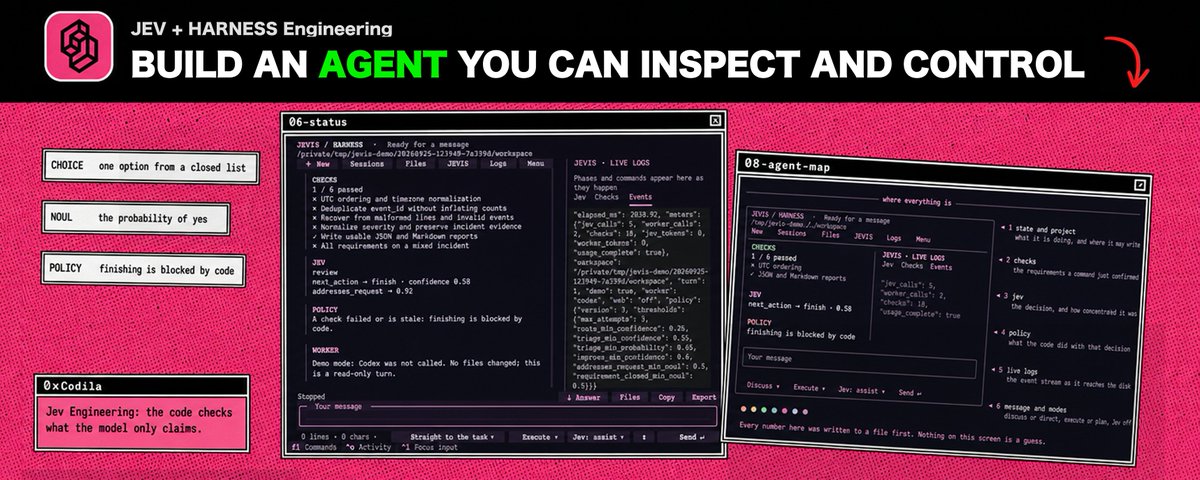
TypeSafe, the team behind Jev, published their guide to building with it
the promise:
> most calls come back in about 100 ms
> their target is over 100× the intelligence per unit of speed and cost
the model hasn't been the slow part for a while
the speed and the cost sit in how much of the work you hand to a model at all
the rules from the guide:
> keep control flow, rules and side effects in code
> break broad judgments into narrow, typed questions
> give each question only the context it needs
> act, review or escalate on the confidence number
how to use it:
> install their skill in Claude Code:
claude plugin marketplace add typesafe-ai/skills
claude plugin install typesafe@typesafe-ai
> drop the guide below into Claude Code and let it rebuild your agent's small decisions around Jev
one catch they spell out: Jev doesn't replace the model behind Claude Code. It makes the small decisions inside what you build
one evening of setup
and your agent starts next week on a harness most teams still don't have
Archive retweeted
REA + Jev + Haiku 5.5 is f*cking dangerous...
REA (Reverse Engineer Anything) gives your AI agent tools to inspect closed-source apps, down to the binary.
Haiku runs the investigation. Jev routes the workflow and checks whether the evidence supports the conclusions.
Paste this prompt into Claude Code and trace how an app’s features actually work.
Then save the article below for the full reverse-engineering setup 👇
Archive retweeted
Jev engineering inside Grok Bot is lowkey insane:
Grok stops deciding whether to retry, and a model that only returns decisions makes the small calls
one router sits in front of every expensive move, and it can only answer with an action:
- reuse_cache hands Grok a fresh artifact instead of redoing the work
- stop_retry ends an approach that keeps failing the same way
- research_capped stops research at 5 pages, then makes Grok write it up
- ask_human holds anything that sends, publishes, pays or deletes until you say yes
→ the same approach kept failing: repeat attempts went from 3 to 0
→ a fresh artifact already existed: browser opens went from 1 to 0
→ 24 candidates to check: Jev ranked them, 53.8 s became 4.1 s and 14 pages became 5, for about $0.0004 of Jev
a cheap judge can be wrong too, so it starts in shadow mode and only logs what it would have done
Grok thinks. Jev decides. You approve.
every call to Jev carries only:
> the goal
> the kind of task
> the last error and how many times it repeated
paste this into Grok Bot:
"Build me a Jev router skill. Before any browser, research, retry or subagent, send Jev the goal, the task type and the last error, then follow its action: reuse_cache, stop_retry, research_capped at 5 sources, or ask_human before anything that sends, publishes, pays or deletes. Run it in shadow mode for a week and log every decision. I'll add TYPESAFE_API_KEY myself. Show me the plan first. Do not switch to active until I confirm"
start with the one routine that keeps retrying, not your whole setup
full setup below
Archive retweeted
An Anthropic engineer open-sourced a motion design studio where Claude makes the whole video, and the trick is that it never starts with the animation
It writes the script first. The story decides what every frame has to show, and all the movement gets added on top of something you already approved.
> SCRIPT - every line and every beat set before any frame exists
> FRAMES - style frames drawn onto that script, so the look follows the story
> MOTION - the movement applied last, as a move between approved frames rather than invention
Prompt-to-video looks incredible in the first second and falls apart by the tenth. Text slides off the edge, the cut lands on the wrong word.
Starting from the script flips the failure. The video may look strange on purpose, but every cut lands on a word that means something.
The transition board is where the personality arrives. Every cut gets an object that carries it, a reason it happens there and the word it lands on, and the screen never goes blank.
Because every session stops at a gate, waiting costs nothing. Leave a project for a day, pin a note on one frame, and a fresh session picks it up and answers that note.
The checks are the detail everyone skips. Point out one real mistake, like text touching the frame edge, approve the new check once, and every future video runs it.
Studios build this knowledge into one senior motion designer. Here it sits in a TASTE.md that every new project inherits.
The repo, the pipelines and a video it made of itself are laid out underneath.