

master Jack ass of some trades, PhD of none, research engineer, computational neuroscience, neuromechanics, ML ⚾ follows not equal to endorse. Peace to all.
Joined November 2015
- Tweets3.5K
- Following1.1K
- Followers420
- Likes9.7K






Manta Array retweeted

Glad to see someone is on board with making replication a top priority! Although the notion that NIH is “scaling down” our work on replication is complete fiction.
We are deeply committed to making replication a core part of the biomedical research enterprise. Work is moving forward on many fronts:
🔎 Investing $174M in efforts to test interventions that incentivize replication, support research with built-in replication, and more.
🔎 Created the Linked Discoveries tool in PubMed Central, which connects researchers with related evidence and replication studies.
🔎 Issued highlighted topic encouraging research on rigor, transparency and replicability.
🔎 Creating a new S-index to measure (and incentivize) data sharing among researchers, with other new metrics to come.
🔎 [Coming soon]: a new journal focused on replication work.
No amount of money will fix the issues the scientific enterprise faces on this topic. It requires a major cultural change affecting how we conduct, evaluate and reward scientific work.
The culture of biomedical science must reward replicable, reproducible research — or else we won’t make much progress improving human health.
statnews.com/2026/10/21/nih-…


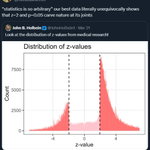
“Committing a Type 1 error does not reflect poorly on the quality of the science done,” writes Mark Louie F. Ramos trib.al/SJh4uMg

So many different interaction types other than firing spikes and synapses on a diverse range of timescales
Manta Array retweeted

hi anil! "three reasons why people overestimate the probability of AI consciousness" would have been a reasonable title for your article. "three reasons why AI consciousness is extremely unlikely" would have been a bad title, in the same ways (discussed above) that the current title is bad.
in general i find people on both sides of this debate are constantly sliding from "argument X for/against AI consciousness doesn't succeed" to "AI systems (probably) can/can't be conscious". or likewise, people slide from "theory X (e.g. computational functionalism) hasn't been established" to "theory X is (probably) false". those are just very different claims. in an area with this much uncertainty, it's important to keep these claims apart.
Manta Array retweeted
"three reasons why AI isn't conscious." really?
"consciousness is not intelligence": not a reason why AI isn't conscious, just rebuts a bad argument for AI consciousness (AI: intelligent therefore conscious).
"consciousness is substrate-dependent"/"noncomputational": would be a reason if true, but truth needs to be established.
more accurate title: "three reasons why AI might not be conscious".
xitter.cf/Nature/status/21121504…

LLMs can mimic thought and feeling with uncanny skill, but intelligence alone is not enough for subjective experience
go.nature.com/3VSXWQ4

Manta Array retweeted

So, like the Huns pushing the Germanic tribes into Rome, the worst thing about AI taking over physics will be that those physicists will be showing up in your field claiming that, yes, your problem also is just a trivial Ising model.
Also I think the maybe early hopes for SUSY or whatever and deriving/explaining the standard model count for something outside of planck inaccessibility. The unmet expectations doesn't refute ST, and like i said as a jack ass non-expert, I have a lot of respect for ST and the theoretical physicists behind it and find it super interesting. Understanding the planck scale doesn’t erase that early history of unmet empirical expectations.
The planck scale doesn’t establish that every possible indirect test is impossible. But my main point was about the response to criticism: people can understand the exp obstacles and still have legitimate concerns about empirical grounding (which is what Chollet OP was doing, albeit more provocative than i thought at first). Treating that concern as ignorance or bad faith is what I was pushing back on.
Manta Array retweeted
NIH had a strong FY2026:
✅ $35.2 billion in extramural funding
✅ 15% increase in funding for competing awards
✅ Record-breaking 1,648 R01-equivalent grants supporting early-stage investigators
Yet some have fixated on a single number: fewer grant awards. But the grant count measures transactions, not scientific investment, much less scientific progress.
The questions that matter are whether the best science is funded, whether the next generation is able to test their ideas, and whether taxpayer dollars are being soundly invested to help Americans live longer, healthier lives. On those measures, FY2026 was a strong year.
yes it is, i think you are missing my point but thats ok. Martin Bauer has a history of condescending takes and mocking some with valid concerns as "retired engineers" etc. And this take dismissing Francois Chollet, who is no dummy, and the lack of testability was his core point
i'm no expert, but I do know experts who are willing to admit that the lack of testability is a valid concern for an empirical science. my point anyway, is that dismissing it outright gives the pro contrarians fuel for their populist shticks against science
telling people "you just don’t get it" is a fast way to build resentment. The core critique that ST lacks testable predictions despite decades of dominance is a valid scientific concern imho and gets dismissed a lot. It gives pro contrarians like EW and SH fuel for their shtick
Chollet doesn't seem angry. I like string theory as a non-expert, but it is Martin telling the masses that they and the critics (Sabine H, Eric W) have "no idea" what they are talking about. That's what makes people angry. The gate keepy ness that any criticism is dumb
Manta Array retweeted

You only have so much time and energy; make sure you are investing them in exploring the problems that, if fixed, will yield you the biggest returns. #principleoftheday

Manta Array retweeted

There is something oddly satisfying about building the exact opposite of what people think we do that actually keeps them safe and keeps their privacy and civil liberties intact.
Manta Array retweeted
"We had a good thing going you stupid SOB. We had string theory. We had everything we needed, it all ran like clock work"


Manta Array retweeted

String theory is what happens when an intelligent system is starved of sensory input and starts hallucinating. Intelligence needs grounding.
For this reason, intelligence is practically never the bottleneck to solving impactful problems. The bottleneck is iterated contact with reality.