

Economist, Finance - Commodities - Time Series, tweets are my own, RT no endorsement
Paris, France
Joined December 2018
- Tweets3.1K
- Following995
- Followers1.4K
- Likes23.6K







Arthur Stalla-Bourdillon retweeted

Frontier models can now propose technical social science research designs that experts grade more highly than the world's top political economist's---that's the finding from our new Free Systems eval, SnyderBench, in which we have PhD experts blind grade research proposals from AI models compared to papers written by Harvard political economist Jim Snyder (which the experts have not previously read).
At the same time, we see no evidence that models can develop research ideas that experts rate as better overall contributions. They're getting better and better at the technical part of research, but not necessarily at the more subjective part.
This could be because human experts possess "judgment" that the models do not.
It could also be that research "contribution" is so subjective that it doesn't actually point at any meaningful goal---consistent with this possibility, we find that our human experts don't agree with one another when rating project ideas for the strength of their contribution, with agreement rates barely higher than random chance. Perhaps social science research is what @alexolegimas might call a "relational good": something people value in part because it's produced by a human. We're not sure.
This past January, I released the results of a pilot in which I had Claude Code replicate and extend a past empirical paper on vote-by-mail. 10 months later, it's stunning the amount of progress that's been made. It's no longer interesting to ask whether AI can collect data and run analyses automagically---we take that for granted---instead, the question is how much of the entire research loop AI can complete. Our tentative answer: AI can handle the technical aspects of empirical political economy research from end to end, devising the design and executing it, but for now, we still need humans to drive the agenda.
This is joint work with @AndyCWMyers, and is of course dedicated to my PhD advisor Jim Snyder, who remains the world's great empirical political economist, AI or no AI.
Lots more in the full piece here:
freesystems.substack.com/p/b…


Arthur Stalla-Bourdillon retweeted

So happy to highlight one of the many applications of Botanic-1, our latest plant FM, on @googlegemma 's website !
xitter.gq/GoogleAI/status/210715…


Arthur Stalla-Bourdillon retweeted

The Kpler team has done everyone an immense service: there is now a dedicated dashboard that tracks total liquids out of MENA.
Means no more laborious data scraping to account for dark transits, STS, and other ephemera.
Oh, and Kpler team is pretty conclusive: regional flows back to near-prewar levels.

Arthur Stalla-Bourdillon retweeted

Physical oil prices in the North Sea and Mediterranean have surged as some refiners seek to replace prompt Saudi barrels loss after the East-West pipeline was hit. Forties crude is now trading +$15 a barrel over Dated Brent, compared to $0.5 a barrel in early September.
Arthur Stalla-Bourdillon retweeted

Dated Brent (spot prices) is back at USD 130/bbl, while the Brent front futures contract trades at USD 107/bbl #oott

Arthur Stalla-Bourdillon retweeted
BREAKING: Saudi Arabia has now confirmed it shut down its East-West oil pipeline following “multiple attacks” on Thursday. Riyadh has not provided a timeline for when the conduit would be operational again. The attacks resulted in a “number” of injuries.
Arthur Stalla-Bourdillon retweeted

No economist has changed my worldview in the past few years as much as Jesús Fernández-Villaverde. He's a beast.

Last week I posted a new paper with Patrick Norrick: “Terra Incognita: The Economics of a Shrinking World.”
We chose the title deliberately. No society in history has experienced the fertility levels now seen in South Korea, China, Thailand, Colombia, Chile, and many other countries. Our knowledge of the causes (and of the economic consequences) remains far more limited than most public discussion acknowledges. Much of what we write is, at best, educated conjecture.
The paper also struggles against a space limit. We wrote 20,000 words, far from the 250,000 or so we would need to address some issues in more detail (if I had the time and resources to hide away for a year, I could do that, but not now). That means some ideas are only sketched.
Nonetheless, we emphasize several important points.
First, fertility has fallen very fast everywhere: rich and poor countries, east and west, north and south, conservative and liberal societies, religious and non-religious societies (with the exception of the Jewish population of Israel; fertility has also collapsed among the Muslim population within the pre-1967 borders), you name it. Even in sub-Saharan Africa we see fast and unprecedented drops in fertility (alas, from a high initial level).
Second, and this is really interesting, the fertility collapse has been concentrated in poor and lower-middle-income countries much more than in rich countries. By now, income per capita and fertility are positively correlated within OECD countries. We conjecture this will hold globally in a few decades.
Third, and related to the second point, the fertility collapse has been concentrated among poor and lower-middle-income women within countries. In countries such as the U.S., the rich and highly educated now have more children than the poor and less educated.
Fourth, we document why we do not understand the data from the U.N. World Population Prospects. See, for example, Tables A.1 and A.2.
Fifth, we explain why some proposed mechanisms struggle when confronted with the data.
A more subtle point is at work here. Many commentators do not seem to understand the difference between proximate causes and ultimate causes. Yes, births might have gone down because fewer women are in long-run relationships. That is the proximate cause. But you need to explain why fewer women are in long-run relationships (the ultimate cause), and saying that they spend more years in school, to take one example, does not get us very far. Why do they spend more years in school? Once you start down the whole chain of reasoning, things become much harder than they seem.
The paper can be found here:
sas.upenn.edu/~jesusfv/Demog…
Comments always welcome!

Arthur Stalla-Bourdillon retweeted
CHART OF THE DAY: Lots of noise today about European nat gas storage levels. I liked this chart from Greek deputy energy minister Nikos Tsafos (@ntsafos lnkd.in/p/eHpe2QDk). Adjust gas storage for demand (which has fallen ~18% in 5 years) and they don't low as low anymore.

Arthur Stalla-Bourdillon retweeted

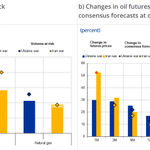
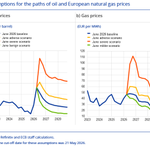
🧵New @ecb Working Paper by @FeveileJakob, M.-S. Lappe, A-S. Manu, D. Rößler, F. Schupp & @ArthurStalla “Gas Market Shocks: Tracing the Effect on Euro Area Inflation Expectations” ecb.europa.eu/pub/pdf/scpwps… 1/3
Arthur Stalla-Bourdillon retweeted

This is a pretty good illustration of the fact that China's buyer's strike wasn't hasn't been simply about not replacing lost Hormuz-flowing barrels, but rather a broader collapse in crude demand by Chinese refineries.
(data via @Kpler)
Arthur Stalla-Bourdillon retweeted
CHART OF THE DAY: Global oil stocks posted an increase in June (entirely due to rising volumes of oil on water), according to @IEA estimates. It's the first monthly increase since the war, and comes after stocks fell ~360 million barres (or ~3.9m b/d) from March through May.

Arthur Stalla-Bourdillon retweeted

La marginalité 2025
source : cre.fr/fileadmin/Documents/R… p. 75


Voilà la marginalité pour 2024.
On note une baisse du coût marginal de l'hydraulique par rapport au gaz.
Source: p. 71
cre.fr/fileadmin/Documents/R…

Arthur Stalla-Bourdillon retweeted

Sans l’air conditionné, qui a rendu habitables les États les plus chauds, l’Amérique n’aurait pas eu le même destin, explique @CharlesSerfaty qui suggère de développer la clim en France.
➡️ l.lepoint.fr/rN5


Arthur Stalla-Bourdillon retweeted
Iran says the Strait of Hormuz is now closed. The US says it remains open and that 17 million barrels of oil crossed the waterway today (that’s higher than pre-war, and a lot higher when the bypass pipelines volumes are added).


Arthur Stalla-Bourdillon retweeted
CHART OF THE DAY: In its first look into 2027, @IEA sees the return of an oil glut. The Paris-based agency warns of higher-than-normal uncertainty about its supply and demand forecasts, but with expected Hormuz reopening, by this time next year, it sees too much oil — again.

Arthur Stalla-Bourdillon retweeted
COLUMN: Why oil is below $100 a barrel?
I take a look at the top-10 reasons; some are structural, but most are ephemeral.
The single most important? China, China and China. Beijing is bailing out the global economy — and US President Trump.
@Opinion bloomberg.com/opinion/articl…

Arthur Stalla-Bourdillon retweeted

One person who was completely vindicated in time was Shiller with his AEA address on narrative economics.
I was there at the time, and thought: cool idea, but no way you can operationalize this.
LLMs have made it much easier to study narratives
aeaweb.org/articles?id=10.12…
