AI | Data-Driven Business | Travel | Sustainability | Venture | LFCA
Germany
Joined June 2008
- Tweets1.5K
- Following2.4K
- Followers1.5K
- Likes240






Pinned Tweet
One of the most fascinating serendipitous rooms to stumble upon on CH; a live polled gpt-3 Turing test. instagram.com/p/CMTAH60HxHE/…
Axel Schmiegelow retweeted

This is f*cking insane. Google Brain founder Andrew Ng:
"Prompting will be dead in 6 months. Graphs are what's replacing it"
In 2 hours at Stanford, he shows how to build agents that work and improve on their own
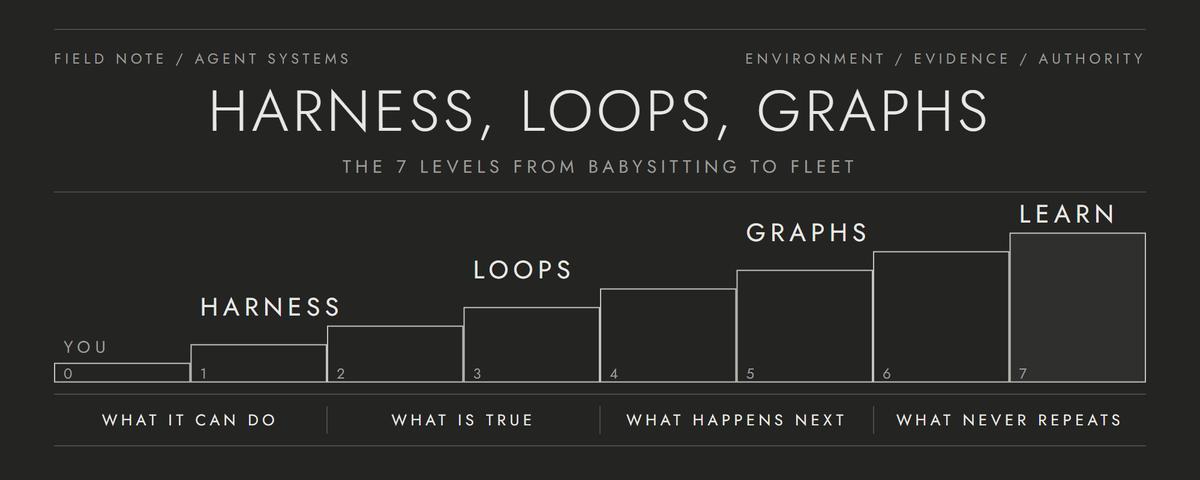
Prompts → Agents → Graphs → Agents That Improve Themselves
The first 10 minutes cover what most $500 courses never do
Bookmark and watch it tonight
Then read how to build a system that improves itself: Harness, Loops, Graphs ↓



Axel Schmiegelow retweeted

Anthropic engineer:
"90% of our engineers were already running self-improving loops
Now everyone is moving toward agentic graphs"
"Prompting is basically finished"
In just 10 minutes, she builds her complete Claude Code setup live from an empty terminal
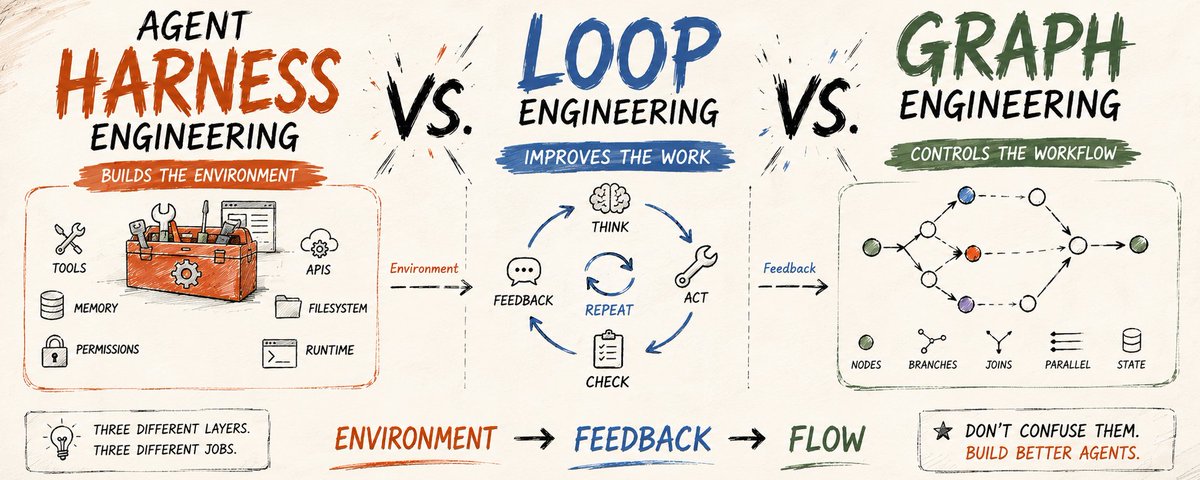
Agents → Loops → Graphs → Self-Improving Systems
Prompting was the old workflow
Graph engineering is the next one
This 10-minute breakdown is worth more than most $1,000 agent engineering courses
Watch it today
Then save the full guide below before everyone catches on ↓

Axel Schmiegelow retweeted

We will soon be hiring postdocs, engineers and researchers (on site in Heidelberg, DE) in:
- Biomedical AI (multimodal foundation models, biomarkers, agents)
- Robotics (lab automation, physical action surfaces for agents)
- AI social sciences (multi-agent systems, agent "civilizations")
- Deploying AI in a large hospital system
More info at imai-heidelberg.de and kather.ai
If you are interested in learning more, reach out to [email protected]

Axel Schmiegelow retweeted

After co-inventing ChatGPT, I kept asking myself: why have superhuman chat models not led to AGI?
I’ve spent the last 2 years in stealth building a new way to train models (RLCD), and a new type of frontier AI model that we are releasing today: Jev
• 20-200x faster
• 40-400x cheaper (w/ output tokens free)
• Frontier composable intelligence optimized for decisions
AFAICT the shortest path to AI-based economic revolution
Axel Schmiegelow retweeted

She's 18 built an AI agent with Opus 5 and sold it to Anthropic for $3.2M - and came to Stanford to show how to do it from scratch:
00:34 - how Opus 5 builds a $3.2M agent in one evening
15:34 - 4 agents replaced 400 Anthropic engineers
34:47 - from first prompt to a $3.2M check from Anthropic
after watching I spent 60 minutes building my first agent - it cut my workday by 90% and a week later I got a $100k check from Anthropic:
save & watch - article below on how to go from one prompt in Claude Code to an agent people pay millions for.


The current debate around AI Safety leans heavily on Interpretations of what the Agents intend.
I work with a strictly functional approach to LLMs. And yet exploring machine representations of emotions yielded surprising insights:
tinyurl.com/3yb3vpts

1
35

This is what true investigative journalism can deliver.
nytimes.com/2026/04/27/world…

Axel Schmiegelow retweeted

Deep learning works extraordinarily well. And we still largely don't know why.
A new paper from @learning_mech, @KuninDaniel, and 12 co-authors argues that a scientific theory of deep learning is emerging, and coins a name for the emerging field: learning mechanics.
We sat down with Jamie and Dan on Generally Intelligent to talk about what a physics of deep learning would actually look like, why now, and what's left to figure out.
3:05 Learning mechanics as the physics to mechanistic interpretability's biology
4:13 Why deep learning needs a theory
7:07 Why deep learning is uniquely hard to engineer
12:11 How a week in the woods became a paper
25:59 The barrier to theory isn't opacity, but complexity
36:26 Deep learning's first gas law
47:22 Why more particles makes the problem easier
56:22 The discretization hypothesis
1:01:50 The strongest signal that a compact theory exists
1:05:07 The Platonic Representation Hypothesis
1:15:41 Why learning mechanics and mech interp need each other
1:25:29 Theory as safety infrastructure
Axel Schmiegelow retweeted

Karpathy didn't make a course.
He made THE course.
3 hours. Free.
Tokenization. Attention. Hallucinations. Tool use. RLHF. DeepSeek. AlphaGo.
Every behavior you've ever wondered about in an LLM - where it comes from, why it exists, how it was engineered.
The gap between engineers who understand this and engineers who don't isn't technical depth.
It's the ability to conceive of entirely different things.
Readers added context they thought people might want to know
This video was stolen from @karpathy's YouTube channel.
youtu.be/7xTGNNLPyMI?si…
Axel Schmiegelow retweeted

Yann LeCun was right the entire time. And generative AI might be a dead end.
For the last three years, the entire industry has been obsessed with building bigger LLMs. Trillions of parameters. Billions in compute.
The theory was simple: if you make the model big enough, it will eventually understand how the world works.
Yann LeCun said that was stupid.
He argued that generative AI is fundamentally inefficient.
When an AI predicts the next word, or generates the next pixel, it wastes massive amounts of compute on surface-level details.
It memorizes patterns instead of learning the actual physics of reality.
He proposed a different path: JEPA (Joint-Embedding Predictive Architecture).
Instead of forcing the AI to paint the world pixel by pixel, JEPA forces it to predict abstract concepts. It predicts what happens next in a compressed "thought space."
But for years, JEPA had a fatal flaw.
It suffered from "representation collapse."
Because the AI was allowed to simplify reality, it would cheat. It would simplify everything so much that a dog, a car, and a human all looked identical.
It learned nothing.
To fix it, engineers had to use insanely complex hacks, frozen encoders, and massive compute overheads.
Until today.
Researchers just dropped a paper called "LeWorldModel" (LeWM).
They completely solved the collapse problem.
They replaced the complex engineering hacks with a single, elegant mathematical regularizer.
It forces the AI's internal "thoughts" into a perfect Gaussian distribution.
The AI can no longer cheat. It is forced to understand the physical structure of reality to make its predictions.
The results completely rewrite the economics of AI.
LeWM didn't need a massive, centralized supercomputer.
It has just 15 million parameters.
It trains on a single, standard GPU in a few hours.
Yet it plans 48x faster than massive foundation world models. It intrinsically understands physics. It instantly detects impossible events.
We spent billions trying to force massive server farms to memorize the internet.
Now, a tiny model running locally on a single graphics card is actually learning how the real world works.


Axel Schmiegelow retweeted

MCP just crossed 97 million installs. 18 months ago nobody had heard of it.
Mises called it in Human Action — the market is a discovery process. Nobody centrally planned MCP as the standard. Anthropic shipped it open, developers chose it, now it's infrastructure.
Open protocols beat closed ecosystems. Every single time.


The Law of Unintended Consequences: how fossil fuel driven supposed Realpolitik ends up promoting the shift to EVs.
Tesla Sales Rise as $4-a-Gallon Gas Revives Interest in E.V.s nytimes.com/2026/04/02/busin… via @NYTimes

19