

Engineer by day, chasing history by night | Family | Freedom | Liberty & Independence Forever 🇺🇸
Old Virginia
Joined February 2026
- Tweets3.7K
- Following737
- Followers18.5K
- Likes5.8K


Pinned Tweet
🇺🇸 Two months before Gettysburg, Joshua Chamberlain and the 20th Maine were quarantined. They got a bad batch of the smallpox vaccine.
In May 1863 at the battle of Chancellorsville, the 20th Maine sat out the fight. They were isolated to ‘Quarantine Hill.’ From their camp they could hear the guns of battle. They still wanted to fight.
Joshua Chamberlain rode to Hooker’s headquarters and asked chief of staff Dan Butterfield to let them in. They were refused.
Chamberlain’s reply: “If we couldn't do anything else, we would give the rebels the smallpox!”
They spent the battle guarding a telegraph line instead.


🇺🇸 Joshua Chamberlain spent his first night in battle lying between two dead men. He used a third for a pillow.
The 20th Maine hit Marye’s Heights at Fredericksburg on December 13, 1862, then got stuck on the slope by heavy Confederate fire. No orders to pull back, so they stayed put through the cold night.
Most of the men had dropped their coats and blankets earlier. Chamberlain wrote later that he laid down between two dead soldiers. He then dragged a third one over crosswise for a pillow and used the flap on that soldier’s coat across his face to cut the wind and the noise of the wounded. He and a few others spent hours moving around giving water and taking last words for families back home.
They held the spot into the next day under fire. When they finally got the order to leave the following night, they buried their own dead first with bayonets and fragments of shell.
Chamberlain wrote the whole thing down years later. The 20th Maine was present at Antietam but held in reserve. Fredericksburg was their baptism by fire.

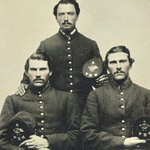
🇺🇸 Twin brothers Bartlett and John Ellsworth with their older brother Samuel of Company A, 12th New Hampshire Infantry.
The three enlisted from Wentworth, New Hampshire, in August 1862. Samuel was 42. The twins were 39.
Bartlett died of typhoid fever near Falmouth, Virginia, on December 22, 1862, and is buried in Fredericksburg National Cemetery. His widow, Nancy, received a pension for their four children.
At Chancellorsville the following May, both John and Samuel were reported missing. Samuel was captured and paroled twelve days later. John returned to the regiment and was discharged for disability in September 1864.
Samuel transferred to the Veteran Reserve Corps in January 1864, deserted in October, and returned home to his wife and children. He lived until 1895. John died in Wentworth in 1881.
Library of Congress Photo


🇺🇸 The National Mall used to have a canal. Right next to where the Washington Monument stands today.
The Washington City Canal opened in 1815 and ran through the Mall along today’s Constitution Avenue. In 1833 it linked up with the C&O Canal, which ran 184.5 miles west to Cumberland, MD.
This picture is from 1860. By the 1870s it was an open sewer. They filled it in.
The old Lockkeeper’s House is still on the Mall.


Oct 26, 1825: The Erie Canal opened, and New York became the Empire State.
Before the canal, moving goods from the Great Lakes to the East Coast meant hauling them over the Appalachian Mountains by wagon on terrible roads. It was slow and expensive. New York's governor, DeWitt Clinton, pushed a plan to dig a canal 363 miles across the state from Albany on the Hudson River to Buffalo on Lake Erie.
People thought he was crazy. Thomas Jefferson reportedly called the idea a little short of madness. Critics called it Clinton's Ditch.
Construction started on July 4, 1817. There were almost no trained engineers in America, so the men in charge learned on the job. Thousands of laborers, many of them Irish immigrants, dug most of it by hand with shovels, picks, and horses. They had to build 83 locks to lift and lower boats over the changing ground, including a famous staircase of locks at Lockport.
It was finished in eight years. On Oct 26, Clinton boarded a canal boat in Buffalo. Cannons had been placed along the entire route within earshot of each other. As the first one fired, the next one fired, all the way to New York City and back, a relay that took a few hours to cross the state.
When Clinton reached New York Harbor nine days later, he poured a keg of water from Lake Erie into the Atlantic Ocean. They called it the Wedding of the Waters.
The cost of shipping goods from Buffalo to New York City dropped by around 90%. The canal paid for itself in about a decade. Towns like Syracuse, Rochester, and Buffalo boomed, and New York City became the biggest port and business center in the country.


🇺🇸 The largest church pipe organ on planet Earth is not in Rome, London, or Paris. It sits inside the Cadet Chapel at West Point.
From the outside, the Cadet Chapel looks like a medieval fortress. Inside, it hides an absolute monster of acoustic engineering.
When the building opened in 1911, the organ was fairly normal, with 2,406 pipes.
Then a unique tradition took hold.
Graduating classes, generals, and families of fallen soldiers started donating new sets of pipes as personal memorials. Decade after decade, whenever an alumnus wanted to leave a mark on the academy, they added more.
Today, it holds 23,511 pipes.
The smallest ones are the size of a pencil, producing high whistles. The largest are 32 foot tall hollow wooden pillars that pump out low vibrations.
The system is so vast that West Point employs a full-time curator just to keep it running, complete with a subterranean workshop.


🇺🇸 Brothers William and Philip J. Letsinger of Company D, 14th Indiana Infantry, pose with their rifles. William made it through the war. Phillip didn't.
They mustered in together from Greene County on June 17, 1861. On September 17, 1862, the 14th Indiana led the assault on the Sunken Road at Antietam. More than half the regiment became casualties that day. Philip, a corporal, was killed.
William later transferred into the 6th U.S. Cavalry and served until his enlistment expired in 1864. He returned home, married, and died in 1873.
They were two of six Letsinger brothers (William, Philip, James, Alexander, John, and Lewis) who served. Three of them did not come home.
James and Alexander of the 31st Indiana died in Georgia in 1864. James was KIA at Chattahoochee River. Alex died of disease.
John and Lewis served in the 85th Indiana. They both survived, however, John was WIA.
Library of Congress Photo


🇺🇸 Joshua Chamberlain spent his first night in battle lying between two dead men. He used a third for a pillow.
The 20th Maine hit Marye’s Heights at Fredericksburg on December 13, 1862, then got stuck on the slope by heavy Confederate fire. No orders to pull back, so they stayed put through the cold night.
Most of the men had dropped their coats and blankets earlier. Chamberlain wrote later that he laid down between two dead soldiers. He then dragged a third one over crosswise for a pillow and used the flap on that soldier’s coat across his face to cut the wind and the noise of the wounded. He and a few others spent hours moving around giving water and taking last words for families back home.
They held the spot into the next day under fire. When they finally got the order to leave the following night, they buried their own dead first with bayonets and fragments of shell.
Chamberlain wrote the whole thing down years later. The 20th Maine was present at Antietam but held in reserve. Fredericksburg was their baptism by fire.
Chamberlains own words on that night
“Necessity compels strange uses. For myself it seemed best to bestow my body between two dead men among the many left there by earlier assaults, and to draw another crosswise for a pillow out of the trampled, blood-soaked sod, pulling the flap of his coat over my face to fend off the chilling winds, and still more chilling the deep, many-voiced moan that overspread the field. It was heart-rending; it could not be borne.”
🇺🇸 The B-52 bomber sitting by the front gate of the Air Force Academy has a confirmed MiG-21 kill.
Christmas Eve, 1972. North Vietnam. Operation Linebacker II was underway.
Riding in the tail of a B-52D nicknamed Diamond Lil was 18 year old Airman Albert Moore. His job was tail gunner and he manned four .50-caliber machine guns.
He spotted the blip on his radar. A North Vietnamese MiG-21 fighter was closing in from behind, climbing rapidly.
Moore tracked the interceptor on his radar scope, waited until the jet was within 2,000 yards, and held down the triggers.
Seconds later, the crew of a trailing B-52 confirmed it over the radio: the MiG was engulfed in a fireball and falling from the sky. Over 800 rounds went downrange.
In the entire history of aviation, a B-52 bomber has shot down an enemy fighter jet exactly twice. Albert Moore became the last aerial tail gunner in American military history to score a kill in combat.
Today, cars drive past that exact plane at the north entrance of the Air Force Academy in Colorado, completely unaware the gate guard is a certified MiG killer.

🇺🇸 This New Testament was carried in Walter G. Jones’s blouse pocket. It stopped a bullet in the pages. Twice.
Jones was a Private in Company C, 8th New York Cavalry. At Cedar Creek, Virginia, on October 19, 1864, a bullet struck the upper corner. Months later, during the fighting around Appomattox, another bullet hit near the center. In each case the small book stopped the shot.
He kept the book and the two bullets. Later he wrote this caption: “I am not a Hobson, a Dewey, a Schley, nor a Sampson, but I was a High Private in Co. C., 8th N. Y. Cavalry and carried this little Testament in my blouse pocket which, in two battles, saved my life from bullets, as represented in the above photo. The bullet in the upper corner was shot at me at Cedar Creek, Va., October 19, 1864. The bullet in the centre crashed into the Testament during the battle of Appomattox (better known as Lee’s surrender), April 8th and 9th, 1865.” Signed Walter G. Jones, McDonough, N.Y.
Jones survived the war, mustered out in June 1865, and returned home to McDonough, New York.
Library of Congress Photo

🇺🇸 This coming weeks topics from me (Sunday thru Saturday):
Joshua Chamberlain, Military Academies, and Common Civil War Soldiers Photos/Stories.
If you have any topics you would like me to do in the future, please leave a note below.
Going to try breaking weeks down like this as a trial. Helps me organize a little better. This last week I did Robert E. Lee and Flag Stories (X did not like those for some reason) if you didn’t notice.


🇺🇸 Took the kids hiking in western Maryland today. Unexpected company: George Washington, 1755.
Wanted to check out some fall foliage so we hiked to St. John’s Rock on Big Savage Mountain in our travels. Was not expecting to see this sign in the woods. How cool, and you could probably imagine my reaction!
I’ll put a close up picture of the writeup in the comments. It’s a really neat read.
Also, Garrett County, MD is beautiful!


🇺🇸 UPDATE: I was able to connect with Alex after my post. He and his father took this first ever photo together with the flag they both carried in combat to share with us.
Adam Cesario raised it every day in Vietnam with the 101st Airborne. Alex (@AirborneBunker) proudly carried it in Iraq with the 82nd Airborne, including when he earned a Purple Heart.
Same flag. Two generations. Two different wars. Thank you BOTH for your service! 🫡🇺🇸

🇺🇸 This flag went to Vietnam with paratrooper Adam Cesario. Then it went to Iraq with his son.
In Vietnam, Cesario carried his own American flag and raised it every single day. Didn’t matter the situation. If he had to, he hung it off a radio antenna.
One mission went bad and he got cut off from his platoon. He spent three days alone in the jungle with Viet Cong after him, but he still raised the flag every day.
After the war, Cesario kept the flag carefully. Family members were rarely allowed to handle it.
When his son Alexander deployed to Iraq with the 82nd Airborne Division, Adam entrusted him with the same flag. Alexander carried it on every mission, tucked into the front flap of his body armor, close to his heart.
The same flag that flew in the Vietnam jungle later made it to Baghdad.
Photo by Staff Sgt. Michael Pryor. 2nd Brigade Combat Team, 82nd Airborne Division. Baghdad, Iraq. 2008.

🇺🇸 This is the Star-Spangled Banner. One of its stars is missing. Not shot away. Cut out. It’s an unsolved mystery who has it.
Mary Pickersgill sewed the flag in Baltimore in the summer of 1813. It flew over Fort McHenry in 1814. Francis Scott Key wrote our national anthem to it. It measured at that time about 30 by 42 feet.
The fort’s commander, George Armistead, kept it. It passed to his widow Louisa, then his daughter Georgiana, then his grandson Eben Appleton.
People kept asking for pieces. Veterans. Dignitaries. Friends. They gave away dozens of small pieces. Nearly eight feet came off the end of the flag. Georgiana wrote: “Indeed had we given all we had been importuned for, little would be left to show.”
Louisa cut out a whole star. She gave it to someone as an honor. Nobody knows who. Nobody knows when. It was already gone when the flag was photographed in 1873.
Eben lent the flag to the Smithsonian in 1907, then gave it for good. Today it measures about 30 by 34 feet. Some snipped fragments have come back to the museum. They cannot be sewn on again. Nobody is sure where each one came from.
One rumor says the star went into Lincoln’s grave. There is no proof.
Somewhere there is a star from THE actual Star-Spangled Banner.

🇺🇸 This black headstone is in Section 8 at Arlington National Cemetery. It reads “First Female Combat Commander To Fly Into Battle.”
It marks the grave of Maj. Marie Rossi of Oradell, New Jersey. She commanded Company B, 2nd Battalion, 159th Aviation, flying Chinook helicopters.
She deployed to Saudi Arabia for the Gulf War. On February 24, 1991, the ground campaign began. Her flight went into enemy territory, hauling fuel and ammunition for the 101st and 82nd Airborne.
Four days later, the shooting stopped.
On March 1, the day after the ceasefire, she was flying at night in bad weather. Her Chinook hit an unlit microwave tower in Saudi Arabia. Three others died with her. She was 32.
Her husband, Chief Warrant Officer John Anderson Cayton, was also an Army pilot serving in Kuwait.
She was buried on March 11. Her husband threw the first spadeful. At the funeral he said, “And I prayed to the Lord to take care of my sweet little wife.”
Thank you for your service 🫡🇺🇸

