

Ph.D. student at UMiami Rosenstiel studying ocean viruses.
Joined February 2022
- Tweets75
- Following250
- Followers140
- Likes530



Benjamin Minch retweeted

This perspective highlights that giant viruses arose from smaller viruses by taking up host genes. They remain typical viruses despite genomes that can reach 5 Mb and virions larger than many bacterial and archaeal cells. The virus-cell boundary to is put between replicators, which use host ribosomes, and reproducers, which build their own. This is a distinction no currently discovered giant virus appears to have crossed. One of the open questions that remains is what drives some lineages to a K strategy, accumulating virus-host interaction genes, while others stay compact. doi.org/10.1073/pnas.2610442…

Benjamin Minch retweeted
Giant virus genomes carry discrete genomic islands that concentrate sequence variation and mosaic gene content. These regions, rather than the conserved core, account for much of what separates closely related Nucleocytoviricota genomes. doi.org/10.1038/s41467-026-7…

Benjamin Minch retweeted

Our work in collaboration with Jed Furhman lab at the USC on the temporal dynamics of marine giant viruses published in ISME communications. PhD student @Benjamin_Minch a co-first author. Please take a look!
academic.oup.com/ismecommun/…

Benjamin Minch retweeted

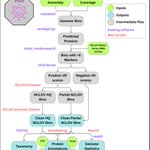
🦠 Now published in Bioinformatics Advances: “BEREN: A bioinformatic tool for recovering giant viruses, polinton-like viruses, and virophages in metagenomic data.”
Full article available: doi.org/10.1093/bioadv/vbaf2…
Authors include: @Benjamin_Minch

Benjamin Minch retweeted
Excited to share our new paper introducing BEREN, a tool for identifying giant and other dsDNA viruses from metagenomic data — now online! Let BEREN help with your discovery-based reseach in viral metagenomics!
academic.oup.com/bioinformat…

Benjamin Minch retweeted
We’re recruiting a PhD student (Fall 2026) to study the ecology & evolution of aquatic giant viruses! Research spans lab experiment, field sampling, & bioinformatics. Background in microbiology/bioinforamtics encouraged. More information:
monirlab.com/join/
Please retweet!

Benjamin Minch retweeted

Scientists used bespoke computer software to identify the genomes of microbes in seawater samples – including 230 giant viruses previously unknown to science. @univmiami @Benjamin_Minch
sciencealert.com/hundreds-of…

Benjamin Minch retweeted

🚨New @delCampoLab Preprint: A Single-cell Atlas of Coral Bleaching! 🪸🦠🔥. We show the microbial ecology of coral bleaching from the gene expression of host and symbiont cells to the shifts in the bacterial and protist communities within the holobiont! researchsquare.com/article/r…
Benjamin Minch retweeted

What if we could put all tailed phages in a single, evolutionarily meaningful phylogeny? Check out the latest from the Aylward Lab (twitterless) and myself - we present a phylogenomic framework toward unifying phage diversity! 🧬🤝 biorxiv.org/content/10.1101/…

Benjamin Minch retweeted

BEREN: A bioinformatic tool for recovering Giant viruses, Polinton-like Viruses, and Virophages in metagenomic data biorxiv.org/content/10.1101/…

Benjamin Minch retweeted

It's Thursday! Time for a new episode of #MattersMicrobial to be released! This time, the #QualityQuorum will hear from @giant_virus about giant viruses and how they interact with their hosts. Please spread the #GoodMicrobialWord. @ASMicrobiology
youtu.be/FWutndOo9aw?si=QG-K…

Benjamin Minch retweeted
Our latest collaborative research on giant viruses with @JedFuhrman lab on how evolutionary history dictates the temporal succession of marine giant viruses. Preprint out!
@Benjamin_Minch
biorxiv.org/content/10.1101/…

Benjamin Minch retweeted
Active viral ecology of deep sea brine pool in the Gulf of Aqaba.
Latest from our lab, and great collaboration with UMiami Marine Geoscience department. Spearheaded by Monir lab PhD student @Benjamin_Minch!
academic.oup.com/ismecommun/…

Benjamin Minch retweeted
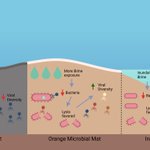
Active prokaryotic and eukaryotic viral ecology across spatial scale in a deep-sea brine pool academic.oup.com/ismecommun/…
Benjamin Minch retweeted

Time of day of infection shapes development of a eukaryotic algal-Nucleocytoviricota virocell biorxiv.org/cgi/content/shor… #biorxiv_micrbio
Benjamin Minch retweeted
Our study on the diversity and distribution of polintoviruses across the sequenced stony coral genomes are out in the @Virus_Evolution journal. Congratulations to my PhD student Danae Stephens who spearheaded this research!
academic.oup.com/ve/advance-…

Benjamin Minch retweeted
'Pickled' in the Brine pool? Not really. Our latest preprint shows highly active and biogeochemically relevant viruses in a deep-sea brine pool.
Led by Monir lab PhD student @Benjamin_Minch in collaboration with the RSMAES Geosciences. Congratulations!
tinyurl.com/45f6t7jc
Benjamin Minch retweeted
‘Api’ New Year! New @delCampoLab pre-print! We present the Ichthyocolids, a new and widespread group of fish-infecting apicomplexans! 🐠🩸
biorxiv.org/content/10.1101/…

Benjamin Minch retweeted
Our new preprint on pervasive presence of Polintoviruses in stony coral (SC) genomes. Polintoviruses with genomes 10-50 kbp occur in hundreds to thousands of copies in SC genomes! (1/3)
tinyurl.com/5hbstczm
Benjamin Minch retweeted
Just published - our latest review in FEMS Microbiology reviews on the incredible array of 'virologs' in diverse giant viruses- pushing the limit of viral mimicry! Sincere thanks to all the co-authors and Monir Lab students who have participated!
academic.oup.com/femsre/adva…