

A learning scientist’s clear-eyed view of mastery, AI, and the future that’s already here. By Michael W. Connell.
Joined June 2026
- Tweets29
- Following31
- Followers5
- Likes1

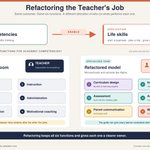


I think part of the problem is simple confusion due to word use. They don’t have human teachers, but they do have human guides. They have refactored the role to be more effective, not eliminated it.

1
86
They are simply refactoring the role of the human in a more sensible way. It seems like they are actually making more room for a human to be effective.

2
27
It stands to reason that a human teacher can’t possibly deliver group instruction as effectively as a well-designed mastery-based app can deliver it individually (at least where knowledge and skills can be codified). Also: Alpha is not removing humans from the experience.
1
45
You seem to have some specific design in mind when you talk about AI in education negatively. Why do you assume using AI to make learning more efficient and effective would decrease the amount and quality of human interaction instead of increasing it?
66
Wrote up Alpha School and Math Academy as two of three existence proofs that mastery-based, individually paced instruction can get past the one-teacher-many-students ceiling. @jliemandt @mackenzieprice @justinskycak, corrections welcome regarding your results or methods.

1/
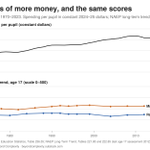
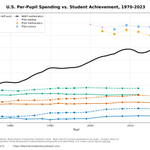
Since 1970 the U.S. has nearly tripled real spending per student. Over the same stretch, NAEP scores for 17-year-olds moved two points in reading and two in math. The chart tells the whole story.

17
4/
Together they make a compelling case that the bottleneck can be overcome today. The essay walks through what they do, how they keep kids motivated, and what they cost.
beyondcomplexity.substack.co…
5
4/
Together they make a compelling case that the bottleneck can be overcome today. The essay walks through what they do, how they keep kids motivated, and what they cost.
beyondcomplexity.substack.co…
3/
So the question is whether anyone has successfully demonstrated how to get past the limitations of that model. I looked at three cases: Alpha School, Math Academy, and a kindergarten math intervention my own company built. Different evidence, same mechanism underneath.
1
56
2/
My read: one teacher in front of many students has a built-in performance ceiling, and we hit it decades ago. More research, more software, and more money go into the same model with no change to the student outcomes.
1
49
1/
Since 1970 the U.S. has nearly tripled real spending per student. Over the same stretch, NAEP scores for 17-year-olds moved two points in reading and two in math. The chart tells the whole story.
Also: This tuition figure is comparable to government spending in some states. Per pupil spending in New York is about $32K/pupil per year, for example, and that figure excludes some costs that the system bears so is not fully loaded.
4
There are three main components to the Alpha curriculum: 1) core academics, 2) life skills workshops, 3) Alpha X projects. They compress core academics into 2 hrs/day. The rest of the program details can be designed locally.
9
8/
Full essay, including where lecture, tutoring, mastery learning, and adaptive software land on the map:
beyondcomplexity.substack.co…
5
7/
"Personalized learning" should retire as a technical category.
When the conversation is serious, ask for coordinates instead. At what resolution does this system adapt? With what bandwidth? Who controls the next step?
Every real implementation has an answer. The label doesn't.
1
5
6/
Back to those two schools.
They match on resolution and diverge on bandwidth and agency. That's why the shared "personalized learning" label told you nothing.

1
4
5/
Adaptive agency: how authority over the next move is split between the learner and everyone else.
This is separate from who picked the goal. A student can have real control over the path and none at all over the destination.
1
4
4/
Adaptive bandwidth: how much learner-specific evidence moves through the loop, & how fast it changes what happens next.
A unit test graded over the weekend sits at the bottom.
A tutor catching & responding to even the minute hesitation before the pencil moves sits at the top.
1
4
3/
Three properties do most of the work.
Adaptive resolution: the smallest unit at which the learning experience can actually diverge.
Whole class → subgroup → individual.
Thirty screens running one fixed sequence is still whole-class resolution.
1
5
