

DeFi maximalist. Ex Dev, almost human. Engineering Manager, ex @blockchain, now at Meta AAI
London
Joined March 2017
- Tweets1K
- Following1.2K
- Followers276
- Likes990







Lorenzo Belli retweeted

Read the excellent explainer from @CompleteSkeptic:
xitter.gq/CompleteSkeptic/status…
And my longer deepdive covering this, and speculative decoding:
newsletter.pragmaticengineer…
This is ALL ABOUT coding use cases!! It's such an interestingly amazing fit for inference. Vendors won't want you to know tho...


Lorenzo Belli retweeted

Beautiful usecase of decision models.
And job-search agents are getting good at reading hiring signals, which often show up before the posting does.
@treg_ai launched a jobs API that lets AI agents search open roles, score fit and find hiring managers.
Agents pull free listings from employer boards, and Jev, TypeSafe AI’s decision model, scores each against a resume for under $0.001.
A people search then finds the team that owns the role, and Treg says it adds no markup.
🤝 Paid partnership


Introducing Jev @typesafeai powered jobs-api
Try it at treg.to/jobs-api
- One API to any jobs data
- $0.03 to run a full job hunt
- Real salary & Hiring manager data
- Plugin to any agent for your dream job
Fully open source, 0% markup
Git Repo below 👇
Lorenzo Belli retweeted

Jane Street just put an AI skill on GitHub. It's not a trading bot.
It's a strict Socratic tutor:
→ Starts with a diagnostic of what you already know
→ Builds a skill map with levels from 0 to 5
→ Asks one question at a time instead of handing you answers
→ Brings old material back with spaced review
→ Ends with a final assessment
Copy it into your agent's skills folder and say "teach me [anything]". Works in a normal chatbot too: paste the SKILL.md.
github.com/janestreet/agent_…

Lorenzo Belli retweeted
New Meta paper shows that Meta’s staff can trust an AI assistant’s numbers about product tests because the AI only plans the steps and never writes a single number itself.
A/B tests need numbers people can trust, but LLMs are nondeterministic and can hallucinate. Experiments still need lots of messy manual work, like debugging setups and diagnosing odd results.
Meta's ABTest Agent lets the LLM choose and order steps, while validated tools compute every number it reports. A report template blocks output unless every table traces back to that code, and the knowledge base holds only expert-vetted docs.
Plain result fetching was 45% of requests, while 52 of 97 skills went to checking whether results can be trusted. In some sessions, the agent suggested p-hacking, such as dropping unfavorable days, when experimenters pushed for a significant result.
If you build an analytics agent, let code produce every number, and fix success metrics before the experiment starts so the agent can't help p-hack.

Lorenzo Belli retweeted

trivia:
• started working on the game as a side project 4 days ago, landing ~1,150 PRs
• every time i found an issue in the code i asked bot to make a lint rule against it
• used TLA+ heavily to find bugs in the game's various state machines: the story, cutscenes, the game's systems. there are many formal verification skills, one for each major system
• i put context into the filepaths: code that runs every frame or every tick gets a .hot.ts extension, and a lint rule bans allocating in it (no object literals, closures, new, etc.), so the game loop creates almost no garbage and GC doesn't cause stutters
• game engine is mostly custom. three.js draws the 3D scene, but the simulation, post-processing and audio are all ours
• the simulation is fully deterministic, so every run replays exactly from its inputs. when you post a high score, the server replays your whole run to check it isn't cheated
• we generate dynamic og:images for every run based on your final stats, and it's all localized too! the game supports 10 languages
• my favorite feature: the music seamlessly transitions into different music for the various biomes, continuing the previous melody
• no audio files. all the music and sound effects are synthesized live in the browser by a custom Game Boy-style chip (two pulse voices, a wave voice, noise) plus a synthwave layer. the songs are written as text in code
• all the pixel art is code. every sprite is a file drawn with one shared palette and packed into a sprite atlas at build time
• it runs inside an X post, from the 245px card up to full screen. the bar is 60 fps with 500 enemies on a mid-range phone
• the build fails if the first download goes over budget. it's about 124 KB gzipped right now
• bots play the game headless to tune each difficulty against target survival rates
• comments are banned by a lint rule. if code needs explaining, the fix is a better name or a test


Lorenzo Belli retweeted

🪢 Introduction To Harness Engineering For Vulnerability Research
Blog: grahamhelton.github.io/harne…
Author: @GrahamHelton3


Lorenzo Belli retweeted
Brutal truth from @Lethain
“If you're in [middle] management (…) you sort of have to decide, am I retiring now or am I re-skilling?”
He did just this: step down from leading a large team (250 ppl) to be hands-on with a small team (25 ppl), ship code & re-learn the new “rules”

Why a 3x CTO went back to a 25-person team. From Will Larson @lethain, Imprint CTO and 4x book author.
"It's a hard time in middle management, right? There's a lot more competition for these roles. What I found personally very rewarding is getting back into the details of writing software.
When I left Carta, my team was around 250. When I joined Imprint, the team I was leading was 25.
This a unique moment to actually re-skill. If you're in management, I think right now either you have to get back into the details, or the world is changing so radically that the profession you know will not be valued in three years. You sort of have to decide, am I retiring now or am I re-skilling?
I think there has to be some openness to taking a backward step or a lateral step. What I knew I wanted was getting back into the details and relearning how to do software in the current age. That's what I believe is going to be the unlock to the longevity of my career."
Lorenzo Belli retweeted

i own a relatively new (2025) samsung tv.
i kept getting weirdly targeted ads.
i tried reversing the firmware but it was aes encrypted and no keys unless tear it apart and do uart/jtag magic.
zero days it is. root shell on new samsung TVs!
discovered PRIVACY HORROR. write up?


Lorenzo Belli retweeted
New Microsoft paper finds that coding agents trip up when they have to understand a lot of code, not when they have to edit a lot of it, so test them on reading and comparing code instead of diff size.
Microsoft researchers built CABRA, which generates synthetic coding tasks and raises 1 kind of difficulty at a time. They ran 8 LLMs and 6 agents on 6,840 tasks and labeled each tool call as reading, analyzing, searching, editing, or testing.
Plain LLMs got worse as tasks grew, but agents stayed near-perfect by using tools like grep. On SWE-bench Verified, the count of reading and analysis calls tracked agent failures better than lines edited, with correlations of -0.200 versus -0.159.

Lorenzo Belli retweeted

I agree and thank you for your support.
We have reimagined our IDEs to become an ultimate agentic workbenches.
Also we created
Air.Teams for EMs and
Air.Governance for CTOs to cover the full agentic sdlcin an org
We'll see how it goes, but so far the feedback is good :cross
Lorenzo Belli retweeted
My keynote at LDX3 New York, "The state of the tech industry in 2026". is out now. Timestamps:
00:00 Introduction
00:53 What changed
12:29 What's not changed
16:14 What broke
22:53 What’s next
And for notes + slides, see: newsletter.pragmaticengineer…
Hope it's useful!
Lorenzo Belli retweeted

Retail usually only gets access to private companies once they go public and the first move is priced in. Pre-IPO perpetuals let you trade your view before the shares exist.
OpenAI, Anthropic, and Oura are live on Liquid now. You can go long or short any of them, 24/7, without an allocation or a secondary-market seller.
The pipeline behind them is already building. Nscale filed its S-1 in September and is lining up a New York listing. Databricks, Anduril, ClickHouse, and plenty of others could be up next. More pre-IPO markets are coming as those names get closer.
Trade the ones that are live. The rest of the list is next.
Lorenzo Belli retweeted

There are two fundamental problems with this set of scenarios related to Muse’s revenue contributions to Meta by 2030:
- A and B (worst and base), where Muse is 0.5% and 2.3% of revenue, respectively, are economically irrelevant to Meta and mean the company should shut the product down absent some second-order effects;
- the revenue assumptions in the only scenario that is commercially meaningful to Meta (C, best case, 7.8%) presume a uniformity of direction in take rate, interchange fees, and GMV share with scale that is improbable, and they ignore the opportunity cost of making Muse free and monetizing it with ads.
The first point is obvious: even with the lofty assumption of 15% eComm addressability by third-party agents (!), and 40% (!!) of Muse GMV passing through partners willing to accept a 4% transaction take rate (!!!), Muse accounts for 2.3% of Meta’s revenue by 2030 in scenario B. Immaterial. Who cares.
The second point is more nuanced. In scenario C, 60% of Muse GMV (!!!!) runs through partners willing to pay a 5% take rate (!!!!!). That doesn’t follow from scenario B; surely the largest retail platform holdouts would negotiate a lower transaction fee. That is to say: the highest fees are likely realizable by the smaller players first, and the average take rate probably decreases as total eComm penetration increases.
But more importantly: why would Meta prefer a uniform transaction fee to the auction mechanism it has spent two decades perfecting? Merchants have heterogeneous margins, conversion probabilities, customer values, product lifecycles, and willingness to pay for access to a consumer. An auction allows them to express that willingness to pay; a 5% transaction fee reduces all of that heterogeneity into a fixed percentage.
This is the opportunity cost missing from the model. Meta already generates enormous advertising revenue per user by auctioning access to consumer attention and intent, without needing to intermediate the transaction or secure a commercial agreement covering the resulting GMV.
The model implies ~76MM Muse users in scenario C. Transaction fees + interchange generate roughly $396 per user per year.
For context, while Meta no longer reports geographic ARPU, its earnings disclosures imply current US/Canada Family ARPP somewhere around ~$340/year: UCAN revenue is running at roughly $95–100BN annually against an estimated ~275–300MM daily users. And UCAN revenue grew 32% YoY last quarter.
So even in scenario C, Muse needs each US user to push $12,784 of annual GMV through the product (>$1,000 / month), 60% of that GMV to flow through fee-paying partners, those partners to accept a 5% rake on average, and Meta to capture 10bps of interchange just to generate ~$396 of commerce revenue per user in 2030.
Whereas Meta’s existing advertising machine, today, is generating something like ~$340 per UCAN daily user.
So Meta could just show those users ads.
And the latter mechanism allows merchants to bid according to the actual value of each impression rather than Meta attempting to impose a uniform fee. So the model ultimately demonstrates just how heroic the assumptions have to become before transaction monetization can approach competition with Meta’s existing advertising machine.

Deutsche sees Muse reaching ~8% of $META revenue by 2030 with agent commerce fees driving ~75% of upside case.
What makes that really interesting is the model assumes only ~0.3% of daily users ever pay and gives no credit for Muse completing purchases through $SHOP and Stripe while helping businesses create and spend more on Meta ads.
So Muse can monetize the transaction itself while also feeding more dollars back into Meta’s core ad business,which makes the upside MUCH bigger.

Lorenzo Belli retweeted
Read on LI: "Our CTO is leaving, and the obvious move would have been to appoint an acting CTO until we find a replacement. We decided not to do that. Instead, we split the role into several distinct areas of responsibility: "
My two cents: it's so, so hard to hire for CTOs now: newsletter.pragmaticengineer…

Lorenzo Belli retweeted

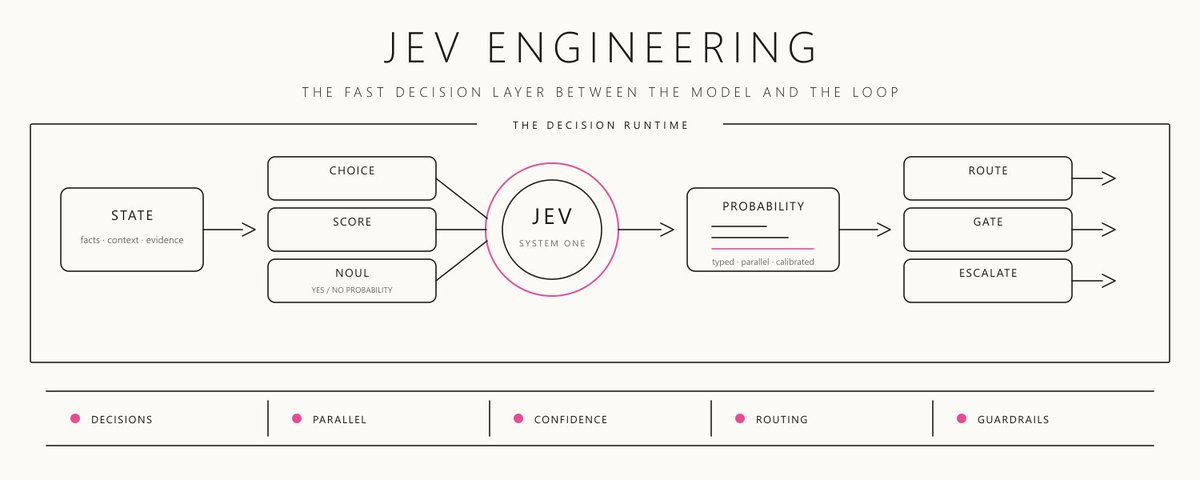
Jev Founder, Diogo Amogo, just released 12-page PDF on building a Jev Harness for production agents
This is a 10-step blueprint for making agent decisions up to 200x faster and 400x cheaper without giving a model authority over your system:
step 1 → meet the decision layer: the LLM creates, Jev judges, code enforces and the harness decides what happens next
step 2 → expose every hidden decision: routing, evidence checks, retries, approvals, escalation and stopping should be visible parts of the agent graph
step 3 → stop dumping the entire transcript into every call: build a compact state packet with only the current goal, facts, evidence, constraints and available actions
step 4 → turn prompts into contracts: declare the possible outcomes, describe what each one means, add an escape route and version the decision like code
step 5 → route by confidence and consequence: automate high-confidence internal work, collect evidence in the middle and send dangerous actions to a human
step 6 → ask independent questions together: choose the next worker, estimate urgency and check approval against one immutable state snapshot
step 7 → build menus from live state: Jev should only see tools, workers, files and browser controls that actually exist and are allowed right now
step 8 → make retrieval decision-aware: deterministic filters remove impossible candidates, Jev keeps the evidence that matters and the LLM receives the smallest useful context
step 9 → create a receipt for every decision: preserve the state, contract version, full probability distribution, threshold, selected route and resulting action
step 10 → deploy in shadow mode: compare Jev with the existing agent, measure calibration and automate the safest branch before expanding the boundary
TypeSafe reports roughly 70–500ms for Jev-shaped decisions and pricing of $0.042 per million input tokens with no metered output-token cost
The real unlock is bigger than one benchmark:
Your most expensive model stops wasting time on decisions that never required another sentence
Send this PDF and the article below to your Claude Code or Codex instance and start rebuilding your agent around typed judgment ↓


Lorenzo Belli retweeted

Opening access for developers to build Muse connectors. You bring the API -- Muse brings the agent, the browser, and the context of what the person actually wants. People reach your service just by asking for it, and their agent takes it from there.
New connectors are live today. Come build with us. muse.ai/platform
Lorenzo Belli retweeted

My conversation with Luca Ferrari, co-founder of Bending Spoons.
0:00 Fanatical founders building enduring companies
1:23 Luca on building the best company there ever was
4:22 The origins of Bending Spoons
5:47 Talent and why experience is overrated
15:05 Turning hiring into a science
23:30 Why Bending Spoons doesn't use bonuses
29:26 Why everyone in the company has the same job
42:41 On finding great potential and saturating their capacity
49:50 Insisting on a culture of extreme ownership
59:28 Luca's principle of relentless simplification
1:05:15 Why Bending Spoons doesn't use job titles
1:10:27 The proprietary operating system behind Bending Spoons
1:17:07 Why Bending Spoons isn't private equity
1:19:32 How Bending Spoons acquired & transformed Evernote
1:28:01 How Bending Spoons uses AI
1:40:42 How Bending Spoons thinks about capital allocation
1:43:50 Why procrastination without laziness is good
1:46:46 Operational excellence is not optional
1:49:07 How Bending Spoons negotiates acquisitions
1:54:47 Logic over numbers
Includes paid partnerships.
Lorenzo Belli retweeted
Why Bending Spoons eliminated all job titles:
“At some point, we were looking for ways to streamline and simplify, and someone said, ‘Why do we even have titles? What's the benefit of titles?’”
“Let's not be arrogant. There's probably some benefit. What's that benefit? We ultimately determined that the benefit was that people needed titles for bragging rights.”
“So we just got rid of titles and told people, ‘You can pick your title for your CV, LinkedIn, whatever. We don't need to know. We don't want to know. We don't need to approve it. We don't want to see it. Just don't embarrass us."
“If you're a new hire, don't say you're the CTO because then people will question our integrity as a company. But as long as it's broadly reasonable, we're good. We have never reintroduced them again. We don't have any titles.”
“We never looked back. We probably saved easily hundreds if not thousands of person-hours in terms of defining different terms and having emotionally draining discussions with people. Never had a problem, not a single instance of someone complaining that we didn't formally assign to them a title ever out of, at this point, many hundreds, actually multiple thousands of people.”

My conversation with Luca Ferrari, co-founder of Bending Spoons.
0:00 Fanatical founders building enduring companies
1:23 Luca on building the best company there ever was
4:22 The origins of Bending Spoons
5:47 Talent and why experience is overrated
15:05 Turning hiring into a science
23:30 Why Bending Spoons doesn't use bonuses
29:26 Why everyone in the company has the same job
42:41 On finding great potential and saturating their capacity
49:50 Insisting on a culture of extreme ownership
59:28 Luca's principle of relentless simplification
1:05:15 Why Bending Spoons doesn't use job titles
1:10:27 The proprietary operating system behind Bending Spoons
1:17:07 Why Bending Spoons isn't private equity
1:19:32 How Bending Spoons acquired & transformed Evernote
1:28:01 How Bending Spoons uses AI
1:40:42 How Bending Spoons thinks about capital allocation
1:43:50 Why procrastination without laziness is good
1:46:46 Operational excellence is not optional
1:49:07 How Bending Spoons negotiates acquisitions
1:54:47 Logic over numbers
Includes paid partnerships.
Lorenzo Belli retweeted
LLMs frequently underestimate how much information they need, so test when they stop instead of relying on answer accuracy alone.
A correct answer can hide poor information gathering.
The model may use prior knowledge or guess correctly without collecting enough evidence.
– arxiv. org/abs/2608.14808
Title: "Do LLMs Know What to Ask and When? Evaluating Multi-Turn Information Seeking"
