




Mike retweeted

Quantum thread attention is actually picking up on its own right now.
Not because of some big catalyst or coordinated shill, but more ppl are just starting to dig into the actual projects building post-quantum stuff.
You’re seeing more real conversations around which chains are native vs which ones still need to migrate, and the pure-play ones are starting to get more eyes.
With this kind of slow burn momentum, I think the narrative still has room to run before it gets fully crowded.
So if you’re looking for projects actually building in the post-quantum space, I’ve got you covered here by tier:
✨ Tier S (already shipped)
@QRLedger | base:0x37696cd8f723ce541ac376f79fc109080e505ba3: Native XMSS since 2018. Every transaction is PQC from day one. Longest track record, no migration needed.
@NEARProtocol | $NEAR: ML-DSA signing live on mainnet since Jul 2026. Accounts can add a PQC key without changing address.
@QuantusNetwork | $QTC: ML-DSA from genesis, mainnet ~Sep 2026. Uses ZK aggregation to reduce signature bloat.
✨ Tier A (gaining traction)
@Starknet | $STRK: Already demoed Falcon/ML-DSA. Account abstraction makes switching signature schemes easier.
@PQabelian | abelian:native: Lattice-based native + privacy. Live mainnet for a while, supports multi-algorithm (Blanc Fork), has QDay L2 EVM-compatible.
@mochimocrypto | $MCM: Native hash-based (WOTS+) since 2018, same generation as QRL.
@Algorand | algorand:native: Falcon-1024 accounts live on mainnet (Aug 2026) + Falcon State Proofs since 2022
✨ Tier B (Building momentum, tooling/infra value)
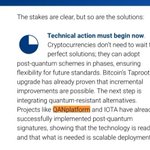
@QANplatform | $QANX: Hybrid Dilithium + hash, EVM-compatible, dual-key.
@cellframenet | $CELL: Uses CRYSTALS-Dilithium, already live.
@SuiNetwork | $SUI: ML-DSA-65 already running on Devnet. Clear roadmap (testnet end of 2026 → mainnet auth Q1/2027).
@projecteleven: Yellowpages (link BTC → PQC key) + Strongpoint custody. Practical tooling, working with multiple large chains.
@qlabsofficial | $Qone: qVAULT + migration toolkit, uses Falcon. Focused on infra to protect existing assets.
✨ Tier C (Still roadmap, slow ship)
Bitcoin (BIP-360): BIP-360 is in the repo but not live yet. Migration is very hard due to the UTXO model.
Ethereum: Targeting ~2029. Nothing meaningful live yet.
Aptos, Nervos, Solana, XRP Ledger (roadmaps / opt-in): Have proposals, opt-in paths, or roadmaps, but haven’t officially shipped yet.
#DYOR. If I missed anyone actually shipping real PQC, drop them below 👇🏻

Mike retweeted
Correction for Mr. Bacon! 🥓 ❌
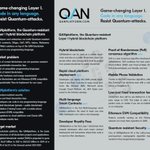
#QANplatform is QR straight from the genesis block. 🛡️
A true #Layer1 blockchain leveraging ML-DSA NIST-certified algorithm, real enterprise adoption is already live on their private chain. 💼⚡
Mainnet B4 end of 2026. 🚀 Please, DYOR on it💎


Mike retweeted

September Milestones: XLINK Goes On-Chain and Deterministic QVM Metering Takes Shape
September was a month of deep engineering for QANplatform. Our team turned their attention to the work that will define the production network: moving XLINK signature management on-chain, building a caching layer to speed up QVM executions, advancing our deterministic gas-metering research toward a real pricing model, and hardening the network against the subtle edge cases that only appear under sustained load.
This month also brought a major strategic milestone: with the execution-layer rebase complete, our audited quantum-safe stack is ready for the final security-audit phase.
Read the full technical recap on our blog (link in replies)🔗👇

Mike retweeted
[Audit status update]
Based on all received feedback, we have finalized the decision on the consensus layer integration for the mainnet stack.
After careful consideration, we selected Lighthouse by Sigma Prime.
As discussed previously, Lighthouse is the most widely used consensus client and is considered semi-official due to its broad adoption among node operators. This choice best meets the technical and policy requirements of our strategic partners.
What happens next:
Step 1:
We are currently preparing the official Go-Ethereum based execution client to be compatible with the modified Lighthouse consensus client.
Step 2:
Once these modifications are ready, we will submit the execution client to the auditors, expected by end of next week.
Step 3:
Once the required Lighthouse modifications are completed, we will also submit the consensus client to the auditor.
Just to clarify, the above steps do not alter the mainnet launch timeline, as these processes are fully parallel.
Where has the official telegram channel gone? Has it disappeared for everyone, or just me?
Strange goings-on
@Tap_Fintech
What's happened with the telegram channel? Seems to have disappeared. Not even linking from the likes of coin gecko
@SaveWithCrypto


My son got a new iPhone 18 pro for his birthday. He also dropped it on day 2, directly onto concrete!!
Glad I spent the extra and got him a case that does what it's supposed to do
#OutsidewithTorras
#Ostandshot

Mike retweeted

$IONQ vient de montrer un truc que presque personne n’explique.
Un ordinateur quantique fait des erreurs. Beaucoup.
Pour qu’il serve vraiment, il faut les corriger pendant qu’il calcule. Pas après. Pas en pause.
Ce « correcteur » s’appelle un décodeur. Jusqu’ici, le risque c’était qu’il soit trop lent ou trop cher : des racks de puces juste pour rattraper les fautes.
Là, leurs chercheurs disent avoir un décodeur de bout en bout, en temps réel, pour une machine fault-tolerant à grande échelle.
Et il tourne sur un seul processeur classique du commerce. Un CPU normal.
Ils ont testé des circuits jusqu’à 408 qubits logiques et plus de 31 millions d’opérations.
Dans leurs conditions, le surcoût de temps tombe autour de 0,02 %.
Pourquoi ça compte???
Si la correction d’erreur exige une usine de serveurs, le quantique reste un labo.
Si elle tient sur un processeur standard, le coût et le rythme deviennent industriels.
Ce n’est pas encore la machine de 2028 livrée clé en main.
Mais C’est un goulot qui recule. Un des plus durs.
thequantuminsider.com/2026/0…

Mike retweeted

JUST IN: IonQ will install the “first on-premise quantum processor” at Nvidia’s quantum research center in 2027.
Mike retweeted

DELL'S CTO JUST CALLED QUANTUM "POTENTIALLY A BIGGER DEAL" THAN GENERATIVE AI.
John Roese, Dell's global CTO and chief AI officer, on the company's new quantum program, "Generative AI was a big deal. Quantum is potentially a bigger deal because it will build on the shoulders of giants. Once we have viable, cost-effective, at-scale quantum systems, it changes everything."
Dell has deployed an HPC cluster inside Diraq's Sydney laboratory, co-located with Diraq's silicon spin qubit processor, to test whether classical servers and a quantum chip can run as one machine with microsecond feedback. Dell's orchestration layer schedules the work and the quantum processor handles the parts classical compute can't.
Diraq's CEO put the division of labor plainly: "call classical AI and CPUs for the big number crunching. Then, when there's a specific hard problem, you call the quantum processing unit."
Diraq's qubits are modified silicon transistors, built on standard foundry processes, with a path to millions of qubits on a single chip inside one refrigerator that fits in a data center. Dell's business is data centers. Roese's word for it: "democratizing," qubits that ship in racks, not buildings. Next month Diraq installs a machine inside a commercial Equinix data center, the first ever.
$DELL $INFQ $IONQ


Mike retweeted

Post-quantum isn’t a patch you add later!
@intel Steve Orrin: 2030/31 is the migration deadline, but the risk is today.
If your blockchain still relies only on ECDSA, your data and keys are already on the “harvest” list.
Quantum-resistant from genesis isn’t optional, it’s risk management. Block 0 must be protected!
bitcoin:native ethereum:native $SOL


Speaking on a recent podcast, Steve Orrin, Intel’s Federal Chief Technologist, warns that the quantum threat is "not a future problem, it's a today problem."
"In my personal opinion, I think that from a risk perspective, 2030, 2031 is the right target. If we could do it earlier, we should, because the harvest now, decrypt later threat is already a risk.
It’s already happening, and it has been happening. Every encrypted piece of data that’s been pulled off the net and waiting in some large database for when the quantum computer comes online — if you want that data to be protected after that, you need to have started post-quantum encrypting back when you created that data." - Steve Orrin, Intel’s Federal Chief Technologist
The takeaway: start securing your data today to keep it safe in the quantum era.
For decentralized systems, this means building on a blockchain that is quantum-safe from block 0.
Mike retweeted
You should check @QANplatform
qanplatform:native is prelaunch and proved their mindset to the Community.
The first Project I ever saw that compensated the whole community after a bridge was hacked.
Legit AF and going for the next narratives.
Quantum resistance
low barriers
Enterprise Blockchain
#NoGhostChain
Check also the team, and the co-founder Silur 😉

Mike retweeted
July Milestone: Successful completion of the TestNet migration to the official Ethereum execution client
Our primary objective this month was clear: migrate the QAN TestNet to the official industry-standard Ethereum execution client while remaining compatible with our previous implementation without compromising our unique quantum-secure features.
The engineering team has not only completed the migration to the official Ethereum client but has also proven that QANplatform can operate seamlessly on a standard Ethereum infrastructure while retaining the full power of the QAN Virtual Machine (QVM) and QAN XLINK.
Read the full technical deep dive on our blog (link in comments) 🔗👇

It's a frustrating experience to receive an email saying that you tried to deliver a parcel, when in fact I have been at home all morning waiting between the alloted delivery time.
@parcelforce .
Mike retweeted
Quantum security is no longer something to watch- it's a requirement.
All systems will be looking for solutions.
That is a huge market for innovation. @QANplatform has the IP and enterprises have shaped what's required for the future of Blockchain utility.

If you wanted to read one thing today about an incredible #layer1 that is about to launch, then @kevalgala03 just made great use of your time . Don't miss this opportunity to be early!
#Quatum #crypto
#SOLANA #Avax #ETH #NIST #BLOCKCHAIN #Bitcoin #CLARITY $QAN $BTC

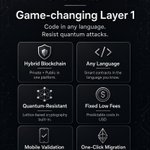
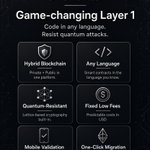
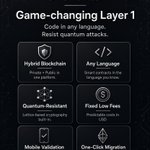
10 reasons @QANplatform is the quantum-resistant L1 worth watching.
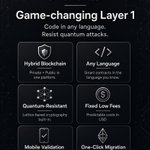
1️⃣ Any programming language: QVM opens blockchain development to 20M+ programmers
2️⃣ Quantum-resistant from genesis: CRYSTALS-Dilithium (NIST-approved ML-DSA) built in
3️⃣ QAN XLINK: cross-signer protocol ensures 100% migration path when quantum attacks hit ECDSA
4️⃣ Harvest now, decrypt later: every ECDSA public key exposed onchain today is a future attack vector, QAN eliminates this
5️⃣ Audited core tech: QVM audited by Hacken (2025), XLINK audited, integration audit ongoing
6️⃣ EVM compatible: existing Ethereum DApps, DeFi, NFTs can migrate without rebuilding from scratch
7️⃣ Developer rewards: first L1 that pays developers lifetime royalties when their smart contract code gets reused
8️⃣ 5-minute cloud deployment: deploy QAN blockchain to AWS, Azure, GCP in under 5 minutes
9️⃣ Ethereum rebase: QVM core logic being ported to Ethereum infrastructure (~70% complete)
🔟 $21M mcap, mainnet 2026: audited, testnet live, CTO publicly committed
The title insurance story says it better than any whitepaper. A property signed onchain in 2022 with ECDSA could have two mathematically valid owners by 2030.
QAN signed its first block assuming ECDSA wouldn't hold. Most chains didn't. $QANX

Mike retweeted

10 reasons @QANplatform is the quantum-resistant L1 worth watching.
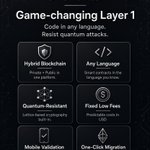
1️⃣ Any programming language: QVM opens blockchain development to 20M+ programmers
2️⃣ Quantum-resistant from genesis: CRYSTALS-Dilithium (NIST-approved ML-DSA) built in
3️⃣ QAN XLINK: cross-signer protocol ensures 100% migration path when quantum attacks hit ECDSA
4️⃣ Harvest now, decrypt later: every ECDSA public key exposed onchain today is a future attack vector, QAN eliminates this
5️⃣ Audited core tech: QVM audited by Hacken (2025), XLINK audited, integration audit ongoing
6️⃣ EVM compatible: existing Ethereum DApps, DeFi, NFTs can migrate without rebuilding from scratch
7️⃣ Developer rewards: first L1 that pays developers lifetime royalties when their smart contract code gets reused
8️⃣ 5-minute cloud deployment: deploy QAN blockchain to AWS, Azure, GCP in under 5 minutes
9️⃣ Ethereum rebase: QVM core logic being ported to Ethereum infrastructure (~70% complete)
🔟 $21M mcap, mainnet 2026: audited, testnet live, CTO publicly committed
The title insurance story says it better than any whitepaper. A property signed onchain in 2022 with ECDSA could have two mathematically valid owners by 2030.
QAN signed its first block assuming ECDSA wouldn't hold. Most chains didn't. $QANX
