

Videos: https://xitter.cf/t.co/vy9r4V6aOZ
Pittsburgh, PA
Joined October 2011
- Tweets749
- Following0
- Followers7.8K
- Likes1.6K




Pinned Tweet
I'm releasing a series of videos called "Quantum Computer Programming in 100 Easy Lessons".
youtube.com/playlist?list=PL…
It will cover the 'usual' content (...CHSH, Grover, Factoring), but with some expositional innovations that I *hope* will make it easier for beginners.
Making some progress on simplifying the '#ETH false' proof, I think. In latest version, the key algebraic construction comes from elementary analysis of Boolean functions.
cs.cmu.edu/~odonnell/some_et…
A couple of my course lectures about ETH and SETH and related things:
youtube.com/watch?v=dVQrj52J…
youtube.com/watch?v=NMOMDz3x…
(From last week!)
I will be the first to admit, I was repeatedly on the record as believing SETH :-)
Ryan O'Donnell retweeted

Here's a direct link to OpenAI's PDF claiming a refutation of ETH. In particular, it's claimed that 3SAT on n variables is in about exp(n/(log n)^{1/2+o(1)}) time
github.com/openai/math/blob/…

William Hoza on the BPL=L result:
youtube.com/watch?v=2hVv47LO…
Ryan O'Donnell retweeted

Happy to share that our better-than-2 approximation results for k-median are now on arXiv:
arxiv.org/abs/2610.18144
arxiv.org/abs/2610.17172
It has been a pleasure working with this fantastic group: @rares_buhai , Vincent Cohen-Addad, Henry Fleischmann, @anupamg , Antoni "Toni" Jubés Monforte, Madhusudhan Reddy Pittu, @mstou73, and @LukasBirdyy
A special shout-out to Toni, who started working on this problem for his Master's thesis almost two years ago. His work led to the impressive analysis of the factor-revealing LP!
Now on to other things...


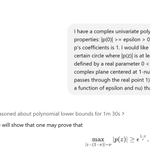
I looked forward to this cleanup! Nikloai Chukhin (eccc.weizmann.ac.il/report/2…) significantly cleans and extends the OpenAI 2^(ω(sqrt(n))) lower bound for depth-3 circuits:
The (4n-1)-bit function sum_ij a_{i+j}x_iy_j mod 2 needs depth-d circuits of size 2^(Ω~(n log n)^{1/(d-1)}).
Ryan O'Donnell retweeted

this is great: a unified and transparent exposition of the recent breakthroughs on the decoding of Reed-Solomon codes.
eccc.weizmann.ac.il/report/2…
Ryan O'Donnell retweeted

The what now?!
arxiv.org/abs/2610.06783v1

Ryan O'Donnell retweeted
oh that's interesting! The authors share the draft generated by Astra, as a companion to their arxiv submission.
arxiv.org/abs/2609.28028

STOC 2027 Call for Papers is out:
acm-stoc.org/stoc2027/stoc20…
Note quite a lot of changes from previous STOC CfPs.
Ryan O'Donnell retweeted
An amazing result in online algorithms. I worked on this for over a decade and it is fantastic to see a solution that looks very clean! Also great to see an expert behind the wheels. Congratulations @sahilsingla81 arxiv.org/abs/2609.14555

Outstanding progress towards the Unique Games Conjecture posted by Yumou Fei, Dor Minzer, and Shuo Wang: eccc.weizmann.ac.il/report/2…
👀
Am teaching grad complexity theory at CMU; about 1/3 of the lectures will be new (vs. last time), 'modern' results. Videos are going onto youtube.com/@ComplexityTheor… which will later also feature student videos.
We did Williams (/Cook-Mertz/Shalunov) TIME(t) in SPACE(~√t) today.

I gave a talk at Carnegie Mellon about the recent proof (by OpenAI) of the existence of a non-sofic group:
youtu.be/uOQvzLjJK6c
Ryan O'Donnell retweeted

Oh my goodness…
eprint.iacr.org/2026/1630
Ryan O'Donnell retweeted
FOCS 2026 Test of Time call for nominations is out:
tc.computer.org/tcmf/2026/05…
Please submit your nominations! More info on the award here:
tc.computer.org/tcmf/focs-te…
and here's DBLP links for FOCS '16, '06, '96:
dblp.org/db/conf/focs/focs20…
dblp.org/db/conf/focs/focs20…
dblp.org/db/conf/focs/focs96…
Ryan O'Donnell retweeted

New w/ Meghal Gupta, William He, @BooleanAnalysis
arxiv.org/abs/2508.09422
We give a quadratically faster classical algo for noisy planted kXOR (k > large const), dispelling (for now) claimed quartic speedup for quantum algos. 🧵 (1/10)