

“Another Random @DrivelineBB Hitting Coordinator ” | BW Baseball Alum | Try not to suck
Seattle, WA
Joined September 2013
- Tweets2.4K
- Following408
- Followers1K
- Likes3.4K



Pinned Tweet
How does someone add 7.2 MPH of Bat Speed in 4 months?
Let's dive in ⬇️

I wonder if this guy just absolutely crushed his off-season training and added a ton of bat speed 😏 @BrandonDim24

Brandon Dim retweeted

While this trend is universal, there are many variables that alter the specifics — one of which is pitch location
For a typical hitter, deep➡️on time➡️out front might be:
Outside pitch — hard GB oppo➡️LD oppo gap➡️FB CF
Inside pitch — low LD to CF➡️LD pull-gap➡️HR pull-side

Brandon Dim retweeted

Elly De La Cruz went from a .776 OPS in 2025 to .880 in 2026, and his xwOBA (.322 to .376) supports the jump.
Two changes drove it: more bat speed and better swing decisions. Here's how they showed up in his ball flight, and where he can still improve.🧵
Brandon Dim retweeted

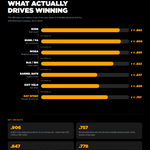
Here's how the projected position players on the Rays and Brewers World Series rosters line up in terms of their average bat tracking metrics.


Brandon Dim retweeted

Bat speed doesn't just help you when you connect, it improves the quality of a miss as well.
Smash Factor is @DrivelineBB's measure of bat to ball skills, essentially how well a hitter translates bat speed into exit velocity. Most batted balls fall between a .9-1.2 Smash Factor. The lower the Smash Factor, the less bat speed the hitter translates into exit velo, the bigger the miss.
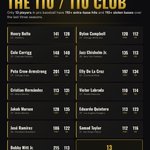
Here are the 3 lowest Smash Factor postseason homers since 2023. A great example of why swinging the bat fast can make your misses valuable.
Last year, Cal Raleigh hit the lowest Smash Factor homer of the last four postseasons.
Smash factor: 1.047. 🧵
Brandon Dim retweeted
Trea Turner went from one of the best shortstops in baseball to a below-average hitter in one year. What changed?
2025 → 2026:
📉 fWAR: 6.5 → 1.1
💥 wOBA: .352 → .298
🏆 2025: NL batting title (.304)
Turner’s avg and max exit velo were both down this year, despite a slight increase in bat speed from 2025. His hard hit rate and LA Sweet-Spot% also decreased, while his K% increased.
Contact quality 2025 → 2026:
⚡️ Bat speed: 71.2 → 71.7 mph
💥 Avg exit velo: 89.3 → 88.4 mph
🚀 Max exit velo: 111.7 → 110.1 mph
🔨 HardHit%: 42.1% → 39.3%
🎯 LA Sweet-Spot%: 36.8% → 32.7%
❌ K%: 16.7% → 21.0%
Turner’s batted balls were much less productive in 2026 than 2025. His oppo% went from 25.8% to 30.3%, and his air% increased by 3 points while his pull air% decreased. He also popped up nearly twice as often (4.3% → 8.0%).
But despite him going opposite field more often, his attack direction and point of contact both moved more pull-side.
While his barrel moved more pull-side in 2026, it’s likely that he struggled to release the barrel to match his direction. This would explain why he was going oppo more despite catching the ball further out in front. This was likely causing him to sidespin balls to the right side of the field and limiting his ability to flush balls in the air to the pull side, which could explain this change in ball flight.
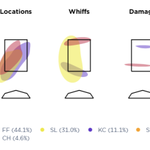
In addition to this, his path moving further out in front coincided with his whiff rate and chase rate both increasing. He particularly struggled with pitches at the bottom of the zone.
Swing and miss 2025 → 2026:
🌀 Whiff%: 24.8% → 27.7%
⬇️ Low in-zone Whiff%: 14.9% → 20.0%
🔥 Low in-zone FB Whiff%: 6.2% → 12.6%
🪃 Low in-zone offspeed Whiff%: 16.7% → 28.6%
🔄 Offspeed Whiff%: 27.6% → 36.8%
These changes likely stem from a small mechanical change. While his bat speed improved from 2025 to 2026, his path made it harder for him to consistently square the ball up. He may benefit from a return to his 2025 bat path.
—@Stevie_T12
Brandon Dim retweeted
When HAA & HBA are both aligned with the Spray Angle, flush contact produces true ball-flight.
When HBA is more pull-side than HAA (club face closed relative to swing direction), the ball will be hooked.
When HBA is more oppo than HAA (club face is open), the ball will slice.
-@kozy_shack
Brandon Dim retweeted

An underrated aspect of being a good coach IMO is your ability to get athletes to "buy-in" to what you are trying to accomplish.
@DrivelineBB I believe this comes from the intersection of a data-driven objective approach & real relationship building.
More on this ⤵️⤵️

Brandon Dim retweeted
Trea Turner:
'25 - 6.5 fWAR, .352 wOBA, batting title
'26 - 1.1 fWAR, .298 wOBA
He went from one of the best shortstops in baseball to a below-average hitter in one year, what changed?
🧵
Brandon Dim retweeted

A few months into my internship with Driveline Hitting.
Being around this staff every day has changed how I think about the swing. A few things I've learned so far 🧵
Brandon Dim retweeted
Bat speed gives you a bigger margin for error.
ALCS Game 6. Junior Caminero chases a splitter off the plate and doesn’t square it up. Usually, that’s an out.
He swung 81 mph and pulled it in the air for a home run.
Moving the bat fast makes your misses more productive.
Brandon Dim retweeted

MLB hitter's full signal attack angle data pre and post season.
Left side: February
Right Side: September (more green, this is good)
It's really common to lose bat speed throughout the season, but huge to see the attack angle in a better place - Both getting into and staying in ideal ranges for a longer period of time.
Example of an in season adjustment that can set you up to make big progress throughout the offseason.
3 years ago, I started at @DrivelineBB
I didn’t even know if I wanted to be a hitting coach.
And here we are.
These are 3 of the biggest things I’ve learned in the last 3 years 🧵
2. The best hitters hit
At Driveline, we put our hitters in some of the most difficult training environments there are.
Trajekt. iPitch. Smash balls. Different training bats. Different angles. Etc.
And the best hitters we’ve ever had in our gyms show up and hit.
To quote Maxx Garrett: “We want robust swings, swings that don’t break down.”
No matter what type of constraint you put a hitter in, the best find a way to hit.
Because at the end of the day, we aren’t swing coaches. We’re hitting coaches.
Players need to know that too, because…
3. Someone can have all the best resources, but communication matters most
There are more biomechanics, motion capture, and “hitting labs” than ever before.
But the ability to effectively communicate that information to a variety of athletes is what separates things.
A compliment from a Major League hitter last offseason stuck with me:
“We’re more than just data nerds. We’re baseball people.”
That’s what separates Driveline’s coaches.
Taking the highest level and complexity of data and turning it into physical deliverables for the athlete — while also being able to communicate it to athletes of all ages.
Not using data is just as much of a disservice to an athlete as not being able to communicate it.
At the end of the day, this is about the athlete, not the coach.
Brandon Dim retweeted
As coaches we must design a practice environment that promotes self-organization.
- pitch type
- pitch angle
- bat type
- ball type
- physical constraints
- ball flight goals
This doesn't mean setting up the environment and just stop watching the hitter.
A coach still monitors the athletes' progression. Create the environment for targeted changes and steer the player in the right direction.
Brandon Dim retweeted

Some recent swings from the fall. True sophomore 1B/OF. 6’1 225
Last seasons stats
AVG: .368
OBP: .519
SLG: .526
OPS: 1.045
@kyle_czaplak @FokkenParker @iamjimmyhill @jholguin3 @nunezcesar7 @BrandonDim24
