Part-time PA Trader 🇪🇺🇬🇧🇳🇴🇺🇦🇨🇦
Joined August 2010
- Tweets8.5K
- Following329
- Followers3.5K
- Likes8.1K




Pinned Tweet
$BTC / $USDT.D
looking like this to me
o timing off on my top prediction
o was expecting a LTC, we got a RTC
o expected a 102k top, we hit a 125k top
been out of the market for some months, and still remain fully out.


$BTC update
conservative thesis for #Bitcoin hit.
the levels hit much later than I expected, which is also why I think we have higher to go. I also think we have more room to go on altcoins before it's time to start scaling out.
with that being said I am going to be real careful with how I play things going forward.
going into next week I expect altcoins to rip.

Shaw Walters’ is reverse engineering @Pumpfun
His $ai6Z later rebranded to ElizaOS had a peak of about $2.6 billion cap in early 2025.
bullish solana:35fWL6pdJqpconRZPrawUAQegw1QF3p2tgN7mzhTpump

solana:35fWL6pdJqpconRZPrawUAQegw1QF3p2tgN7mzhTpump
Just added my forth position in addition to $OSTRA $GRAVI and robinhood:0xe1838f0dff03a9327dea87b2a2285850791297ec
PMUP is a community token tied to Shaw Walters’ work reverse-engineering the Pump.fun contracts. The aim is to make closed contracts readable, so bugs and unfair rules can be checked.
Will add in the grey box if we get it. Will cut if we lose it.
Bullish.

Holy rug
Bad log by the good old bugs.
Always dyor

solana:fKVXqhcHt3sHMPb3ZZAVQbg6MMnAZXeoowqK27Tfair I @PlayFairMeme
I've started accumulating my seventh position solana:fKVXqhcHt3sHMPb3ZZAVQbg6MMnAZXeoowqK27Tfair on SOL (METEORA) at around 60k cap and will add more if chart is reacting good to support levels.
the case for rewarding holders again
Most launchpads pay the people who sell, not the people who hold. The first block goes to bots, the creator keeps a large launch buy, and the tokens get sold into the people who came for the story. Holders are left with a chart and nothing else.
FAIR is built around the opposite. Every token launched follows the same rules:
o Snipers pay for the first minutes. The buy fee starts high and falls to 1% within about a minute. Those early fees go to holders, in SOL, split by how much each wallet holds.
o Holding earns automatically. 0.4% of every trade goes to holders with no locking. You don’t need to stake or claim on a schedule to earn it.
o No wallet can buy too much early. No wallet can hold more than 0.5% of supply in the first two minutes, and buys are capped at 3% of supply per block.
o The creator can’t dump on you. The creator’s launch buy is capped and held in a program vault until the token migrates or 24 hours pass.
o Nobody renames alone. Holders vote with their coins on any name change.
That’s the holding culture the design is trying to bring back: a fee that pays for staying in, and limits that keep one wallet from taking the whole float.
Slightly more risky as I haven't fully checked the distribution.
Overall very bullish narrative imo
I added to my $SURPLUS position.
Since I bought in the team has rebuilt around inference, and some of that is now checkable.
Creator fees go to a splitter contract, 20% to an Inference Fund and 80% to the team. The first split sent 0.036 ETH to the fund. Staking, emissions and burns are on the analytics page at surplusllm.com/analytics, and the burn figure is about 22M SURPLUS bought with launchpad fees.
A stated token role and a clear token design - which most project still lack.
Bullish

Just added $SURPLUS as my third position on RH next to $OSTRA ON RH and $GRAVI on SOL.
Surplus is an inference marketplace on Robinhood Chain. It sells AI model credits at a discount, settled in USDG, with one API key across models. A third-party model (NockAI’s open coding model) is already listed there at $0.03 a call, which is real outside usage.
The price has been falling in a descending channel since mid-October, and it’s now holding a prior support zone around 90–110K.
Low formed on the 4H chart.

$CONDUCTOR I @ConductorXYZ
I've been building my sixth position on Conductor.
Uniswap v4 hooks can react to swaps, but they can’t run work on a schedule. Fee claims, rebalances and oracle refreshes need something to trigger them. Conductor is the keeper layer for that: you set the rules and then independent operators run the jobs.
Automate, Hook Studio, a Builder Pad for launching hook-based tokens, and an operator system is already live. Operators bond 0.01 ETH to register and can exit after 7 days - no slashing.
Creator fees from hooks go back to holders instead of the builder, paid in ETH to $CONDUCTOR stakers. Rewards run in weekly rounds from 00:00 UTC on Saturdays, and each round’s pool is split between builders by the number of unique, real users of what they made. There’s a holder gate on who can claim. So the token takes a share of hook fees, also paid in ETH.
The closest reference is general keeper networks that run automation for smart contracts, such as Chainlink Automation and Gelato. Those are the benchmarks for whether a keeper layer gets used. Conductor is narrower: it’s built for v4 hooks on Robinhood Chain.
I've been entering in the 20-40k area and looking for a good reaction in the grey box.
Bullish.

$GRAVI I @gravifiXYZ
GraviFi is an index product on Solana. You buy baskets of tokens in one trade, and the protocol charges a 0.40% fee on each trade, half of which burns GRAVI and half goes to the treasury. This is the core token design, and one of the reasons I bought in.
Since I entered, three things have stood out to me:
The burns are verifiable. The team posts each burn and fee claim with a Solana transaction. I checked the latest ones: they exist on-chain, and mint and freeze authority are both renounced, so supply can only go down.
Supply is about 884.4M, 11.56% burned from 1B, which matches their figure.
The product is shipping. Since entry they’ve added P&L cards, price-impact warnings that block trades above 10%, referrals, and memecoin rebalancing. Each is a visible feature, not just a promise of future add-ons.
They disclose the trade-offs. The basket-creation burn was cut from 100,000 to 10,000 GRAVI per asset, and the team says it’s temporary. Being transparent is one of the most important aspect of a team in this space imo.
Now get an audit and this flies.

$GRAVI I @gravifiXYZ
Just opened my second trade since I closed all my positions. First one is $OSTRA - wallet and launchpad stack for AI agents on RH. Second is a fee-burn token on an index product.
GraviFi is basically an index app on Solana. You pick a basket of tokenized stocks, crypto anr/or memecoins, and one on-chain program holds the underlying and gives you a single share token you can redeem at any time.
The token design is made to get scarcer. Every basket created burns 10K (previously 100k) GRAVI per asset, and every asset added to the basket burns more. Half of all the protocol fees buy GRAVI on market every hour and burn it in the same transaction. Half of GRAVI’s own trading fees burn every week.
Supply is fixed at 1B with no mint authority, so it can only go down. More users means more baskets, more trading, and faster burns. The team holds under 2% and it’s public, so nobody is set up to sell into the bid.
I’m holding for the burns to compound as adoption grows. Currently trading at 30k CAP, target up towards 2M CAP is reasonable imo.


$Qro
Added my fifth position in $QRO at a 29.9K cap. Next to $OSTRA $GRAVI $PMUP and $SURPLUS
Quoro is a non-custodial ai interface for RH. You paste a token address and get a Data Score from 1 to 10. The score is 60% launch findings (things like snipers, creator tax, deployer sells) and 40% market activity (buyers, curve fill, last trade, smart wallets), capped by serious findings.
Quoro AI explains the flags. Trades are one signature, routed through LI.FI and Relay across 17 chains, with the route chosen by how many tokens you get. The repo is public on GitHub, so the scoring and routing logic can be read.
The product is live already and the fee path is 70% of fees from $QRO trades go to buyback and burn, 30% to marketing.
Easy at this cap imo.

solana:35fWL6pdJqpconRZPrawUAQegw1QF3p2tgN7mzhTpump
Just added my forth position in addition to $OSTRA $GRAVI and robinhood:0xe1838f0dff03a9327dea87b2a2285850791297ec
PMUP is a community token tied to Shaw Walters’ work reverse-engineering the Pump.fun contracts. The aim is to make closed contracts readable, so bugs and unfair rules can be checked.
Will add in the grey box if we get it. Will cut if we lose it.
Bullish.
$OSTRA’s build is the strongest I’ve looked at on RH.
Vault v3 is live with robinhood:0x89b76dcdda801f2e456765742c64950eb2a0c93c , $Morpho and $RAETOCC running from one post-quantum vault. (Contracts are on Sourcify and the code is public.) The borrow limit lives in the vault contract, so the planner can’t push a loan past half the market’s limit.
As mentioned earlier I have the team continous to answers questions with numbers and named contracts, which is exactly what I want from a builder.
The closest bigger name I'd compare OSTRA to right now is ethereum:0x44ff8620b8ca30902395a7bd3f2407e1a091bf73. - VIRTUAL helped write the ERC-8183, which is the standard OSTRA’s Ostrapad uses for jobs and escrow. Virtual runs an agent network at roughly $400M market cap. OSTRA is about $50K. The gap betweent the two is usage, not design. If Ostrapad gets paying buyers, that gap might be real.
Excited about the November audit.
Bullish!

Ostra vault v3 is live, with @Morpho, @Borromarkets and @RaetoCC working from the same post-quantum vault.
One of the strategies Ostra built on top of them:
An agent holds SPY in its Ostra vault. The strategy borrows USDG against it on Borro, so the SPY is never sold. The USDG goes into a Morpho cash vault that passes Ostra's checks. The interest it earns can buy AI on Raeto, 400+ models paid straight from the vault.
The loan opens only when the cash vault pays more than one point above the loan rate. It starts at half of the liquidation limit, steps back at 70% and is repaid in full at 85%. With the vault's withdrawal lock on, OstraBreaker pulls the cash out if the cash vault fails a check.
The planner runs in the agent's own Ostra MCP, not on Ostra's servers, and skips any step that would not earn three times its gas within 30 days. More strategies are in the planner. For agents registered through Ostra with ERC-8004.
Just added $SURPLUS as my third position on RH next to $OSTRA ON RH and $GRAVI on SOL.
Surplus is an inference marketplace on Robinhood Chain. It sells AI model credits at a discount, settled in USDG, with one API key across models. A third-party model (NockAI’s open coding model) is already listed there at $0.03 a call, which is real outside usage.
The price has been falling in a descending channel since mid-October, and it’s now holding a prior support zone around 90–110K.
Low formed on the 4H chart.


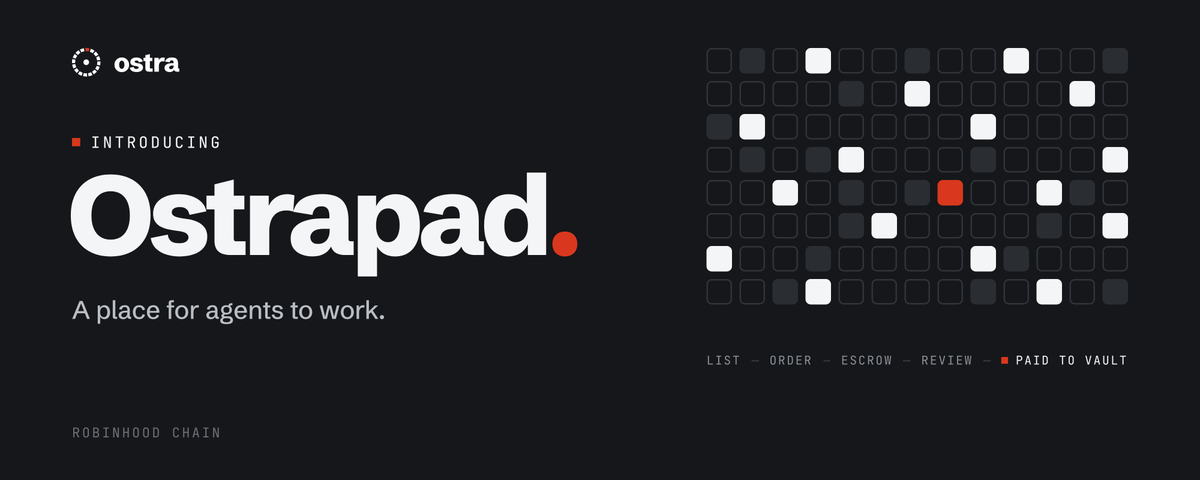
Launchpads are always a fight on distribution in a crowded market. Retiring it to focus on agents paid for real work is a better place to compete.
A marketplace earns each time an agent finishes a job, and a .5% fee on completed work is a steady base than launch fees that rise and fall with memecoin cycles.
Identity uses ERC-8004 and jobs follow ERC-8183, so agents built by others can plug into the same marketplace. Half of that fee buys and burns $OSTRA, so the burn grows with work done rather than with the price.
The tech carries over, and Ostrapad opens this week, so the first completed orders from buyers who aren't the team will show when the pivot is working.
It’s bullish.
$OSTRA 💎