

CARES helps communities measure standard outcomes for out-of-hospital cardiac arrest, allowing for local QI & benchmarking capability to improve care & survival
Joined May 2020
- Tweets815
- Following142
- Followers729
- Likes454




The first shock matters.
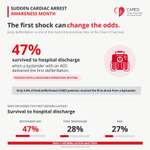
2025 CARES data show 47% survival to discharge when a bystander delivered the first shock to patients with a shockable rhythm.
Yet only 5.8% of field-defibrillated patients received their first shock from a bystander.
AED access saves lives.

The 2026 CARES Fact Sheet lists more than 3,200 EMS agencies and more than 2,300 hospitals participating. Thank you to the people behind the data.
Interested in joining CARES?
mycares.net/sitepages/enroll…
When cardiac arrest strikes, every second counts. A child's survival following a near-drowning highlights the power of immediate CPR. With CARES data showing bystander CPR in only about 42% of cases, awareness and action are critical.
hoodline.com/2026/10/cpr-res…

Put CARES data to work: ask a specific question, choose a measure to review, and agree on an action to evaluate. What would your community like to understand about its cardiac arrest response?
mycares.net/sitepages/upload…
Survival is more than leaving the hospital.
2025 national CARES data show that 78.6% of cardiac arrest survivors discharged from the hospital had a positive neurological outcome (CPC 1–2).
CARES tracks more than survival. We track outcomes that matter.

He learned CPR at school. Then he used it to save his dad's life.
CARES data show approximately 70% of out-of-hospital cardiac arrests occur at home. CPR training matters.
hoodline.com/2026/10/miami-d…

Hospital outcomes are part of the picture. CARES links hospital information with dispatch and 911 responder data so communities can examine cardiac arrest care. Thank you to our hospital partners.
mycares.net/sitepages/upload…
In 2025, CARES captured 140,427 out-of-hospital cardiac arrest events, representing 52% of the U.S. population.
Every data point helps us understand cardiac arrest and identify opportunities to improve survival.
Measure the problem. Find the gaps. Improve survival.

Why CARES Matters highlights Hawaii's use of CARES insights to expand high-performance CPR training, from lifeguards to hospital teams. A community example of putting data to work.
mycares.net/sitepages/upload…
When a heart stops, the people nearby matter first.
2025 CARES data: 42.5% received bystander CPR. Survival was 12.8% with bystander CPR vs. 7.7% without.
This World Restart a Heart Day, know what to do: Call 911. Start CPR. Use an AED. #worldrestartaheart

Today is World Restart a Heart Day. CARES invites you to learn Hands-Only CPR and share the American Heart Association's resource with someone you know.
cpr.heart.org/en/cpr-courses…

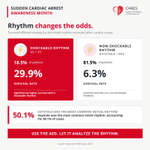
Heart rhythm matters in cardiac arrest survival.
2025 CARES data:
• Shockable rhythm: 29.9% survival
• Non-shockable rhythm: 6.3% survival
You don't need to identify the rhythm. Start CPR, use an AED, and let it analyze the heart.

Witnessing cardiac arrest can change the odds.
2025 CARES data show survival was 4.3% for unwitnessed arrests, compared to 16.1% when witnessed by a bystander and 18.0% by a 911 responder.
Recognize cardiac arrest. Call 911. Start CPR.

CPR can make a difference, even when performed by a family member.
A study using CARES data from 824,000+ cardiac arrests found higher survival with family-administered CPR (9.6%) than with no bystander CPR (7.3%).
sciencedirect.com/science/ar…
What happens before a cardiac arrest patient reaches the hospital matters.
2025 CARES data show 36.9% survival to discharge with sustained ROSC in the field, compared with 6.3% without it.
From bystander CPR to hospital care, every link in the Chain of Survival matters.

Chicago's bystander CPR rate rose from 15.5% in 2014 to 54.2% in 2024. Why CARES Matters highlights the city's collaborative approach to response, community engagement, and mapping.
mycares.net/sitepages/upload…
A bystander applied an AED in 13.9% of public-location arrests in the 2025 CARES data, excluding 911-responder-witnessed arrests. This week, locate the AED at your workplace or gym.
mycares.net/sitepages/upload…
Early action changes outcomes. In 2025, 42.5% of CARES patients received bystander CPR, with 12.8% surviving to hospital discharge compared with 7.7% without bystander CPR. Recognize cardiac arrest. Call 911. Start CPR.

The 2025 CARES bystander CPR rate was 42.5%, excluding medical-location and 911-responder-witnessed arrests. Make CPR education a community priority. Start with AHA resources.
cpr.heart.org/en/cpr-courses…
In the 2025 CARES data, 71.4% of cardiac arrests occurred in residential settings. Make CPR education a household priority this Sudden Cardiac Arrest Awareness Month.
mycares.net/sitepages/upload…