

Trading the markets with code. Price action, automation, and what actually works. Software Engineer.
EU
Joined July 2016
- Tweets364
- Following161
- Followers287
- Likes3.9K


Pinned Tweet
The world has put ~$2T into AI. That’s about 3x what the US spent on the Moon landing, the Marshall Plan and the Manhattan Project combined.
Most of it is borrowed.
Here’s what I found digging into the money:
GPUs and data centers are bought on credit, with the same GPUs and data centers as collateral. Everyone wants to get paid, and nobody can say where the real revenue is.
Oracle borrowed a fortune to build Stargate for one client, OpenAI. OpenAI loses money and nobody knows when it pays. Oracle’s bills are due now, and lenders are done lending.
Nvidia sells the shovels in the gold rush. It also lends customers money to keep buying its GPUs, including ones that haven’t shipped yet.
OpenAI wanted to raise $30B. It got $11B.
Anthropic is going public with a ~$80B loss. Both labs lose money, and both are valued at $1T+.
The tech itself is real. Opus 5.5 is smarter than the average employee, and a good dev using it can outwork 99% of their peers.
So what does this mean for the Nasdaq?
The index leans on AI: Nvidia, Microsoft, Google, Meta, Amazon, Broadcom. When the market doubts AI spending will pay back, everything goes down together.
That’s already happening. In early November the Nasdaq-100 fell more than 10% from its Oct 6 record, which is an official correction.
Then it bounced. Chipmakers led first, and on Nov 4 the Nasdaq gained almost 2% after Democrats won Congress. AI still lagged: Nvidia closed red, CoreWeave dropped ~9%, and some data center builders are down 20%+. Part of that is fear of tighter data center rules from the new Congress.
My read: the market has stopped buying anything with “AI” in the name. Money is leaving “build on debt, profit later” for companies with real revenue. If the payback doubts grow, the Nasdaq keeps shaking.
The tech isn’t what’s popping. It’s the belief that AI pays off fast. By 2030 AI needs to earn $8.5T. Best case, it earns $3.6T. That’s a miss of more than 2x.
Are you trimming AI exposure or buying the dip?


Huang's Way
To understand what really happened to Jensen Huang, two minutes from the interview he gave on April 16 this year to a popular American blogger of Indian descent: youtube.com/shorts/u3sy8nvjh… for the context: Dario Aodei said in January, said that in January Selling China's advanced chips is "how to sell North Korea's nuclear weapons."
Washington AI has long been discussed in the logic of enriched uranium and non-proliferation regimes. And Huang began to oppose this position on camera, refused to recognize Nvidia purely an American company and had his view of abandoning the Chinese market as a "loser mentality." Therefore, what happened is by no means a coincidence, just there were convenient reasons to remove it from a strategic resource, if it did not agree to cooperate differently.
There would be no story with a spy, there would be something else, I don't even doubt it. And what are the conclusions for us? AI is not some fiction or fashion that will pass. It is certain that even enriched uranium will bypass humanity. Who does not understand this, does not invest in training, tools, process restructuring and the like - he risks repeating the Huang path, only without billions of dollars in his pocket.
The world has put ~$2T into AI. That’s about 3x what the US spent on the Moon landing, the Marshall Plan and the Manhattan Project combined.
Most of it is borrowed.
Here’s what I found digging into the money:
GPUs and data centers are bought on credit, with the same GPUs and data centers as collateral. Everyone wants to get paid, and nobody can say where the real revenue is.
Oracle borrowed a fortune to build Stargate for one client, OpenAI. OpenAI loses money and nobody knows when it pays. Oracle’s bills are due now, and lenders are done lending.
Nvidia sells the shovels in the gold rush. It also lends customers money to keep buying its GPUs, including ones that haven’t shipped yet.
OpenAI wanted to raise $30B. It got $11B.
Anthropic is going public with a ~$80B loss. Both labs lose money, and both are valued at $1T+.
The tech itself is real. Opus 5.5 is smarter than the average employee, and a good dev using it can outwork 99% of their peers.
So what does this mean for the Nasdaq?
The index leans on AI: Nvidia, Microsoft, Google, Meta, Amazon, Broadcom. When the market doubts AI spending will pay back, everything goes down together.
That’s already happening. In early November the Nasdaq-100 fell more than 10% from its Oct 6 record, which is an official correction.
Then it bounced. Chipmakers led first, and on Nov 4 the Nasdaq gained almost 2% after Democrats won Congress. AI still lagged: Nvidia closed red, CoreWeave dropped ~9%, and some data center builders are down 20%+. Part of that is fear of tighter data center rules from the new Congress.
My read: the market has stopped buying anything with “AI” in the name. Money is leaving “build on debt, profit later” for companies with real revenue. If the payback doubts grow, the Nasdaq keeps shaking.
The tech isn’t what’s popping. It’s the belief that AI pays off fast. By 2030 AI needs to earn $8.5T. Best case, it earns $3.6T. That’s a miss of more than 2x.
Are you trimming AI exposure or buying the dip?
80
Polymarket and futures fix each other's weak spots.
Polymarket answers "will it happen?"
You pay 27¢ to win $1. Your upside is capped, but you can't lose more than you put in.
Futures answer "how far will it move?"
Your profit has no ceiling, and you can exit any second. The catch: losses and liquidation risk grow just as fast.
Here's how they work together.
Say you buy YES at 27¢ on "US announces lifting the Iran blockade." If it hits, each share pays $1. That's about 3.7x.
Now the hedge. While the blockade holds, oil stays expensive because the market prices in war risk. So you go long oil. It rises in the same scenario where your Polymarket bet loses.
Blockade lifted: the bet pays ~3.7x, and oil drops and eats part of the profit.
Blockade stays: the bet goes to zero, and oil rises and wins some of it back.
Size it right, and if oil reacts as expected, you don't walk away empty-handed in either case. Only the size of the result changes.
Polymarket gives you a precise bet with capped risk. Futures give you speed, leverage and an exit at any time.
Would you hedge a Polymarket bet with futures, or keep it simple?

1
5
119


🔴 US intelligence knew about Alice Huang the whole time.
🔴 Rubio personally briefed Trump on it back in May.
🔴 The NYT runs the story, and Huang admits the affair over the weekend.
🔴 The board brings in Joon Kim, former acting US Attorney for SDNY, and Wachtell Lipton.
🔴 Days later: reports of $7B+ in NVIDIA chips reaching China through her ties.
🔴 Schumer attacks, and House Republicans threaten subpoenas.
🔴 Today: Huang resigns. CFO Colette Kress is interim CEO.
"He fell for the wrong woman" doesn't add up.
Now look at the chart. NVIDIA lost ~$400B at Monday's open, and half of that was bought back within an hour. Someone was ready.
My read: this was never about an affair.
Huang stalled on export controls as long as he could and kept China open through Singapore. He has to sell what he builds somewhere. Washington wants a clean break, or at least full Pentagon and intel control over compute.
You can't nationalize a $4.5T stock without crashing the market. You can remove the founder and CEO. If US intel knew about her for a year and let it run, that's a choice.
The lesson for traders: when a monopoly sells off on a headline, the biggest funds buy first. Retail sells the news, and institutions soak up the liquidity.
NVIDIA is still the chokepoint for AI, surveillance and drones. Intel got brought in line. So did TikTok. The next permanent CEO will be someone Washington is comfortable with.
NVIDIA will bounce back. 🤪
Are you buying this dip or waiting for the new CEO?

4
118
Nvidia CEO really pops an AI bubble with his affairs
Can I say, all as I predicted?
The world has put ~$2T into AI. That’s about 3x what the US spent on the Moon landing, the Marshall Plan and the Manhattan Project combined.
Most of it is borrowed.
Here’s what I found digging into the money:
GPUs and data centers are bought on credit, with the same GPUs and data centers as collateral. Everyone wants to get paid, and nobody can say where the real revenue is.
Oracle borrowed a fortune to build Stargate for one client, OpenAI. OpenAI loses money and nobody knows when it pays. Oracle’s bills are due now, and lenders are done lending.
Nvidia sells the shovels in the gold rush. It also lends customers money to keep buying its GPUs, including ones that haven’t shipped yet.
OpenAI wanted to raise $30B. It got $11B.
Anthropic is going public with a ~$80B loss. Both labs lose money, and both are valued at $1T+.
The tech itself is real. Opus 5.5 is smarter than the average employee, and a good dev using it can outwork 99% of their peers.
So what does this mean for the Nasdaq?
The index leans on AI: Nvidia, Microsoft, Google, Meta, Amazon, Broadcom. When the market doubts AI spending will pay back, everything goes down together.
That’s already happening. In early November the Nasdaq-100 fell more than 10% from its Oct 6 record, which is an official correction.
Then it bounced. Chipmakers led first, and on Nov 4 the Nasdaq gained almost 2% after Democrats won Congress. AI still lagged: Nvidia closed red, CoreWeave dropped ~9%, and some data center builders are down 20%+. Part of that is fear of tighter data center rules from the new Congress.
My read: the market has stopped buying anything with “AI” in the name. Money is leaving “build on debt, profit later” for companies with real revenue. If the payback doubts grow, the Nasdaq keeps shaking.
The tech isn’t what’s popping. It’s the belief that AI pays off fast. By 2030 AI needs to earn $8.5T. Best case, it earns $3.6T. That’s a miss of more than 2x.
Are you trimming AI exposure or buying the dip?
62
Trading doesn't get easier with time.
Most traders think it does. They expect the doubt, the uncertainty and the pressure on their decisions to fade with experience.
They don't fade.
You just get better at working with them and keeping your head clear. That's the most important skill in this job.
The market keeps changing, so you keep adapting. There's always something new to learn, rethink or fix.
Don't wait for the day it gets easier. Get stronger.
29
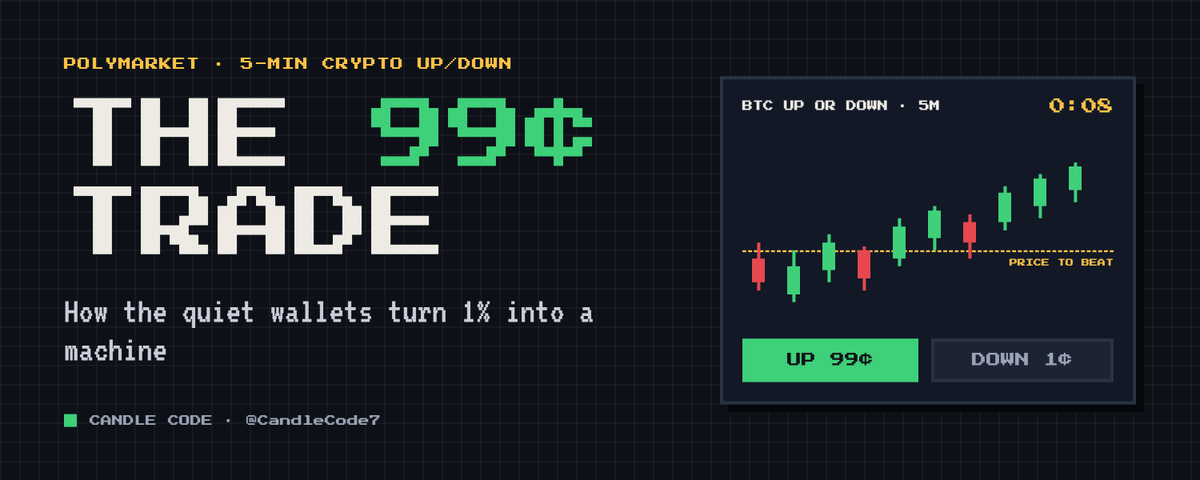
Two Polymarket trades both pay 40%. One is a far better trade.
Trade A: an Iran position that resolves in 2 months. Trade B: an NBA game that resolves in 2 days.
The return is the same, but B wins on everything else:
Your capital is free again in 48 hours and ready for the next trade
Less time means fewer surprises. A lot can happen in 60 days, not much in 2
The payout doesn’t shrink. Short-dated trades can still pay 40 to 60%
That’s why I focus on fast resolution, mostly NBA and NFL. A small deposit grows faster when the money keeps moving instead of sitting in one position for months.
Judge a trade by return per day, not by return alone.
Which would you take: 40% in 2 days or 60% in 2 months?

41

The best Polymarket wallet I’ve tracked doesn’t try to predict direction.
Tokor, since July:
1,947 markets
$9M volume
$940k profit
That’s 10.5% of volume, the best result of any wallet I’ve shared.
His edge is trading the extremes.
When the market charges 90¢ for “ETH won’t hit $4,500” or “BTC won’t drop to $50k”, he buys and waits.
At the other end he picks up cheap tails: ETH drop shares at 16 to 26¢.
Biggest open position: ETH to $2,000.
Entry 26.1¢, 228k shares, up 89%.
Best single trade: $454.9k from one market.
Would you copy a wallet that pays 90¢ to win 10? Profile in the reply

2
3
152
Tokor’s profile: polymarket.com/@tokor
Bookmark it if you’re building a copytrading watchlist. Not financial advice. Past results don’t guarantee future ones.

33


Candle Code retweeted

Claude now has a line item for “personal or off-topic.” Here is what’s in it🤨
Your admin can now see the bill for your off-topic Claude chats. Not the chats.
Claude Enterprise “smart reports” (generally available since Oct 28) include an Inefficiencies section: sessions that produced nothing usable, and sessions that were personal or off-topic.
What it shows: a count and a cost at list price.
What it does not: summaries or drilldown. Names show as “User” unless the company turns attribution on, and every reveal is logged. Reports are off by default.
A sample screenshot shows 18 off-topic sessions costing $217 vs 115 failed sessions costing $106. My math: about $12 per off-topic session vs $0.92 per failed one. (Screenshot source not confirmed.)
My take: a cost counter, not a spy cam. Anthropic says reports should not be used for performance reviews. A tech outlet notes nothing technical enforces that.
Is this a fair way to track AI spend, or too much oversight?