

Design is getting cheap. Production is where biology still dies. Building the instruments in between. CEO, Reshape Biotech (YC W21). Copenhagen.
Copenhagen, Denmark
Joined June 2023
- Tweets125
- Following111
- Followers34
- Likes58
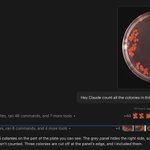


Anthropic just filed for IPO 🚀
Funnily enough, their IPO's page 3 has a picture of a plate.
Reshape Colony Counter App:
- 0.8s
- 74 colonies
- pretty much dead on
Claude Opus 5.5:
- 27 minutes(!!!!)
- 66 colonies
- Crafted +50 sub-images and still missed a few.
I've no doubt their IPO is going to be massive, it's still interesting how poorly Claude performs on something they're posting on the frontpage of their filing 😅
Biology is solved right?


1
1
54
Thanks to AI, biology doesn’t have a design problem anymore. It has a proof problem ☠️
The chart below shows the cost of sequencing a human genome. In 2001 it was around $100 million. Today it’s a few hundred dollars, about 180 000x cheaper. That’s why AI got so good at designing biology: it had cheap data to learn from.

4
1
31
I can’t believe some of our competitors are still doing product demos with pictures in slides.
Tech has progressed so much the last year, the divide between good and great companies is just going to widen.
So, to help and inspire others:
Here’s the demo of our world-class, 700 plates/hr, ~4x better AI-than-humans at finding pathogens, validated plate reader.
meanwhile, in bio: "nooo you can't just scale up a small scale fermentation it's way too complex"

1
83


Microbes in 4D. This is parts of the data feeding out detection algorithms to figure out which organism is which, allowing us to annotate billions of microbes automatically.
6
48
@VenomResearch is an insanely cool company working on next-level insecticides for the fields.
This timelapse looks so crazy cool. Love to see it.
31
Biology is the most complex technology that exists, and today, we're capturing less meta-data than we do for marketing leads.
We need a step-change in how biology is done if we want the H100's to have any significant effect.

Every tech VC wants to believe that drug discovery is now a function of compute. They think if we throw enough H100s at the problem, tokenize enough dead sequences, and scale virtual cells, biology will be 'solved'.
They are wrong.
Drug discovery is not a function of compute. It is a function of measurement.
40

This is a co-inoculation study. Two (or more) microbes on the same plate, then you let them sort it out.
Alone, a colony tells you what it can do. Together, they tell you what they do to each other. Very different information.
Three things to watch:
– the two pink colonies grow into each other and fuse. Same strain, no fight.
– a no-man's-land opens where olive meets pink. Something diffusing through the agar is stopping growth.
– the pink edge facing the olive turns red, and the agar browns. That's the chemistry of whatever this is producing
38
I love seeing the science behind the industries. Agriculture is run on seeds, and a lot of work is going into how we treat them and control nutrients.
25
Synbio raised $18 billion in 2021.
As much as the whole field had raised in the twelve years before it. In one year.
Two years later: Zymergen, $1.3B raised and a $3B IPO, sold for $300M. Amyris, bankrupt. Ginkgo, down ~87%.
I think that everyone's got a theory - mine is quite boring: none of them died in the lab. They died on the way to market.
Zymergen's own IPO filing said it had no commercial-scale manufacturing. Its first product worked in the lab and failed inside customers' factories. That's not a design problem.
That's a production problem.
Now the AI labs are racing to design proteins and organisms, and the decks look exactly like 2021: better designs, faster. Nobody is asking the boring question. Who is going to produce this stuff, at a cost that works, before the money runs out?
Design is getting cheap. Production is still where biology goes to die.
We don't want a repeat of the last synbio-push, we want to actually succeed this time around. If you're passionate about this problem, we'd love to talk!
55
There are two versions of 2050. / In one, fossil carbon still makes most of our chemistry. / In the other, biology makes it. In tanks. From renewable feedstocks. Anywhere on Earth. / The hard engineering problem between them: scale-up. / We're on it — and we need tanks. 🧵


Design experiment -> Throw it inside a smart incubator -> Get insights
If you design your experiment correctly, everything else should come automatically.
We've seen sooo many scientists spend hours on end capturing data, generating metrics, doing the statistics, making graphs.
So now we're opening up some of our cool tech that we've built in-house to the public in our organism library.
Next up is bringing these insights back into your design of experiments. If you already have data available, why not have it on hand the second you need it?
24
In 2025, software engineers are having the same moment mechanical engineers had in 2017.
China owned the world in manufacturing 🧵
6
1
27
Microbio is at least 20 years behind all other areas of tech. We need smarter people working on bio, and especially on making tools for accelerating research.
We just made the smart incubator. Basically the bare minimum tooling to get actually good data.
1
26
IFL digital incubators and AI models
We've just released a new microbiology model that's pretty bonkers
28
