Some of Canada’s most important stories are still waiting to be told.
Telling Canada’s Stories invites Canadians to share the life of a historical figure whose contributions deserve greater recognition. Submit a short video or written post and help preserve a broader record of the people who shaped this country.
Share your story: buff.ly/OTVpkFT
#TellingCanadasStories #CanadianHistory #HistoryMatters #CIHE
The first game in NBA history wasn’t played in New York, Boston or Los Angeles.
It was played in Toronto.
On this day, November 1, 1946, the Toronto Huskies hosted the New York Knickerbockers at Maple Leaf Gardens. Eighty years ago tonight, 7,090 spectators watched the opening game of a league that would become a global sporting giant.
Technically, it was then called the Basketball Association of America. In 1949, it merged with the National Basketball League to form the NBA, which recognizes that Toronto matchup as the first game in its history.
New York’s Ossie Schectman scored the opening basket. The Knicks won 68–66.
The Huskies lasted just one season. But their brief existence gave Toronto a place at the very beginning of professional basketball’s biggest league, nearly half a century before the Raptors arrived in 1995.
There’s a Canadian thread running through basketball’s story: Canadian-born James Naismith invented the game, Toronto hosted the NBA’s first contest, and the Raptors brought its championship trophy north in 2019.
Long before Jurassic Park, there were the Huskies.
Did you know the NBA’s story began at Maple Leaf Gardens?
#Canada #History #Culture #raptors #canadianhistory #nba
CANADA’S HUNDRED DAYS: THE ROAD TO REMEMBRANCE
Part 1: The final push
We remember the hour the guns fell silent. But what happened in the months before?
On August 8, 1918, Canadian soldiers joined a major Allied attack at Amiens, France. After years of devastating trench warfare, the breakthrough helped launch a series of offensives that would bring the First World War to an end.
We know this period as Canada’s Hundred Days.
From Amiens to Arras, across the Canal du Nord and onward to Cambrai, Valenciennes and Mons, the Canadian Corps played a leading role in the Allied advance. Its achievements depended on hard-earned experience, careful planning and coordination among soldiers, artillery crews, engineers and other supporting forces.
But as victory drew closer, the sacrifice continued.
Thousands of Canadians were killed or wounded during those final months. Behind every advance were people whose families were waiting for them to come home.
In the days leading to November 11, we’ll follow the road from Amiens to the Armistice—exploring the battles, the people and the cost of the final push.
Did someone in your family serve in the First World War? If you’re comfortable sharing, tell us what you know about their story.
#HistoryMatters #CanadasHundredDays #RemembranceDay #CanadianHistory #LestWeForget
A single name can make remembrance deeply personal.
R.H. Thomson recalls families gathering through the night to see their relatives’ names projected onto the National War Memorial.
Listen to the full episode and subscribe: buff.ly/VI2RBjY
#HistoryMatters #CanadianHistory #Remembrance #RHThomson
This Week in History | When Canada Went to War in South Africa
If Britain went to war, did Canada have to follow?
In October 1899, that question divided a country still finding its place within the British Empire.
On October 30, roughly 1,000 Canadian volunteers sailed from Quebec City for the South African War, also known as the Boer War. It marked Canada’s first official dispatch of troops to an overseas war.
Many English-speaking Canadians saw participation as a duty to Britain—and an opportunity for Canada to prove itself. Many French Canadians opposed fighting an imperial war far from home. Critics also questioned why Canadians should be committed without a parliamentary debate.
Prime Minister Wilfrid Laurier sought a compromise: Canada would equip and transport volunteers, while Britain would pay for the bulk of their service overseas. He insisted the decision should not set a precedent.
But Liberal MP Henri Bourassa disagreed, resigning his seat in protest. He feared Canada was accepting obligations that would draw it into future British wars.
Historian Réal Bélanger, writing in the Dictionary of Canadian Biography, explains that Laurier faced pressure from both sides: Bourassa opposed the commitment, while imperialists accused the prime minister of doing too little. The compromise exposed competing visions of Canada’s future—close integration with the Empire or greater freedom to choose its own course.
The soldiers were heading to South Africa. Back home, Canadians were debating who should decide when—and why—their country went to war.
#CanadianHistory #SouthAfricanWar #WilfridLaurier #HistoryMatters #CIHE
150 years ago, Canada passed a law that gave Ottawa extraordinary control over the lives of First Nations people. That law is still in effect today.
This week, Manitoba Premier Wab Kinew called for an end to the Indian Act, one of the oldest and most controversial pieces of legislation in Canadian history.
But what exactly is the Indian Act, and why does it still exist?
A brief history.
Passed in 1876 under Prime Minister Alexander Mackenzie, the Indian Act consolidated earlier colonial laws governing First Nations people and their lands.
Its underlying objective was assimilation: to gradually absorb First Nations people into Canadian society, often at the expense of their cultures, traditions and systems of government.
Over the following decades, the Act and its amendments gave the federal government sweeping powers:
• Ottawa determined who legally qualified as an "Indian," creating a system of registration and identification that continues today.
• Traditional First Nations governance structures were displaced or undermined by federally imposed systems of administration.
• Cultural and spiritual ceremonies, including the potlatch and Sun Dance, were prohibited.
• First Nations women who married men without Indian status lost their legal status, while men who married non-Indigenous women did not face the same consequence.
• The Act became one of the legislative instruments used to enforce compulsory attendance at residential schools.
Did the Indian Act apply to all Indigenous peoples?
No. This is an important distinction. The Indian Act primarily governs First Nations people. Inuit and Métis are distinct Indigenous peoples whose legal relationships with Canada developed differently.
The Act was amended repeatedly, including major reforms in 1951 and 1985 that removed some of its most discriminatory provisions.
Yet its fundamental framework remains.
So why not simply abolish it?
The answer is complicated.
While the Indian Act has long been criticized as an instrument of colonial control, it also establishes certain federal obligations and legal protections concerning First Nations lands, governance and status.
Repealing it without an agreed replacement could put important rights and protections at risk.
That is why many First Nations leaders argue that any replacement must be developed with First Nations themselves, recognizing their treaty rights and right to self-government.
150 years after its introduction, Canada is still debating how to replace it.
Understanding that history is essential to understanding the debate today.
Further reading: For those interested in exploring this history, we recommend John F. Leslie's The Indian Act: An Historical Perspective (2002), which traces the development of the legislation, and First Nations author Bob Joseph's 21 Things You May Not Know About the Indian Act (2018), which examines its lasting impact on Indigenous communities and the path toward self-determination.
#CanadianHistory #IndianAct #FirstNations #IndigenousHistory #HistoryMatters
Behind every casualty count is a name.
R.H. Thomson explains how The World Remembers connects families with those lost in the First World War, across national borders.
Listen to the full episode and subscribe: buff.ly/VI2RBjY
#HistoryMatters #CanadianHistory #TheWorldRemembers #RHThomson
The Great Depression didn't just change who governed Canada. It changed what Canadians expected from their government.
In 1935, Canadians voted out R.B. Bennett's Conservatives and brought Mackenzie King's Liberals back to power.
But the bigger shift happened over the following years. With provinces and municipalities overwhelmed, Ottawa gradually took on a greater role, including the introduction of unemployment insurance in 1941 and family allowances in 1945.
These changes helped lay the groundwork for Canada's modern social safety net.
For more on the 1935 election, check out historian David MacKenzie's King and Chaos: The 1935 Canadian General Election.
Explore more Canadian history at cihe.ca
#CanadianHistory #GreatDepression #HistoryMatters
Why has former PM Robert Borden been forgotten?
On Monday, author J.D.M. Stewart spoke to Friends of CIHE Halifax about the prime minister that presided over Canada during WW1.
Hear the entire talk on our website at buff.ly/WcTagTz
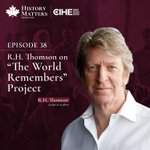
In Episode 38 of History Matters, Allan Williams welcomes actor and arts advocate R.H. Thomson to discuss his book, By the Ghost Light: Wars, Memory, and Families, and his international commemoration project, The World Remembers.
The conversation explores his family history and the letters of his great uncles who served in the First World War, the challenges of compiling millions of names across more than 30 nations, and the power of remembering each person individually.
They also discuss war’s lasting effects on families and women, and how Remembrance Day can become more inclusive.
🎧 Listen to Episode 38 and explore more Canadian history at cihe.ca.
#HistoryMatters #CanadianHistory #RemembranceDay
October 29, 1929: Wall Street crashed. Canadians paid the price.
You didn’t have to own a single share to lose your livelihood.
On Black Tuesday, panic swept the New York Stock Exchange. The crash became a noteworthy contributor to the Great Depression, exposing economic weaknesses that would bring years of hardship to Canada.
For a country dependent on selling wheat, lumber, minerals and other resources abroad, collapsing demand was devastating. Businesses closed. Workers lost their jobs. Families who had felt secure suddenly struggled to pay rent and put food on the table.
In The Great Depression: 1929–1939, Canadian historian Pierre Berton argues that the suffering was compounded by political leaders who failed to respond boldly enough to mass unemployment, drought and despair. His account brings the crisis down to human scale: families dependent on relief, young men travelling in search of work, and unemployed Canadians protesting for a better deal.
Through Berton’s lens, the story becomes a question of responsibility: what should a country do when so many of its people can no longer earn a living?
On the Prairies, economic disaster collided with drought. Wheat prices plunged as crops withered and topsoil blew away. Farmers faced debts they could no longer repay, and some abandoned their land altogether.
By 1933, roughly one in five Canadian workers was unemployed. Canada’s banks survived, but that offered little comfort to families without a paycheque.
There was no national unemployment insurance. People turned to relatives, charities and local relief offices. Assistance could depend on where you lived, whether you were married and whether officials considered you deserving. Single men and women often faced particular barriers.
The Depression changed more than Canadians’ finances. It challenged the belief that poverty was simply an individual failure and helped reshape expectations of government’s responsibility when livelihoods disappear.
A financial collapse in another country had reached into Canadian kitchens, factories and farms.
#CanadianHistory #GreatDepression #OnThisDay #HistoryMatters #CIHE
How Canada Avoided a Pension Crisis
As protests grip France, questions about economic fairness between generations are once again making headlines.
One longstanding source of tension is France's "pay-as-you-go" pension system, where today's workers finance the pensions of today's retirees. As the population ages, the financial burden on younger generations grows.
Canada once faced a similar problem. But nearly 30 years ago, our governments made a difficult decision that helped secure the country's financial future.
Established in 1966, the Canada Pension Plan (CPP) initially relied largely on contributions from current workers to pay retirees.
By the mid-1990s, government actuaries warned that the CPP's reserve fund could be exhausted by 2015. Without reform, combined employer and employee contribution rates were projected to reach 14.2% by 2030.
In February 1997, Finance Minister Paul Martin warned Parliament:
"The problems facing the CPP are fundamental."
He explained that younger Canadians faced the prospect of paying more than twice as much into the system without receiving greater benefits.
Under Prime Minister Jean Chrétien, Ottawa and the provinces agreed to overhaul the CPP.
Contributions would rise, reaching a combined 9.9% by 2003. Benefits were adjusted, and an independent investment board was established to invest pension funds and help finance future retirement benefits.
University of Toronto economist James E. Pesando, writing in his 2001 analysis *The Canada Pension Plan: Looking Back at the Recent Reforms*, observed that the case for reform rested largely on intergenerational equity.
The central question wasn't simply how to save the pension system. It was how to avoid leaving an unfair financial burden for future generations.
Nearly 30 years later, the CPP reforms remain one of Canada's most consequential fiscal policy achievements.
While France continues to grapple with pension sustainability, Canada's experience offers an important historical lesson: sometimes good government means confronting tomorrow's problems today.
And sometimes, history reminds us of what Canada got right.
#HistoryIsHappeningAgain #CanadianHistory #CanadaPensionPlan #EconomicHistory #HistoryMatters
Photo By FreCha - Own work, CC BY-SA 4.0
What if Canada–US friendship was the exception?
Madelaine Drohan revisits a history of conflict between neighbours.
Explore the discussion on CIHE’s event page: cihe.ca/2026/10/01/250-years…
#CIHE #CanadaUS
Here is the live link: cihe.ca/cihe-live-stream/?ut…
Talk tonight is streaming online.
cihe.ca/cihe-live-stream/?ut…
🍁 On This Day | October 26, 1813 l The Battle of Châteauguay
An American army was advancing toward Montréal. Capturing the city would help cut the supply lines supporting the defence of Upper Canada.
Along the Châteauguay River, Lieutenant-Colonel Charles-Michel de Salaberry prepared to block its path. His defenders included French-Canadian Voltigeurs, Canadian Fencibles, militia and Indigenous allies. About 300 occupied the forward position, with a larger reserve behind them, facing an American force of roughly 3,000.
Salaberry used the wooded terrain to his advantage, creating barriers of felled trees. During the fighting, he ordered bugles sounded from different directions and his men to shout—making the defenders seem more numerous than they were.
The deception helped unsettle the attackers. By afternoon, American commander Wade Hampton ordered a withdrawal. His troops crossed back into the United States days later.
Châteauguay helped protect Montréal and thwart the American invasion campaign. It also demonstrated the crucial role of French-Canadian soldiers and Indigenous allies in defending the territory that would become Canada. Parks Canada describes the victory as a “national triumph for Lower Canada.”
A battle where Canada’s defence drew on different peoples, working together.
#OnThisDay #CanadianHistory #Châteauguay #WarOf1812 #HistoryMatters #CIHE
#OTD | October 25, 1993
The election that redrew Canada’s political map.
From 169 seats in the 1988 election to just two in 1993. The Progressive Conservatives’ collapse was staggering.
On October 25, Jean Chrétien’s Liberals won a majority with 177 seats. The governing PCs, led by Kim Campbell, nearly disappeared from Parliament. Campbell lost her own seat.
Meanwhile, Preston Manning’s Reform Party won 52 seats, drawing strength from the West. Lucien Bouchard’s Bloc Québécois won 54—all in Quebec—making a party committed to Quebec sovereignty Canada’s Official Opposition.
Historian John Douglas Belshaw, in Canadian History: Post-Confederation, writes that the near-disappearance of the PCs, alongside the NDP’s poor showing, “ushered in a new era in Canadian federal politics.” His analysis traces how Reform eroded the Conservatives’ Western base and helped change the direction of Canadian conservatism.
The deeper transformation was the fragmentation of national political coalitions. As political scientist Lynda Erickson argued, Reform and the Bloc challenged the established practice of building governing parties that combined support in Quebec with votes across English-speaking Canada. Regional divisions now found powerful expression through separate parties in Parliament.
What do you remember about election night in 1993?
#OnThisDay #CanadianHistory #HistoryMatters #CIHE
LAST CALL FOR TOMORROW’S EVENT: “Indomitable Spirit”: Robert Borden and Halifax
Join the Canadian Institute for Historical Education on October 26 for “Indomitable Spirit”: Robert Borden and Halifax, featuring J.D.M. Stewart, historian and author of The Prime Ministers: Canada’s Leaders and the Nation They Shaped.
The presentation will explore Borden’s personality and premiership, his leadership during the First World War, and his connection to Halifax, including important speeches delivered in the city and his response to the Halifax Explosion in 1917.
📍 Lindsay Children’s Room, Halifax Public Library, 5440 Spring Garden Road, Halifax
🕖 Monday, October 26 | 7:00 PM Atlantic
💻 Attend in person or watch via livestream
🎟️ Free admission; donations welcome
Learn more and register: cihe.ca/eventcalendar/indomi…
#CanadianHistory #RobertBorden #Halifax #CIHE
History is happening again.
October 24: UN Day and Canada’s Middle-Power Moment
How does Canada make itself heard in a world dominated by larger powers?
On October 24, 1945, the United Nations officially came into being. Canada was a founding member, emerging from the Second World War with a growing role in international affairs.
Canada’s approach became known as middle-power diplomacy: building influence through alliances, skilled negotiation and institutions that gave countries a way to act together. Supporting those institutions also served Canadian interests, helping balance our relationship with the much more powerful United States. Lester Pearson helped shape that approach through his work at the UN and in building NATO.
Its defining test came in 1956.
When Israel, Britain and France attacked Egypt during the Suez Crisis, Canada faced a dangerous fracture between its allies. Pearson, then secretary of state for external affairs, helped advance a practical solution: a United Nations Emergency Force to supervise a ceasefire and withdrawal.
Working with UN Secretary-General Dag Hammarskjöld and other countries, Pearson helped establish the UN’s first large armed peacekeeping force. Diplomacy created a way out of the crisis. His contribution earned him the 1957 Nobel Peace Prize.
This was no solo Canadian achievement. Its success depended on international support, negotiation and the willingness of countries to make a new institution work.
Seventy years later, the circumstances are different, but the question feels familiar: can Canada turn partnerships and practical ideas into influence when the international order is under strain?
This UN Day, what would an effective Canadian middle-power role look like today?
#HistoryIsHappeningAgain #UNDay #CanadianHistory #LesterPearson #HistoryMatters
A revolution crushed in Hungary. Thousands of new beginnings in Canada.
On October 23, 1956, Hungarians rose against Soviet domination, demanding political reform and independence. Soviet forces crushed the uprising in November, sending thousands fleeing across the country’s borders.
In 1956 and 1957, Canada welcomed more than 37,500 Hungarian refugees. Public sympathy helped drive an extraordinary response: the federal government eased admission procedures, helped arrange transportation and worked with voluntary organizations to help newcomers rebuild their lives.
Among those who arrived were George Jonas, the future author and journalist whose book Vengeance inspired the film Munich, and Frank Hasenfratz, who would establish manufacturing giant Linamar.
Another child displaced by the uprising, Robert Lantos, eventually reached Canada in 1963 after his family first found refuge in Uruguay. He would become one of this country’s most influential film producers.
Their stories are part of a much larger history of families finding safety, building communities and contributing to their new country.
Canada’s response also helped establish a model for future refugee resettlement. An international crisis changed lives abroad, and helped change immigration policy and attitudes at home.
Seventy years later, the recurring question remains: how does our response to people fleeing conflict shape the country we become?
#HistoryMatters #CanadianHistory #HungarianRevolution #CIHE
REMINDER FOR FRIDAY'S BOOK LAUNCH EVENT:
Wartime secrets. Stolen radium. A scandal with consequences reaching into Toronto neighbourhoods.
During the Second World War, Canada’s Eldorado Mining and Refining supplied uranium to the Manhattan Project, helping develop the atomic bomb. Behind that historic contribution lay another story: fraud, weak oversight and secrecy that delayed justice for decades.
In their new book, In the Shadow of the Manhattan Project: Radium, Fraud, and Secrecy at Eldorado, historians Patricia I. McMahon and Robert Bothwell uncover this remarkable chapter of Canadian history.
What happens when national security puts accountability in the shadows?
Join CIHE and both authors for the Toronto book launch and discover a story whose questions still resonate today.
📅 Friday, October 23, 2026
🕖 7 p.m.
📍 Gatherings Resto Bar, 49 St. Clair Avenue West, Toronto
RSVP here
buff.ly/jPM2G8V
#CanadianHistory #TorontoEvents #BookLaunch #HistoryMatters
Join us tomorrow for the Toronto book launch of "In the Shadow of the Manhattan Project: Radium, Fraud, and Secrecy at Eldorado" with co-authors Patricia I. McMahon and Robert Bothwell! 📚✨
Uncover the gripping story of stolen radium, wartime secrecy, and Canadian legal history.
🗓️ Friday, October 23, 2026 ⏰ 7:00 PM – 9:00 PM 📍 Gatherings Resto Bar (49 St. Clair Ave W, Toronto) 🎟️ Free Admission, Refreshments provided
Details & RSVP: buff.ly/Bqha0lt