नेपाली 🇳🇵 . Marrying with Low Risk Entry point . Strategy over Emotion . Deliberate Creator Choosing the profession of a Professional Gambler.
Joined August 2023
- Tweets1.9K
- Following526
- Followers1.2K
- Likes48.5K





Thrifty_Chartist retweeted

Jesse Livermore made and lost fortunes multiple times.
Stan Druckenmiller shorted $200M worth of internet stocks in 1999 and lost $600M within weeks. Every one of those companies eventually went bankrupt. He was right about the businesses but was wrong on timing.
Kristjan Kullamägi grew his account to $105M, then gave back nearly $60M in about eight months.
Dan Zanger turned a five-figure account into $42M, then reportedly suffered a 75% drawdown.
Paul Tudor Jones lost 60 to 70% of the equity he was managing on a single cotton trade. He nearly quit trading.
These are some of the greatest traders to ever do it. People who understood markets better than most ever will. None of that made them immune to devastating losses.
I was doing my usual re-listen of “Best Loser Wins” by Tom Hougaard, and two stories really stayed with me.
One was about Adam, a brilliant trader with extraordinary patience and discipline. He had built great wealth through his trading. Then one heavily leveraged trade went wrong and wiped out nearly half of it.
But that loss alone wasn’t what destroyed him. It was his inability to accept it and move on. He abandoned the discipline that made him successful in the first place, started doubling down, and desperately tried to make it all back fast.
He went on to lose everything. His money, his home, his family. He ended up homeless.
Then Hougaard talks about another friend who had been trading full-time for 15 years.
He never made “f**k you” money. He earned what someone in a well-paid corporate job would. He paid his bills, took his family on vacations, bought a nice car, and was home when his kids got back from school.
We spend so much time admiring huge returns and huge accounts. And rightfully so. They’re worth admiring, even aspiring to. But we rarely talk about what it takes to keep what we’ve made, or what we’re willing to give up chasing more and more.
Very very few end up as Market Wizards. Then there is the guy who is home when his kids get back from school.
Thrifty_Chartist retweeted

Unemployed at 23.
Broke at 25.
Starting over at 27.
Millionaire at 30.
Don’t underestimate what God can do in your life.
Philippians 4:13. xitter.gq/btwnthuts/status/20741…
Thrifty_Chartist retweeted

The only way to make big strides in your trading performance is via a quantifiable adjustment of your statistical trading behavior.
It's perfectly normal to experience losing weeks, months, or even quarters. The key is to remember that trading is a long-term endeavor. The 'holy grail' everyone seeks begins with shifting focus from just solely studying charts to also analyzing your trading statistics. This is the only way to identify and fine-tune your issues on a law of large number perspective.
Your good and bad trading behavior can't escape your journal if you are diligent with this process. Some things you can start identifying;
1. That 1-3 days duration (MoM) that you are 'hyper' actively executing new position, what is the spot of the market index? what was the previous 10 days trend at breadth level? Are the outcome desirable? If not, that's a major area you could fixed immediately.
2. Track your longest consecutive losing streaks every month. My average is around 11 to 13 (yes 13 straight losses, it's normal for me). There was a standout recent month in 2023 where the number was 25 (That's +200% more than my usual proficiency), and I was able to correct the issue immediately the following month (back down to 11) from such end of month review. What the journal told me was my losing streak largely stern from 13 new trades in 3 days when $SPY was already extended from 10 and 20-MA spot, which all got stopped out within a 2 days period from a minor pullback. That 'chasing' behavior was largely because I just came out of a losing month when most are profitable (i knew because my ranking dropped out of top 10 in USIC period while those within my placing +gain% in performance).
3. Work on reducing your average R loss, and track the progress MoM. You need to accept that outcome of a trade cannot be controlled, but you can absolutely control your risk. A reduced average R loss is another method to push your up your monthly profit factor. If you size your risk via R-concept approach, the conventional understanding is stop loss is equivalent to 1R loss. Be creative, you can reduce this number easily via scaling down size in unprofitable trades even before it hit the eventual stop. In my experience, my best trade are often the ones that never re-visit your entry-stop range, it will just go and give your a tidy profit by day #1 market close.
4. Track the progress of your monthly Profit Factor (I use R factor so Avg R Gain / Avg R Loss). Improvement stern from this number. Don't be satisfied with catching 1 big winning trade, that is not trading proficiency. If I were to hire, I will hire someone not making money but with PF improvement for 6 consecutive months. It is just a matter of time he becomes a money printing machine.
5. Your monthly Max R loss (maximum $ loss also). Go study it and find out the reason why you lose more than you expected. It is a good reminder not to let such behavior repeat again because these are potential account blow up behavior. My max R loss was -8.4 in a single trade 7 years ago. It was an execution prior to earnings with a perfect setup that seemingly meant for a gap up, I was wrong but i never allow myself to be in that spot again. My last 5 years max R loss is only at -2.45 on an unannounced earnings guidance (warning), unavoidable.
Breaking down and studying your trading journal is really necessary. If you are not doing the above 5, which imho are the most impactful to your performance and proficiency growth as a trader, you can only blame yourself if you don't make it.


Thrifty_Chartist retweeted

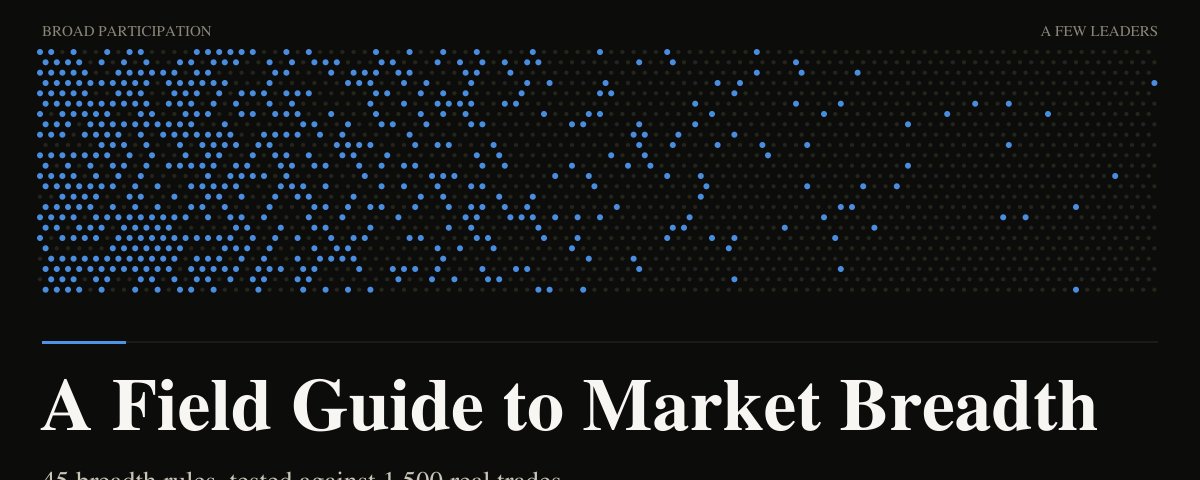
Market breadth: what actually works.
I tested 45 rules against 1,500 logged breakout trades. the Stockbee Market Monitor, new highs vs new lows, $MMTW, McClellan, % above the 20-day.
Which ones help, when they help, and when to ignore all of it.
Thrifty_Chartist retweeted
Books changed my life.
I may have dropped out of school, but that doesn't mean I'm uneducated. Quite the opposite. My personal library contains more than 4,000 books, and I've read every one of them.
Long before I could afford to buy books, I spent countless hours at my local library—week after week, year after year—for more than a decade. That library became my classroom, and books became my mentors.
I never finished school, but I never stopped learning. One idea, one lesson, or one page from someone with real experience can inspire and change the direction of your life.
That's why I write books today. I know firsthand the power of learning from someone who has actually walked the path and achieved real results. A great book can change the trajectory of a life, just as it changed mine.
Learn. Do. Achieve. Inspire. Pass the torch.
minervini.com

Thrifty_Chartist retweeted

There was Xabi Alonso, Xavi, Iniesta & that could have been enough but Busquets was the fulcrum on which every one of them revolved. Yes Rodri has more skill-set & that makes him a more complete footballer. But if we are talking of the CDM role/position, Busquets edges him for so many reasons:
— Busquets’s game-readability is the highest you can ever get. This makes his positioning cleaner than Rodri’s athleticism. Busquets didn’t have to be pacy/depend on physical duels. He was already at the hot areas. He could see it before anyone; he puts off the smoke before the fire. Pep Guardiola said Busquets is going to be a great coach because he solves everything in his head.
— Scanning & Press resistance: See, very few players in that position could evade trouble like Busquets. One time, Koke Resurreccion said that Busquets communicates to you with his pass. When he passes it to you when you are facing him, he wants you to reset it; by the side, he wants you to turn and so on. Not only that he evaded trouble, he helped his teammates evade that trouble. Remember the famous quote: “If you watch the game, you don't see Busquets. If you watch Busquets, you see the whole game”.
— A blueprint of the modern #6. Busquets redefined the role. So much so that Yaya Toure discovered that his best zone of impact was the CM. Pep made sure Busquets was the priority CDM because he could simply play the role better. Even Rodri thrive there today because Busquets walked so he could run. In fact, Busquets was the most irreplaceable piece from the prime Barcelona.
Yes, Rodri’s Ballon d'Or, Euro Player of the Tournament, and World Cup player of the Tournament give him an outstanding individual award cabinet. But at the core of it all where Xavi & Iniesta were playing, Busquets didn’t have the leadership responsibility & couldn’t have been seen as a lead for his team.
But a certain Luis Enrique made Busquets the CDM & Rodri the CB when it was time for both to play in the same team.
Respect The Octopus.

Thrifty_Chartist retweeted
came across a discussion & there's a misconception between 'Trading For A Living' and being a 'Full-Time Trader'
TFAL is the ultimate grail. it is extremely difficult to achieve even being profitable to a 7-fig trading a/c for 8yrs (I'm in #fintwit for 12 yrs 😅)
let me explain
Thrifty_Chartist retweeted

Barcelona fans are actually getting that Spain vs. Argentina final. xitter.gq/Bitcoin_Teddy/status/2…
Thrifty_Chartist retweeted

"Final 1978":
Por la final Argentina - Holanda remasterizada de 1978 4K perfecta, se cagaron a palos
xitter.gq/futnostalgico/status/2…
Thrifty_Chartist retweeted

📈 $RIDI on watchlist!
breakout above the pivot with strong volume could signal the next move. Always wait for confirmation and manage risk.
Strong uptrend ✅
Tight consolidation ✅
Volume drying up in the base ✅
#RIDI #NEPSE #SHAREMARKET #NEPAL #HYDRO #TRADER #SHAREBAZAR

Thrifty_Chartist retweeted

The World Cup has been absolutely butchered as a concept - something that used to be widely anticipated as the pinnacle of sport has been completely hijacked by the worst people on the planet. I honestly wouldn’t go to any game, including an England final, if you paid me.


Thrifty_Chartist retweeted
Low risk.strong trend.tight setup.high probability! acc to @Chartist45 never approaching stock below 200MA,low adr,>50rs,,blaaahh. hey bro this stock #SAHAS meet all #strictrule,you want. aba jagga hanne hola ni ??haha😂😂
#NEPSE #SAHAS


Thrifty_Chartist retweeted

Read the Market Wizards chapter on Kristjan Kullamägi this weekend. The one section that really stood out was when he discussed his drawdown off of his 2021 peak.
"I started 2020 with $3.5 million and ended the year at $36 million. It was a thousand percent year. Then I ran that $36 million to a high of $105 million, and the last portion of that move from $65 to $105 million occurred in just a month and a half. For a brief period, just a few days, I was over $100 million. You have to understand what that did to my psyche. It made me feel completely detached from reality. I thought, “I’m going to get to $200 million in six months.” I was completely sure of that. I started seeing trading as a video game, which I kept winning.
Measured from my $105 million peak in November 2021 to my mid-2022 low, I lost approximately $60 million. About half of that loss represented the late 2021 retracement of the large open profits at the November peak to the stops on those positions. The initial retracement loss was so large because I was leveraged long at my peak. My long exposure was $150 million—a number I recall because I remember bragging about it to a friend"
These boom and bust type tales are as old as time. Look at Jessie Livermore as the classic example. Net worth of $0 in 1906 to a peak of $1.6 billion (inflation adjusted to 2021 dollars) in 1929. Just 5 years later he blew up and owed $104 million dollars to his brokers...
Or look at Paul Tudor Jones. Hit one of the most legendary trades in history, making roughly $200 million dollars during the 1987 crash. It cemented him as a legend. His mental coach Tony Robbins said that Jones consistently lost money for the next 4 years after that peak.
Dan Zanger parlayed $10,000 into $42 million during the late 90's. Then in late 2000 he took a 70% drawdown when he was 200% long 3-4 fiber optic stocks as the dot-com bubble was popping.
Charles Harris reached 8-figures status after he ran up his account over 4,000% from 2020-21, then experienced a -80% drawdown, mostly due to his big TSLA bet in 2021-2022.
I have seen a few people speculating on Kristjans story from the outside. Saying "I would have stopped trading at $100 million" or "I would have just taken that money and started investing". To those people I ask if you have ever experienced a real euphoric run in your trading account, let alone turning 5k into 100mil? Extreme winning streaks like the ones above breed overwhelming euphoria and overconfidence. The mind shifts its focus from process to outcomes, with ego-driven decisions overriding risk parameters and rules. From my experience I have found it near impossible to be aware of this at the peak of the run. It is almost like you are blacked out and the greed/ego completely takes over your trading.
Then the drawdown begins. The emotions shift from euphoria and greed to revenge, fear, and doubt. This is where things can really start to spiral out of control. It is only after the drawdown has run its course that you finally come back to your senses and your emotions drift back towards baseline levels. Then all you're left with is regret...
Few people ever talk about what a big winning streak can do to you. It can literally change the way you think and operate. Often the ability to achieve super returns is also its biggest drawback—a true double-edged sword. To be able to conquer both sides is the holy grail...
From the Hour Between Dog and Wolf by John Coates:
"When traders enjoy an extended winning streak they experience a high that is powerfully narcotic. This feeling, as overwhelming as passionate desire or wall-banging anger, is very difficult to control. Any trader knows the feeling, and we all fear its consequences. Under its influence we tend to feel invincible, and put on such stupid trades, in such large size, that we end up losing more money on them than we made on the winning streak in the first place. It has to be understood that traders on a roll are traders under the influence of a drug that has the power to transform them into different people."