

Ex-academic data coach helping researchers and teams build confident R skills, using AI to assist, not replace you. Founder @DataSharpAcadem. Here to help.
Europe
Joined November 2012
- Tweets553
- Following611
- Followers414
- Likes340





Pinned Tweet
After the last successful 𝗥 𝗙𝘂𝗻𝗱𝗮𝗺𝗲𝗻𝘁𝗮𝗹𝘀 𝗳𝗼𝗿 𝗗𝗮𝘁𝗮 𝗦𝗰𝗶𝗲𝗻𝗰𝗲 workshop a month ago, I decided to revisit all my slides, exercises, and outline.
As I keep teaching this class, I understand more and more what the participants expect and where they come from.

1/3 The person best placed to solve one doctoral candidate's data problem may be another candidate in the same network.
One may know visualisation. Another coding, statistics or data management. But they need shared foundations to help one another.

2/3 Repeated network-wide training creates peer learning and knowledge exchange across projects, institutions and disciplines. Candidates become less isolated, and technical discussions can grow into scientific collaborations.
3/3 Not every technical question then lands on a supervisor's desk. Training should turn individual PhD projects into a functioning network. I can help design it. DM me or email [email protected].
1/3 One data workshop will not create a common data culture across an MSCA Doctoral Network. Candidates return to different institutions, datasets and problems. They need a programme that develops alongside their research.

2/3 I spent 15 years as a researcher. I often meet people only after their experiments are complete, trying to salvage what they can from the data. I can help then. But I can do much more before the important decisions have been made.
3/3 Research brings delays, imperfect data and changing questions. A strong training structure survives them: shared foundations keep the network aligned; later training responds to real needs. Let's talk: [email protected].
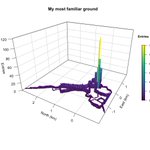
I’ve fallen back on my favourite procrastination exercise: making maps.
There’s something fun about making my own instead of handing the job to an app that decides how my data should look.
My latest notebook entry: manuelchevalier.com/running-… 📓

1/3 Your MSCA Doctoral Network should not leave every candidate to invent their own way of working with data. Give them shared foundations in R and Python from the beginning.

2/3 The goal is not to turn them into software developers. It is to make them independent enough to understand their work, evaluate results and collaborate. These technical skills are also transferable skills that improve employability.
3/3 "We will provide data-analysis training" is a promise. A structured, network-wide curriculum is a credible plan. I can design it with you. DM me or email [email protected].
1/3 Writing an MSCA Doctoral Network proposal? Build data training in from the start, not after data collection. Once the data exist, some important decisions cannot be undone.

2/3 A credible, network-wide programme connects experimental design, data management, analysis, reproducibility, FAIR data and open sharing. It should complement local training, not duplicate it.
3/3 I can help design and deliver that programme around your network's research and candidates. The initial discussion carries no commitment. DM me or email [email protected].
Today I received this on a mailing list: "We are expanding our team at the Department of XXX in XXX and are opening a semi-permanent full-time Research Scientist position starting in 2027"
I must be getting dumb, but could someone explain the concept of a semi-permanent job?
In a few weeks, I need to be teaching some AI to master's students for 6 hours
Easy on paper, but I find myself struggling to find a good starting point.
What can I teach people who, in all likelihood, are already familiar with the tool?
As usual, I don't want to go into the details of how the models are built, but I'd rather make them think about the tool itself, what it does and doesn't do well, and where they can use it.
Manu Chevalier retweeted

📖 Want a free hard copy of the next Past Global Changes Magazine? 🌋
Our upcoming issue explores Volcanic Impacts on Climate and Society.
📬 Free hard copy
📅 Order by 30 October
👉 pastglobalchanges.org/form/p…
⚠️ Hard-copy delivery to US addresses is currently unavailable.
