

Northern Italy
Joined November 2023
- Tweets7.1K
- Following188
- Followers3.3K
- Likes26.7K




Pinned Tweet
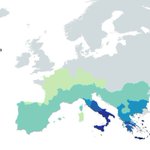
Continental Celtic (Urnfield+Hallstatt+LaTene) admixture in modern day Europeans⚔️
NOTE: The map is not meant to be perfect and does not reflect complex micro intra-regional differences.


Cisalpine Heritage retweeted

In the Middle Neolithic western Cisalpine was the primary source of jadeitite and other minerals used to craft polished stone axes.
Materials extracted from Monviso and Monte Beigua were distributed as far as Scotland and Denmark, with a particular concentration around Brittany.


Cisalpine Heritage retweeted

The dual Celtic migrations that affected Britain likewise impacted northern Italy.
The Lepontic language was derived from Proto-Celtic, represented first by the Canegrate culture of the late Bronze Age, then by the Golasecca culture.
During the La Tene period, Celts who spoke Gaulish would likewise enter the region, adding another linguistic layer.


I agree with this and have been saying so for years.
There were three separate migrations into Britain and Ireland.
The first was the Bell Beaker period. The second was towards the end of the Bronze Age, by Urnfield/Hallstatt. The third was La Tene.
During the Iron Age southern Britain and northern Gaul were basically one contiguous zone with constant population movement, and not only in one direction.
Besides migration, Britain also maintained close economic connections with the mainland, which could have ensured that the language continued to participate in the same Gallo-Brittonic continuum.
Gaelic is an isolated Proto-Celtic language of the Urnfield Culture. Brythonic is a surviving dialect of the La Tene period Celts that retained a large degree of mutual intelligibility with Gaulish during the 1st century AD.
Cisalpine Heritage retweeted

The situation in Italy is out of control.
We regular citizens are forced to defend our cities as our desperate pleads to the authorities seem to go unheard.
I, despite my broken foot, will be present in my city, beautiful Como, to defend it from the foreign hordes.
Stop making excuses and join your own.
We are waiting for you.


Cisalpine Heritage retweeted

Origin of Lineages of ancient Celts
Y-DNA Sankey Graphs showing the Evolution from the Beaker Culture to the Hallstatt Culture to the Laténe Celts of Antiquity.
Hallstatts Y-DNA is differentiated from the Beaker period primarily by a large amount of G2a, specifically L497, while in the Laténe period R1b-P312 becomes bigger again.
43.5% of Hallstatt Lineages trace back to the Beaker culture, and 87.4% of Laténe lineages trace back to Hallstatt.
Chart uses a Clade Depth of 12


Cisalpine Heritage retweeted

Niceforo II: “Voi non siete Romani, siete Longobardi!”
Liutprando da Cremona: “Noi proviamo un tale disprezzo per i Romani che, quando siamo adirati con i nostri nemici, per offenderli non diciamo altro che: "Sei un Romano!”
Né nord Italia, né sud Germania: Lombàrdia libera
Cisalpine Heritage retweeted
The Polesine is a narrow strip of plain in the interfluve between Po and Adige, the two major Cisalpine rivers.
This territory hosts "Frattesina", one of the richest sites dating to the Final Bronze Age, where over 3000 glass beads were found along with furnaces and crucibles.🧵


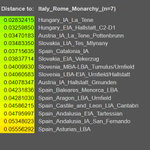
Distance map, Neolithic and Iron Age models for Ligurians from Genoa, as this topic has been the subject of considerable debate over the past few days.
Huge disappointment, I know.
Colombus was neither Spanish nor Italian: he was Cisalpine/Lombard.
#WeWuz


Cisalpine Heritage retweeted
Leggo di spagnuoli e italo-americani (cioè teroni) che si azzuffano contendendosi Cristoforo Colombo. Cosa ci sia di eroico in un probabile ebreo sefardita, che scoprì quel che poi divenne la centrale globale delle feci mondialiste, lo sanno solo loro. X, il nuovo The Apricity.


Neolithic model and distance map for EBA Cisalpine samples from Arano (Verona Alps).
Good proxy for pre-Gaulish Proto-Celtic and Proto-Raethian from Northern Italy.
Similar profile to Etruscans and so on, hence why N.Italians genetically resemble them.


