

Helping you leverage AI tools to build scalable digital systems & save 10+ hours a week. Daily prompt architecture, workflows & monetization cases.
Joined September 2026
- Tweets859
- Following511
- Followers158
- Likes842







Pinned Tweet
Most people use AI as a glorified Google search.
The top 1% use it to build automated digital systems that generate cashflow.
Here is the exact 3-step framework to transition from a casual AI user to an AI systems builder 👇
1. Stop Prompting, Start Systemizing
Don't ask ChatGPT for single answers. Create structured workflows with clear inputs, constraints, and multi-step execution logic.
2. Automate the Friction
Identify repetitive high-value tasks in your workflow and map them to dedicated LLM agents and API integrations.
3. Build Scalable Digital Assets
Turn your validated workflows into repeatable prompt templates, micro-SaaS ideas, or automated content engines.
📌 I breakdown daily AI prompt architecture, workflows & monetization cases.
Follow @CodeToCashAi to stay ahead.

Stop paying flagship prices for work that doesn't need one.
Today's numbers, as reported:
Browser tasks: DeepSeek V4.1-Flash 1017 hit 75.0 at $0.22 a call. GPT-6 Astra: 77.9 at $10.77. ~49x for 2.9 points.
Hard reasoning: Gemini 4 Carbon leads the AA index at 59, priced $2 / $10.
Background chatter: a gist says Claude Code spent ~16% of one user's budget on a 3-word status line.
The rules:
Route by task, not by brand.
Escalate when the cheap run fails the check.
Count retries in the cost.
What's the most expensive thing in your stack that doesn't need to be?

Are we really celebrating vendors "fixing" self-imposed limits instead of moving to a clean API-first stack?
Next week’s feature: paying extra for the right to pay them again.

Day 25/
We are doubling all usage limits for all Pro 100/200/500 tiers and Business Premium, effective today.
We heard your kind feedback and won’t be reducing usage limits for Pro 200, so your Work and Codex usage will stay the same. We’re also going to continue offering extended limits for dots for now, and usage of your dot will still continue to be separate from your default usage.
And we'll of course also keep shipping better models and other efficiency improvements that increase your effective usage over time.
🚨 The AI race isn’t just about smarter models anymore.
5 companies. 5 different bets.
-OpenAI — AI that can execute work through tools and agents.
-Google — frontier intelligence integrated into a massive ecosystem.
-Anthropic — coding, long-running workflows, and developer tools.
-DeepSeek — cost-efficient models and accessible development.
-xAI — Grok, real-time information, and integration with X.
But here’s the question most benchmark threads miss:
Which company helps you finish real tasks with the least cost, time, and rework?
The answer may change depending on the job.
The next advantage won’t come from one model doing everything. It’ll come from routing each task to the right model.

Stop assigning every task to the same AI agent.
Here’s a smarter routing setup using Claude:
- Research & exploration → Claude Haiku 5.5
- Implementation & code review → Claude Sonnet 5.5
- Complex debugging → Claude Opus 5.5
The rules that matter:
Split only genuinely independent tasks.
Give every agent a clear scope.
Escalate when a task gets harder.
Measure cost per successful task — including retries and review.
More agents mean more tokens and coordination overhead.
Don’t maximize agent count. Maximize useful work per dollar.
That’s orchestration.

Most AI coding setups have a hidden bottleneck: agents stepping on each other’s code.
Claude Code worktrees solve part of that problem.
One agent builds a feature.
Another fixes a bug.
Each gets its own isolated workspace.
But spawning more agents isn’t the same as getting more work done.
You still need task routing, testing, and clean integration.
Parallel agents are easy. Coordinating them efficiently is the real engineering. ⚡
That’s where AI orchestration matters.

🚨 Gemini 4 Carbon just dropped — 2 weeks after Argon.
But there’s a catch: access is still limited to selected cybersecurity experts and trusted partners.
The early numbers look impressive:
• AI Index: 59 vs 50
• Terminal-Bench: 65.2% vs 57.1%
But benchmarks only tell part of the story.
The real question is whether better models mean fewer retries, faster workflows, and lower cost per successful task.
Smarter AI is great. Cheaper execution is better.

Everyone is waiting for Fable 5.5. 👀
But I’m more interested in one question:
What if the biggest upgrade isn’t intelligence - but efficiency?
A model that solves tasks with fewer retries, less context and lower cost could be more valuable than one that simply scores higher on benchmarks.
No confirmed specs yet. Just one thing worth watching:
Will Fable 5.5 make AI cheaper to use, not just smarter? ⚡

Same $200. Less AI usage.
OpenAI is lowering included usage for some legacy Pro subscribers starting October 30.
One-time credits may soften the change, but they don’t replace predictable monthly value.
Are you paying for AI access — or for work actually getting done?
Would you keep paying $200/month under these conditions?

GPT-6.1 Terra, Gemini 4 Argon, Claude Haiku 5.5.
Which model would you trust to handle 80% of your daily AI tasks - and why?
Stop building fragile multi-agent hierarchies. Collapsing routine tasks into a single primary loop with deterministic routing is the way forward.

Boris Cherny, Head of Claude Code at Anthropic, just shared an official tip before Fable 5.5 ships
The setup: fold routine subagents into Sonnet 5.5, keep Opus 5.5 on call, and only spawn Haiku 5.5 subagents when tasks hit 340 tok/s parallel sweeps
Multi-agent sprawl kills execution: passing state through custom routers creates telephone-game context loss, bloated frankenprompts, and 2x latency multipliers
You just launch Claude Code like this:
claude --model sonnet --advisor opus
here's the split:
→ Sonnet 5.5 runs the folded main loop: writes code, runs tests, and loads skills dynamically without telephone-game context loss
→ Haiku 5.5 swarms disposable subagents: maps repo trees, greps call sites, and parses API specs at 340 tok/s with zero history bloat
→ Opus 5.5 stays on call as advisor: ingests full multi-turn session transcripts on high-leverage forks without burning tokens on routine edits
→ you stop losing intent across subagent boundaries and cut execution latency in half while keeping your primary context lean
Opus only steps in at three moments:
→ right before a plan locks: evaluates architecture and contract invariants
→ the second an identical test or build error hits twice: breaks debugging loops before tokens burn
→ right before declaring a complex task complete: audits diff contracts and verify passes before merging
Sonnet builds · Haiku swarms · Opus reviews
JEV engineering is the same move one layer down: the forks that need no thinker (which file, which tool, retry or stop) go to JEV in milliseconds, and the big models only see the ones that split
the full tree
> Sonnet 5.5 runs the folded main loop, applies skills on demand, and executes code edits
> Haiku 5.5 swarms parallel read-only scouts (search, grep, docs) at 340 tok/s
> Opus 5.5 stands on call as advisor, evaluating plans and reviewing diffs
> Routine subagents fold into the main loop to kill telephone-game context loss
> Subagent payloads pass as plain text with zero conversation history dump
> JEV routes micro-forks in milliseconds
paste the tree and this prompt into Claude Code ↓
"Rebuild my Claude Code setup around this tree:
1. Run the primary session on Sonnet 5.5 with Opus 5.5 as advisor via --advisor opus
2. Fold single-tool subagents into the main loop using progressive disclosure and dynamic skills
3. Spawn disposable Haiku 5.5 subagents only for parallel file discovery and repo sweeps at 340 tok/s
4. Add one rule to CLAUDE.md: consult the advisor before locking a plan, after repeating the same error twice, and before marking a task done
5. Route fast deterministic forks through JEV, show all changes as diffs first. No edits until I say go"
↳ claude.com/resources/article…
bookmark this, stop building multi-agent sprawl when a folded loop runs 2x faster
My GPT-6.1 Terra math, no benchmarks:
10M input + 2M output tokens a day.
Sol 6.1: $40. Terra: $20. 80/20 router: $24.
Savings are real only if Terra needs one try. Two tries per success and you're back at $40.
Count cost per successful run, not per token.
What's your retry rate?
GPT-6.1 Terra just made AI automation a lot more interesting.
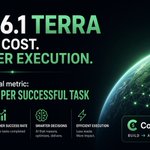
And the biggest upgrade isn’t just intelligence. It’s the cost.
OpenAI says Terra delivers:
→ 3×+ faster computer-use tasks than GPT-6 Astra and GPT-6.1 Sol.
→ 50% lower API prices than GPT-5.6 Terra.
→ Stronger coding performance, scoring 50.3% on Terminal-Bench 4.0.
→ Visual reasoning that can turn what an AI sees into real actions.
→ More automation without paying flagship-model prices.
But here’s the real opportunity:
Use Terra for everyday workflows.
Bring in Sol or Astra when the task gets harder.
The goal isn’t to use the smartest model for everything. It’s to get the job done at the lowest reliable cost.
That’s where orchestration wins.
What would you automate first with Terra?
Want to cut AI costs? Stop paying premium prices for every task.
GPT-6.1 Terra. Gemini 4 Argon. Claude Haiku 5.5.
The trick isn’t picking one winner. It’s using the right model for each job - and avoiding costly retries.
Smarter routing. Lower costs. More results.
The real AI race isn’t just about intelligence. It’s about cost per task.
OpenAI says GPT-6.1 Terra can complete computer-based workflows faster and at a lower cost.
Its standard API pricing is 50% lower than GPT-5.6 Terra and GPT-6.1 Sol.
That changes the question for developers:
Not “Which model is smartest?”
But “Which model gets the job done reliably for less?”
Because cheaper tokens mean nothing if your agent needs five retries.
Optimize the workflow, not just the model.

GPT-6.1 Terra changes the economics of AI agents.
$1/M input. $5/M output. Half the standard API price of GPT-6.1 Sol.
OpenAI also reports a major coding benchmark jump over GPT-5.6 Terra.
But cheaper tokens don’t automatically mean cheaper automation.
The metric that matters: cost per successful task — retries included.
Terra for volume. Sol or Astra for the hardest edge cases.
Route by evals, not hype.
Orchestration > raw model intelligence.

OpenAI vs. Anthropic. GPT-6.1 Sol vs. Claude Opus 5.5.
And now everyone is waiting for the next big release.
But here’s the question nobody should ignore:
What if the winning model isn’t the smartest — but the one that delivers reliable results at the lowest cost?
Benchmarks create hype.
Execution creates value.
Which matters more to you: raw intelligence or cost per successful task?

Anthropic just filed for its IPO. $ANT is coming to Nasdaq.
Now the AI community is watching for the next Claude model.
Fable 5.5? Sonnet 5.6? Or no release before the IPO?
Could Anthropic surprise everyone with a new model before the roadshow — or is the hype getting ahead of reality?
No confirmed launch yet.
What do you think? 👀

NVIDIA Nemotron. Cadence Maestro. One big shift.
AI is moving beyond “one model for everything.”
Cadence says its new specialized AI system achieved up to 5× token efficiency in initial tests vs. a general-purpose model.
The lesson for AI builders?
The future may not belong to the biggest model - but to the best system around it.
Would you choose a specialized model or a general-purpose flagship?

What if you don’t need a bigger AI model?
A new experiment combined 5 Qwen3.8-27B agents to tackle hard coding problems.
The authors report 92.4% pass@1 vs. 90.4% for Claude Fable 5.
But an independent recheck found no statistically clear winner.
Still, the idea is worth watching:
Better architecture can be as important as a better model.
Would you choose one flagship model — or a team of smaller agents?

A lesson for all of us: stop guessing where your tokens go.
Audit your session logs to find what's burning your budget, then lock hard rules directly into CLAUDE.md / AGENTS.md.
Fix your agent hygiene before you blame the model. 🛠️

Keep hitting your Claude Code usage limit?
Paste this into Claude Code. It digs through your last 7 days of sessions, finds 𝘁𝗵𝗲 𝟯 𝗵𝗮𝗯𝗶𝘁𝘀 𝗯𝘂𝗿𝗻𝗶𝗻𝗴 𝘁𝗵𝗲 𝗺𝗼𝘀𝘁 𝘂𝘀𝗮𝗴𝗲, estimates each one's share, and writes rules to 𝗽𝗹𝘂𝗴 𝘁𝗵𝗲𝗺:
Change nothing until I say yes. Write a small script to scan my Claude Code session logs in ~/.claude/projects from the last 7 days, using the token counts recorded in them; don't read the raw files into context. Find the 3 habits that burned the most usage, like reading whole files, dumping long test or build output, spawning subagents, or keeping one session going for hours. For each, work out roughly what share of my usage it took and write one rule that would stop it. When I say yes, add the rules to the instruction file this project actually loads: CLAUDE.md if there is one, otherwise AGENTS.md. Never print secrets.
On Codex, swap Claude Code for Codex in the prompt, use ~/.codex/sessions as the path, and put the rules in AGENTS.md only.