




Pinned Tweet
Which AI should screen 10,000 abstracts?
Chatbots write one word at a time. BERT reads both ways and gives a score you can tune for high recall.
TITAN-SR kept 99.8% of included studies in 22 later Cochrane reviews.
sciencedirect.com/science/ar…
coresr.ai
#SystematicReview #Epi
When a frequentist and a Bayesian NMA disagree, that's information, not noise. In a sparse network it's usually the heterogeneity prior doing the work. In CoreSR you can fit both in real R on the same data and see where estimates move before you write up any ranking.
#NetworkMetaAnalysis #MetaAnalysis #SystematicReview
CoreSR runs pairwise, frequentist and Bayesian NMA, component NMA and dose-response in real R, with GRADE in the same project. 7-day trial, from $39 CAD/mo: coresr.ai
Nice theory paper in Res Synth Methods: Rücker, Davies & Schwarzer show an NMA's covariance matrix is a geometric series of diffusion matrices, no inversion. Hat-matrix entries become random walks between treatments.
Could slow convergence flag thinly connected networks?
Convergence was fastest with a central node like placebo as the absorbing node. The authors are candid that it changes no day-to-day NMA practice. Open access, R code on Zenodo: doi.org/10.1017/rsm.2026.101…
#NetworkMetaAnalysis #EvidenceSynthesis #RStats

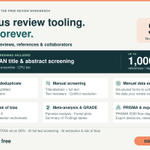
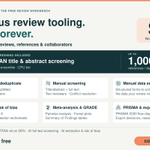
The CoreSR free plan now includes TITAN title/abstract screening (dual3 ensemble, CPU tier, 1,000 refs/day), alongside the full manual workbench. No card, never expires.
drtylerpitre.substack.com/p/…
V-Exploder (BMC Med Res Methodol) rebuilds patient data from Kaplan-Meier plots and overlays the new curve live. Using censoring ticks, 89-94% of HRs fell within 0.01 of truth; Guyot drifted in small cohorts.
But the test plots were clean. What about blurry journal figures?
Acker, Koschade et al. BMC Med Res Methodol 2026, open access. Credit for keeping data local, testing 3 methods head to head, and saying plainly that poor-quality images weren't tested.
doi.org/10.1186/s12874-026-0…
#MetaAnalysis #SurvivalAnalysis #EvidenceSynthesis

TITAN-SR v6 is trained to predict final inclusion in the published review. Held-out internal test (60 reviews): 99.9% recall, 78.0% specificity at max recall.
Internal only. External validation is next.
drtylerpitre.substack.com/p/…

Paid plans add TITAN v6 on GPU, AI full-text screening, and AI extraction and risk of bias. #SystematicReview #MetaAnalysis

A new review mapped 55 quantitative bias analysis methods for summary-level data. Only 4 were rated applicable to meta-analyses of observational studies, and 9 to hazard ratios.
So when a review pools adjusted HRs, what does a line about "residual confounding" actually buy us?
Correia, Wallach et al. built applicability matrices (confounding 28, information bias 21, selection 6) and tried them on 3 published studies. Open access: doi.org/10.1186/s12874-026-0…
#SystematicReview #MetaAnalysis #EpiTwitter

New this week at CoreSR: TITAN-SR v6, ROB BERT v6 and GLASS v3, with what the evidence does and doesn't yet show for each.
Weekly update 👇
drtylerpitre.substack.com/p/…
Launching SynthesisBench: an open screening benchmark across 85 systematic reviews, 2,327 records and 26 systems. Top Youden's J: TITAN-SR v6 0.879, Claude Opus 5.5 0.831, GLASS-SR 0.827. Run by CoreSR. synthero.ai/screening

Youden's J = sensitivity + specificity − 1. Intervals: 5,000 whole-review bootstrap replicates. #SystematicReview #EvidenceSynthesis #AI
A living review is only as current as its slowest step. A new trial lands: screen it, extract it, appraise it, rerun the model, re-rate certainty.
If those steps sit in five tools, the update stalls. In CoreSR they sit in one project, so each update starts where the last ended.
TITAN screening, GLASS quote-grounded appraisal, real-R meta-analysis and NMA, native GRADE. 7-day trial at coresr.ai, from $39 CAD/mo.
#LivingReview #SystematicReview #EvidenceSynthesis
Cluster RCT in your meta-analysis, no ICC reported? You borrow one.
Bhat & Beretvas (Res Synth Methods) simulated pooling ICCs: REML vs RVE barely mattered; the variance formula did. Only the Fisher-transformation weight never gave a substantially biased pooled ICC.
One question: they simulated continuous, normally distributed outcomes. Health cluster trials often use binary ones. Does the Fisher advice carry over? The authors flag it as untested.
Open access: doi.org/10.1017/rsm.2026.100…
#MetaAnalysis #ClusterRCT #EvidenceSynthesis

When two RoB 2 raters disagree, often it isn't judgment. They read different sentences: one stopped at "analysed by ITT," the other found the dropout table.
In GLASS, every RoB call sits next to the quote it rests on. You argue about text, not memory. A human still decides.
GLASS is the quote-grounded appraisal step inside CoreSR, next to screening, extraction, real-R meta-analysis and GRADE. 7-day trial: coresr.ai
#RiskOfBias #SystematicReview #EvidenceSynthesis