

Facilitating Global Investors' access to high-quality, high-growth credit products in Emerging Markets via tokenization. CM is the next-gen RWA marketplace.
Web3
Joined June 2024
- Tweets1K
- Following71
- Followers238
- Likes1.2K




Pinned Tweet
2nd place at #StableHacks 2026 among 100+ projects from 59 countries! 🏆
Being recognized by institutional giants like @aminabank, @solana, and @solstice_fi validates our mission to bring Brazilian credit on-chain.
Thanks @Tenity_global! 🚀 – at Zug, Switzerland


How Credit Markets works.
We connect Brazilian credit originators with global institutional capital. Each party does the job it is best placed to do.
→ Local originators underwrite, service the loans and put their own capital in first
→ We run the rails on @solana. Vaults, legal structure, FX hedging, live collateral tracking
→ Institutions allocate in USDC to the vault they choose
Each vault is isolated, so one curator’s default can’t spread to another. Every payment is tracked onchain, not in a monthly PDF.
We never lend from our own balance sheet.
Request access → credit.markets

You can measure how mature a credit market is by how well it prices protection to match the volatility of each asset.
In FIDCs, the subordination layer reflects how each market behaves.
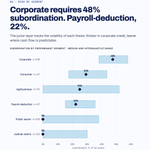
→ Corporate leads, with a median junior subordination of 48%
→ Consumer has a median of 29%, in line with the statistical predictability and granularity of its portfolios
→ Agribusiness has a median of 25%, adapted to crop cycles and the sector’s receivables
→ Payroll-deduction has stable cash flows and a median of 22%
→ Public sector structures rest on budget predictability, with a median of 0%
Tailoring protection to each value chain like this shows how sophisticated risk modeling in the Brazilian market has become.

Tailored financial engineering: the flexibility of FIDC quota structures.
One of the FIDC's greatest strengths is its ability to adapt the capital structure to the nature of the asset and the profile of the originator.
Across the 2,645 structures with senior quotas:
→ The median subordination ratio is 15.7%, a consistent barrier of capital protection.
→ In corporate portfolios, which require greater risk absorption, the median subordination rises to 47.7%.
→ In contrast, structures focused on very low-risk credit or sovereign/public risk run lean and efficient, optimizing the cost of capital.
The FIDC architecture makes it possible to design exactly the level of protection investors require, balancing efficiency for the borrower and security for quota holders.

Fund-level data for every FIDC, updated monthly: score.credit.markets/
Source: CVM, FIDC Monthly Report (Informe Mensal). Data through Aug 2026. Prepared by Credit Markets.
🤝🥇


The product directory for Crypto World's Fair is live. 🎡
This was our biggest hackathon ever & the largest in crypto history with 2,973 submissions.
Winners and Colosseum's next accelerator startups will be announced in 4-5 weeks. Stay tuned!
colosseum.com/arena/projects…

Markets close on weekends. Onchain rails don't.
That's part of why we're building Credit Markets on @solana, bringing real-world credit to infrastructure that never sleeps.
A complete ecosystem: from institutional scale to niche specialists.
Across Brazil's FIDC market:
→ Median fund: R$ 52.6 mn
→ Average: R$ 235 mn, lifted by large institutional vehicles
→ The 100 largest hold 42.9% of net assets; the top 10, 17.3%
Large vehicles bring scale. Thousands of specialized funds serve specific sectors and originators.

Fund-level data for every FIDC, updated monthly: score.credit.markets
Source: CVM, FIDC Monthly Report (Informe Mensal). Data through Aug 2026. Prepared by Credit Markets.
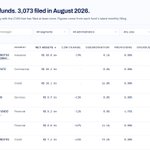
Comparing FIDCs used to mean digging through thousands of CVM filings.
We built a single view of Brazil's R$ 1 trillion FIDC market instead: every fund, every month.
You can pick any FIDC and see where it stands against every other operating fund, or zoom out to the full picture, the same data behind our recent posts.

We built it for our own work: it's the data layer behind Credit Markets, so every allocation can be benchmarked against the full market.
Look up any fund and see where it stands: score.credit.markets/
R$ 767 bn in receivables, spread across eight sectors of Brazil's economy.
→ Financial: 43.4%
→ Commercial, credit and industrial: 39.8% combined
→ Services, public sector, judicial claims and agribusiness: the rest
FIDCs connect capital markets directly to the companies and credit that drive Brazil's real economy.

Fund-level data for every FIDC, updated monthly: score.credit.markets/
Source: CVM, FIDC Monthly Report (Informe Mensal). Data through Aug 2026. Prepared by Credit Markets.
Originators and managers are turning to FIDCs at a record pace.
6,224 new funds registered with the CVM since 2019, 3.3 new funds for every one that closed.
→ Registrations accelerated from 2023 and hit a record 1,543 in 2025
→ Net balance: 4,344 new funds in the market
→ Closed-end structures dominate every vintage, giving portfolios stable capital
→ Most new funds are multi-investor vehicles
Standardized securitization has changed how Brazilian companies fund their receivables.

Fund-level data for every FIDC, updated monthly: score.credit.markets
Source: CVM, FIDC Monthly Report (Informe Mensal). Data through Aug 2026. Prepared by Credit Markets.
Brazil's FIDC market holds about R$ 1 trillion across ~4,400 funds, built from blocks any securitization investor knows: tranches, subordination, triggers.
We wrote a short guide for global investors looking at Brazilian private credit.


Credit Markets is competing in @colosseum's Crypto World's Fair.
We're building institutional access to collateralized private credit in LATAM, starting with Brazil's R$ 1 trillion FIDC market, through regulated onshore funds and US dollar investment offshore. Built on @solana.
Our team will be at Breakpoint in London this November. Come meet us! 🇬🇧
