


Ryuma retweeted

One stack. Different entry points. One direction.
Cortensor is taking shape across multiple layers - from network execution and infrastructure, to visibility, hosted API access, agent runtimes, delegation, validation, and product-facing workflows.
Mainnet Full now becomes the environment where more of these pieces can start being exercised together under real usage.
🔹 Mainnet Full → execution foundation
🔹 Dashboard → visibility and operations
🔹 Portal → hosted API / model access
🔹 PyClaw → local agent runtime and broader user distribution
🔹 Corgent / Bardiel → delegation, validation, and trust-oriented workflows
The goal is not to build isolated products.
It is to build a connected execution + trust stack that developers, agents, and eventually broader users can enter from different layers.
#Cortensor #MainnetFull #AIInfra #AgenticAI #Portal #Dashboard #Corgent #Bardiel #PyClaw


Cortensor is not just one product or one surface.
It is increasingly becoming one stack:
- Network & Infra as the foundation
- Dashboard for visibility and operations
- Portal for hosted access
- Corgent for infra-native agent execution
- Bardiel and PyClaw as higher-level product and agent layers
That is the bigger picture:
One stack that people can build on, operate on, access through products, and turn into real applications.
#Cortensor #AIInfra #AgenticAI #Portal #Dashboard #Corgent #Bardiel #PyClaw


Ryuma retweeted
Mainnet Full is designed to grow in stages - not just in infrastructure, but in developers, products, usage, and demand.
🔹 Alpha
- Controlled access
- Real workload testing
- Validate Portal, PyClaw, Corgent, Bardiel, and core network paths
🔹 Beta
- Expand node, model, router, and gateway capacity
- Bring in more developers and workloads
- Use hackathons and builder programs to increase real usage and feedback
🔹 General Availability
- Broader access once infrastructure and product paths are consistently healthy
- Support more sustained applications and agent workloads
- Continue ecosystem growth beyond GA
🔹 Developer entry points
- Portal → hosted model / API access
- PyClaw → agent runtime
- Corgent → delegation / validation
- Bardiel → trust-oriented agent services
🔹 The broader loop
more exposure → more developers → more applications → more real workloads → better products → stronger network demand
The goal is to grow infrastructure, products, developer community, exposure, usage, and demand together over time.
#Cortensor #MainnetFull #Portal #PyClaw #Corgent #Bardiel #Hackathon

🔎 Recap: How Alpha → Beta → GA Connects to Developer Growth
The Mainnet Full rollout is not only about increasing infrastructure capacity.
Each phase should also gradually expand developer access, real usage, ecosystem exposure, and demand.
🔹 Alpha
- Controlled access and baseline product testing
- Validate Portal, PyClaw, Corgent, Bardiel, and core network paths with real workloads
- Start bringing in smaller groups of builders as the environment stabilizes
🔹 Beta
- Increase node, model, router, and gateway capacity
- Open access to more developers and workloads
- Use hackathons and builder programs to bring in more real applications, agent workflows, and feedback
🔹 Products as developer entry points
- Portal can give builders hosted model / API access
- PyClaw can give them a practical agent runtime for research, coding, tools, and delegation
- Corgent and Bardiel can give agents and applications delegation, validation, fact-checking, and trust-oriented network services to interact with
- Different builders can therefore enter through different parts of the stack
🔹 General Availability
- Broader access once infrastructure and product paths are consistently healthy
- Support more sustained applications and agent workloads
- Continue hackathons, ecosystem programs, and broader exposure beyond GA
🔹 The broader loop
Hackathons and developer exposure are part of the rollout itself:
- more exposure → more developers
- more developers → more applications and agents
- more applications → more Portal, PyClaw, Corgent, and Bardiel usage
- more real workloads → better feedback and product improvements
- stronger products + more capacity → more sustained network demand
The goal is to grow infrastructure, products, developer community, exposure, usage, and demand together over time.
#Cortensor #MainnetFull #Portal #PyClaw #Corgent #Bardiel #Hackathon
Ryuma retweeted
Mainnet Full Alpha is where the pieces start getting exercised together.
Infrastructure validation continues, but the bigger focus now is controlled real-world usage across Portal, PyClaw, Corgent, and Bardiel - while we prepare the onboarding, capacity, examples, and developer workflows needed for Beta.
Alpha is also the phase where PyClaw keeps maturing, Corgent / Bardiel v4 delegation + validation starts getting iterated more seriously, and hackathon prep begins.
The goal is simple:
Alpha → stronger products → more builders → more real workloads → better feedback → Beta.
#Cortensor #MainnetFull #Portal #PyClaw #Corgent #Bardiel #Hackathon

🔎 Recap: What the Mainnet Full Alpha Phase Is Meant to Accomplish
Mainnet Full Alpha is not just an infrastructure milestone.
It is the first stage where the network, product layer, and developer-facing tools start getting exercised together under more realistic usage.
🔹 What Alpha means
- controlled access rather than broad public availability
- continued validation of Mainnet1, routers, sessions, dedicated nodes, dashboard, indexer, and recovery paths
- real product traffic through Portal, Corgent, Bardiel, and PyClaw-related workflows
- enough usage to expose operational, compatibility, onboarding, and capacity gaps before Beta
🔹 Portal during Alpha
- Portal gives developers the simplest hosted API entry point into Cortensor
- The focus is to keep improving OpenAI-compatible behavior, model availability, onboarding, reliability, and usage visibility
- Capacity will still be limited early, so Alpha also helps us understand where node / model expansion is actually needed
🔹 PyClaw during Alpha
- PyClaw will continue maturing in parallel rather than waiting for the network rollout to finish
- Research and coding remain the main reference workflows, while memory, context, tools, scheduling, delegation, verification, recovery, and longer-running projects continue through repeated E2E testing
- Onboarding, packaging, model setup, and the early Desktop App are also important because broader developer usage requires more than just a working runtime
🔹 Corgent / Bardiel during Alpha
- Alpha is also where we expect to start iterating more seriously on the future v4 delegation and validation direction
- v3 gives us the current network-native baseline for delegation, validation, redundancy, consensus, and fact-checking
- v4 is intended to push further into richer agent workflows: clearer outcomes, feedback, revision, retry, re-delegation, approvals, and stronger validation loops
- Corgent and Bardiel can become the product-facing surfaces where those workflows are tested against real agents and applications
🔹 Preparing for hackathons
- During Alpha, we can start preparing the product surfaces, examples, documentation, capacity, and onboarding needed for later hackathons
- Portal can give builders a familiar API-key path
- PyClaw can give them an agent runtime to build research, coding, automation, tool, and multi-agent workflows
- Corgent / Bardiel can expose delegation, validation, fact-checking, and trust-oriented agent services as those surfaces mature
🔹 Why prepare before Beta
Alpha gives us time to:
- identify onboarding friction
- improve examples and documentation
- test model / provider compatibility
- strengthen Portal and PyClaw reliability
- iterate Corgent / Bardiel v4 concepts with real workflows
- prepare enough infrastructure capacity
- understand which developer use cases are actually useful
🔹 The broader loop
Alpha → stronger products → hackathon prep → more builders → more real workloads → better feedback → faster iteration → Beta → stronger usage and network demand.
🔹 Current takeaway
- Alpha is where Mainnet Full starts moving from infrastructure validation toward controlled real-world product usage
- It is also a preparation phase for PyClaw maturity, Portal reliability, and early Corgent / Bardiel v4 delegation + validation iteration
- The goal is to enter Beta with better products, clearer developer entry points, stronger onboarding, and a much better foundation for hackathons and ecosystem growth
#Cortensor #MainnetFull #PyClaw #Portal #Corgent #Bardiel #Hackathon
Ryuma retweeted
From Alpha → Beta → GA, Mainnet Full is meant to grow more than infrastructure alone.
Each phase should gradually expand access, developer participation, real workloads, product maturity, and network demand.
Portal, PyClaw, Corgent, and Bardiel give builders different ways to enter the stack - from hosted API access to agent runtimes, delegation, validation, and trust-oriented services.
Beta is where hackathons and builder programs become especially useful: more developers try the stack, more real applications and agents get built, and those workloads expose the gaps we need to fix before broader GA.
The loop is simple:
more exposure → more builders → more apps and agents → more product usage → better feedback → stronger products and demand
#Cortensor #MainnetFull #Portal #PyClaw #Corgent #Bardiel #Hackathon

🔎 Recap: How Alpha → Beta → GA Connects to Developer Growth
The Mainnet Full rollout is not only about increasing infrastructure capacity.
Each phase should also gradually expand developer access, real usage, ecosystem exposure, and demand.
🔹 Alpha
- Controlled access and baseline product testing
- Validate Portal, PyClaw, Corgent, Bardiel, and core network paths with real workloads
- Start bringing in smaller groups of builders as the environment stabilizes
🔹 Beta
- Increase node, model, router, and gateway capacity
- Open access to more developers and workloads
- Use hackathons and builder programs to bring in more real applications, agent workflows, and feedback
🔹 Products as developer entry points
- Portal can give builders hosted model / API access
- PyClaw can give them a practical agent runtime for research, coding, tools, and delegation
- Corgent and Bardiel can give agents and applications delegation, validation, fact-checking, and trust-oriented network services to interact with
- Different builders can therefore enter through different parts of the stack
🔹 General Availability
- Broader access once infrastructure and product paths are consistently healthy
- Support more sustained applications and agent workloads
- Continue hackathons, ecosystem programs, and broader exposure beyond GA
🔹 The broader loop
Hackathons and developer exposure are part of the rollout itself:
- more exposure → more developers
- more developers → more applications and agents
- more applications → more Portal, PyClaw, Corgent, and Bardiel usage
- more real workloads → better feedback and product improvements
- stronger products + more capacity → more sustained network demand
The goal is to grow infrastructure, products, developer community, exposure, usage, and demand together over time.
#Cortensor #MainnetFull #Portal #PyClaw #Corgent #Bardiel #Hackathon
Ryuma retweeted
Mainnet Full is not one switch from testing → full availability.
The rollout is planned to expand gradually through:
- Alpha
- Beta
- General Availability
Each stage increases access, capacity, models, and real product usage based on what the network can support reliably.
The goal is to grow compute and demand together - not launch everything at once.
#Cortensor #MainnetFull #Portal #Corgent #Bardiel #AIInfra

🔎 Recap: How the Mainnet Full Rollout Is Expected to Progress
A quick recap on the current Q4 rollout direction for Mainnet Full.
🔹 The simple framing
- Mainnet Full is not planned as one large switch from testing → full availability
- The rollout is expected to expand gradually through Alpha, Beta, and General Availability
- Each stage will increase access, capacity, and product usage based on what the network can support reliably
🔹 Alpha
- Start with controlled access and baseline product usage
- Continue validating Portal, Corgent, Bardiel, routers, sessions, and dedicated-node paths
- Use early real workloads to identify issues and refine the environment
🔹 Beta
- Expand node and gateway capacity
- Add more models and broader developer access
- Increase parallel workloads and product traffic
- Continue improving routing, monitoring, reliability, and service quality
🔹 General Availability
- Move toward broader access once the infrastructure and product paths are consistently healthy
- Scale compute alongside actual Portal, agent, and developer demand
- Continue adding models, features, fixes, and infrastructure improvements even after GA
🔹 Why the staged rollout matters
- Capacity should grow with real usage rather than too far ahead of it
- Demand should not be exposed faster than the available compute can support
- Alpha → Beta → GA gives us room to expand both sides gradually while learning from real workloads
🔹 Current status
- Mainnet Full already has a working baseline across the L3, nodes, routers, Portal, Corgent, and Bardiel
- Current work is still focused on compatibility, capacity, model coverage, and continued E2E validation
- The staged rollout is expected to begin during Q4 as planned
🔹 Current takeaway
- Q4 is the beginning of the Mainnet Full rollout, not the end of development
- Alpha, Beta, and GA represent increasing levels of access, capacity, and real usage
- The broader goal is to grow products, models, compute, and demand together rather than treating Mainnet Full as a single launch event
#Cortensor #MainnetFull #Portal #Corgent #Bardiel #AIInfra

Ryuma retweeted
Agent cloud is not one place where every agent runs.
It is a broader execution layer where work can move between:
- local workflows
- hosted model access
- remote delegation
- validation
- trusted execution
PyClaw, Portal, Corgent, @0xBardielTech, and /delegate each represent a different part of that path.
The goal is one connected workflow, not one agent doing everything itself.
#Cortensor #AgentCloud #AgenticAI #PyClaw #Portal #Corgent #Bardiel

Agent cloud is more than agents calling APIs.
It is one workflow that can span:
- local execution
- hosted models
- remote delegation
- validation
- and trusted execution
That is why /delegate matters.
Instead of every agent doing everything itself, work can move across specialized execution surfaces and return into one connected workflow.
That is the direction connecting PyClaw, Portal, Corgent, @0xBardielTech, and the Cortensor Network.
#Cortensor #AgentCloud #AgenticAI #PyClaw #Portal #Corgent #Bardiel

Ryuma retweeted
Agent cloud is more than agents calling APIs.
It is one workflow that can span:
- local execution
- hosted models
- remote delegation
- validation
- and trusted execution
That is why /delegate matters.
Instead of every agent doing everything itself, work can move across specialized execution surfaces and return into one connected workflow.
That is the direction connecting PyClaw, Portal, Corgent, @0xBardielTech, and the Cortensor Network.
#Cortensor #AgentCloud #AgenticAI #PyClaw #Portal #Corgent #Bardiel
🔎 Recap: What We Mean by “Agent Cloud”
A quick recap on one of the longer-term directions behind Cortensor.
🔹 The simple framing
Agent cloud does not just mean agents calling an API.
It means agents can:
- work locally
- use hosted model access
- delegate tasks outward
- call remote subagents
- validate results before acting
- return outcomes into one connected workflow
🔹 Why it matters
As agents get more capable, they should not have to do everything in one place.
Some work stays local.
Some work uses hosted inference.
Some work gets delegated outward through remote trust and execution layers.
That is the shift from “one agent, one runtime” toward a broader execution fabric.
🔹 How the stack connects
- PyClaw = local-first agent workflows
- Portal = hosted model access
- Corgent / Bardiel = remote delegation, validation, and trusted execution
- Cortensor Network = routing, validation, and execution underneath
So the stack is not just one app or one endpoint.
It is a broader execution environment that agents can build on.
🔹 Why /delegate matters
/delegate is what starts making this real.
Instead of every agent doing everything itself, work can be handed off into another execution surface and brought back into the same flow.
That is why the “AWS for agents” framing exists:
- remote execution
- delegated work
- capability-aware routing
- trust and validation
- reusable infrastructure underneath
And that direction also lines up with the broader “intelligent delegation” idea now being discussed more openly: delegation is not just calling another model, but deciding who should do what, under what constraints, with what oversight, and how the result should be verified.
🔹 Current takeaway
Agent cloud, in the Cortensor sense, means agents can move work across local, hosted, and remote delegated paths on top of one broader execution layer.
That is the direction connecting PyClaw, Portal, Corgent, Bardiel, and /delegate over time.
#Cortensor #AgentCloud #AgenticAI #Corgent #Bardiel #PyClaw
Ryuma retweeted
Cortensor is starting on @Arbitrum because the rollout needs more than a chain to deploy on.
It needs a path that fits the product flow:
- responsive sessions
- routing and validation
- hosted/API access
- dedicated-node rollout
- L2 first, then Orbit L3
Mainnet Lite starts the controlled path on Arbitrum L2.
Mainnet Full expands toward the fuller native stack on Arbitrum Orbit L3.
That staged path is the key reason.
#Cortensor #Arbitrum #MainnetLite #MainnetFull #AIInfra

🔎 Recap: Why Cortensor Is Starting on Arbitrum
A quick recap on why @Arbitrum became the initial place for the Cortensor rollout path.
🔹 Why Arbitrum came first
- The biggest reason was practical execution responsiveness
- Cortensor is not only about “put a model onchain”
- It also needs routing, sessions, validation, and product-facing flows to feel responsive enough to be usable in practice
🔹 Why that matters for Cortensor
- Earlier on, one of the main things we cared about was a stack that could support:
- faster session flow
- more practical hosted/product paths
- cleaner L2 → L3 progression
- room for dedicated-node and broader network rollout over time
Arbitrum fit that direction better for the initial path.
🔹 Why not treat every chain the same
- Different chains may all be usable in theory
- But they do not all create the same UX, operational shape, or rollout path for this kind of stack
For Cortensor, the important thing was not only “can it run there?”
It was:
- can it feel responsive enough
- can it support the right product flow
- can it support the fuller network direction later
🔹 Why Arbitrum fits the rollout path
- Arbitrum L2 gives the cleaner earlier rollout path for Mainnet Lite
- Arbitrum Orbit L3 gives the fuller longer-term path for Mainnet Full
- That means the stack can start with a more practical controlled rollout first, then expand into the broader Cortensor-native direction after that
🔹 What this means in practice
- Mainnet Lite on Arbitrum L2 = earlier controlled rollout, more dedicated-node-heavy, more product/demo oriented
- Mainnet Full on Arbitrum Orbit L3 = fuller native stack, broader long-term direction
So Arbitrum is not just “where we deployed first.”
It is the chain path that best matched the staged rollout we wanted.
🔹 Current takeaway
Cortensor is starting on Arbitrum because it gave the best initial fit for:
- responsiveness
- staged L2 → L3 rollout
- product readiness
- and the broader long-term network direction
That is why Arbitrum is the starting place.
#Cortensor #Arbitrum #MainnetLite #MainnetFull #AIInfra
Ryuma retweeted
Why Arbitrum first?
Because Cortensor is not only about putting models onchain.
It also needs routing, sessions, validation, and product-facing flow to feel usable in practice.
@Arbitrum gave the cleaner path:
- Lite first on L2
- Full later on Orbit L3
#Cortensor #Arbitrum #MainnetLite #MainnetFull #AIInfra

🔎 Recap: Why Cortensor Is Starting on Arbitrum
A quick recap on why @Arbitrum became the initial place for the Cortensor rollout path.
🔹 Why Arbitrum came first
- The biggest reason was practical execution responsiveness
- Cortensor is not only about “put a model onchain”
- It also needs routing, sessions, validation, and product-facing flows to feel responsive enough to be usable in practice
🔹 Why that matters for Cortensor
- Earlier on, one of the main things we cared about was a stack that could support:
- faster session flow
- more practical hosted/product paths
- cleaner L2 → L3 progression
- room for dedicated-node and broader network rollout over time
Arbitrum fit that direction better for the initial path.
🔹 Why not treat every chain the same
- Different chains may all be usable in theory
- But they do not all create the same UX, operational shape, or rollout path for this kind of stack
For Cortensor, the important thing was not only “can it run there?”
It was:
- can it feel responsive enough
- can it support the right product flow
- can it support the fuller network direction later
🔹 Why Arbitrum fits the rollout path
- Arbitrum L2 gives the cleaner earlier rollout path for Mainnet Lite
- Arbitrum Orbit L3 gives the fuller longer-term path for Mainnet Full
- That means the stack can start with a more practical controlled rollout first, then expand into the broader Cortensor-native direction after that
🔹 What this means in practice
- Mainnet Lite on Arbitrum L2 = earlier controlled rollout, more dedicated-node-heavy, more product/demo oriented
- Mainnet Full on Arbitrum Orbit L3 = fuller native stack, broader long-term direction
So Arbitrum is not just “where we deployed first.”
It is the chain path that best matched the staged rollout we wanted.
🔹 Current takeaway
Cortensor is starting on Arbitrum because it gave the best initial fit for:
- responsiveness
- staged L2 → L3 rollout
- product readiness
- and the broader long-term network direction
That is why Arbitrum is the starting place.
#Cortensor #Arbitrum #MainnetLite #MainnetFull #AIInfra
Ryuma retweeted
🔎 Recap: Where Portal Currently Stands
A quick recap on where Portal is right now.
🔹 Current state
- Portal has passed the main basic tests and the first basic stress tests
- So the core hosted path is no longer just a concept - it is working in development form
🔹 What it is today
- This is still a development version
- It has enough shape to test, refine, and keep improving
- But it should not be mistaken for the final production form yet
🔹 Why rollout will be phased
- After Mainnet Lite, Portal will go through a more phased rollout and testing path
- The reason is simple: we want to refine it under real usage gradually, not pretend it is instantly final
🔹 Rough rollout path
- development
- alpha
- beta
- GA
That means:
- development = building and internal/external early testing
- alpha = early real-world rollout with tighter scope
- beta = broader and more stable usage path
- GA = when the product is mature enough for general availability
🔹 Why Mainnet Full matters more for broader Portal rollout
- Portal eventually needs a path where higher throughput and more active usage make sense
- That is much more aligned with Mainnet Full, where the stack is better suited for heavier transaction flow without the same cost friction as the earlier Mainnet Lite path
🔹 Current takeaway
- Portal has passed the early basic tests and stress tests
- it is now in a real development phase, not just mock stage
- but the broader rollout is still meant to happen gradually:
- Mainnet Lite first for phased rollout/testing
- then more serious expansion during Mainnet Full
#Cortensor #Portal #MainnetLite #MainnetFull #AIInfra

Ryuma retweeted
One foundation.
Multiple layers.
The stack taking shape.
From network and infrastructure, to visibility, hosted access, and agent/product surfaces - this is the Cortensor stack coming together.
And with Mainnet Lite planned this quarter on @Arbitrum, that stack starts moving closer to real mainnet usage.
#Cortensor #AIInfra #AgenticAI #Portal #Dashboard #Corgent #Bardiel #PyClaw #MainnetLite #Arbitrum

Cortensor is not just one product or one surface.
It is increasingly becoming one stack:
- Network & Infra as the foundation
- Dashboard for visibility and operations
- Portal for hosted access
- Corgent for infra-native agent execution
- Bardiel and PyClaw as higher-level product and agent layers
That is the bigger picture:
One stack that people can build on, operate on, access through products, and turn into real applications.
#Cortensor #AIInfra #AgenticAI #Portal #Dashboard #Corgent #Bardiel #PyClaw
Ryuma retweeted
🧪 Testnet Phase #4 – Wrap-Up Complete
Testnet Phase #4 is now finished.
🔹 What this phase focused on
- network execution
- hosted access
- routing
- metering and observability
- Mainnet Lite readiness
🔹 What moved forward most
- Mainnet Lite baseline checks under real mainnet conditions
- Portal V1 stress tests, multi-model routing, metering, and public/internal observability
- testnet1a / L3 recovery and stronger infra-ops readiness
- earlier Mainnet Full pre-prep on the infra side
- clearer stack direction across Network, Dashboard, Portal, Corgent, Bardiel, and PyClaw
🔹 Simple takeaway
- Phase #4 helped turn a lot of rough pieces into a much more connected stack
🔹 What comes next
- finalize the phase wrap-up and prize side
- move into Mainnet Lite planning and prep
- continue the path from baseline checks into actual rollout preparation
🔹 Final note
- Phase #4 was less about one single feature
- and more about making the full stack hold together under more realistic conditions
Next focus: Mainnet Lite.
#Cortensor #Testnet #Phase4 #MainnetLite #Portal #PyClaw #Corgent #Bardiel #AIInfra #DePIN #L3 #Arbitrum

🧪 Testnet Phase #4 – Wrap-Up Recap
Testnet Phase #4 is wrapping up over the next 48 hours.
Phase #4 focused on tightening the full Cortensor stack under more realistic conditions - network execution, Portal, router pools, observability, L3 recovery, and Mainnet Lite readiness.
Core Infra:
🔹 Mainnet Lite baseline validation
- Mainnet Lite moved from rough setup into real E2E baseline checks under actual mainnet conditions
- Dedicated-node user tasks, ephemeral-node network tasks, and ephemeral-node user-task → node-pool flows all worked end to end
🔹 Mainnet Lite infra readiness
- Contract/module deployment, RPC/server setup, oracle/indexer/dashboard setup, explorer checks, and chain-side validation reached rough baseline form
- Heartbeat/ping timing was adjusted around real Arbitrum mainnet gas-cost assumptions
🔹 RPC / environment separation
- Internal RPC infrastructure was refreshed and migrated toward newer internal/community-backed paths
- Testnet and mainnet RPC separation started on newly provisioned servers as prep for Mainnet Lite and later Mainnet Full
🔹 Testnet1a / L3 recovery
- Testnet1a went through a real sequencer / local Nitro DB recovery exercise using L2 batch data plus DAS/DA-backed data
- The recovery helped validate L3 rebuild flow, edge cases, and future sequencer backup/redundancy planning
🔹 Cortensor L3 progress
- Cortensor L3 closed Phase #4 in a much stronger operational position
- The network has processed over 8M blocks and over 16.5M transactions
🔹 Mainnet Full early tryouts
- Very early Mainnet Full infra work started across rough server setup, bridge flow, contract deployment, explorer checks, and connectivity validation
- This remains early, but helped prepare the path beyond Mainnet Lite
Products / Stack:
🔹 Portal V1 – hosted API layer
- Portal stress tests expanded into larger prompts, heavier token-size requests, longer-running hosted API calls, and multi-model testing across oss-20b, gemma4, qwen 3.5 9b, and oss-120b
- API Gateway → router pool → session routing was validated in rough form, including dynamic model reconfiguration, capacity-aware routing, and multi-instance gateway deployment
🔹 Portal V1 – metering + observability
- OpenAI-style and Anthropic-style REST compatibility advanced, with SSE / streaming MVP support added at the gateway level
- Usage tracking moved toward token-based metering, while public stats and admin/ops views expanded across usage, latency, route health, gateway health, tokens, heatmaps, and model/session triage
🔹 Portal auth + control-plane direction
- Portal auth matured with prod OAuth setup for Google, X, and Discord, while wallet login was de-emphasized because of spam/abuse concerns
- Backend planning advanced toward a future API/control-plane path beyond the current Supabase-style pattern
🔹 Docs V2
- Docs V2 progressed in rough form with cleaner structure, updated diagrams, and clearer operator/developer paths
- Current direction is to preview the new docs website during Q3 between Mainnet Lite and Mainnet Full
🔹 PyClaw
- PyClaw early WIP direction continued with a public early snapshot/repo push
- Framing became clearer: local-first agent/app layer now, with future connection into remote delegation and agent-cloud-like flows
🔹 Stack messaging
- Public stack messaging expanded across Network & Infra, Dashboard, Portal, Corgent, @BardielTech, and PyClaw
- Mainnet Lite vs Mainnet Full was clarified further: Lite first as the controlled L2 rollout path, Full later as the fuller @Arbitrum Orbit L3 path
Phase #4 tightened the path from network execution to hosted access, routing, metering, observability, L3 recovery, and Mainnet Lite readiness.
After Phase #4 wraps, the next focus is detailed planning and execution toward Mainnet Lite.
#Cortensor #Testnet #Phase4 #DevUpdate #Portal #MainnetLite #PyClaw #Corgent #Bardiel #AIInfra #DePIN #L3 #Arbitrum

Ryuma retweeted
Mainnet Lite comes first for a reason.
A more practical and controlled L2 path on @Arbitrum, built for early hosted access, developer APIs, and real mainnet validation before the fuller stack rolls out.
It is also the earlier demo / playground-style path where the system can be used, tested, and refined under real mainnet conditions before broader expansion.
Q3 2026 has started, and Mainnet Lite is the first mainnet step we are building toward in this phase.
#Cortensor #MainnetLite #Mainnet #Arbitrum
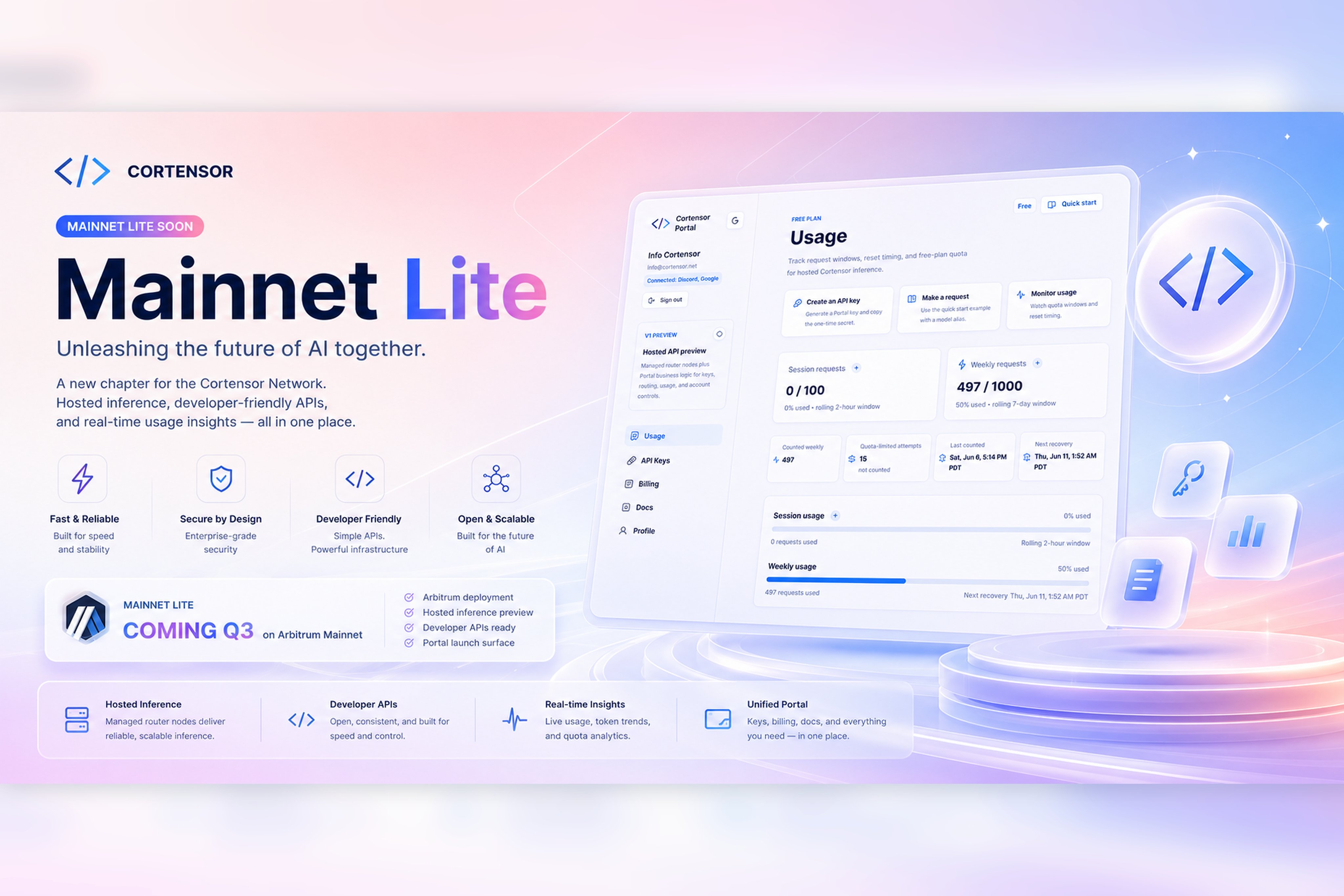
Mainnet Lite is the controlled first step for bringing the Cortensor stack onto real mainnet conditions.
The point is not to do everything at once. It is to start with a simpler, more productized L2 path first at @Arbitrum, validate the stack under real conditions, and then build outward from there.
Q3 2026.
#Cortensor #MainnetLite #Mainnet #Arbitrum


Ryuma retweeted
Two layers, one direction.
Corgent is the more infra-native trust and execution surface.
@BardielTech is the more product-facing trust and execution layer built on top.
Together, they show how Cortensor can move from raw network capacity into real agentic execution, trust, and product utility.
ERC-8004 references:
8004scan.io/agents/ethereum/…
8004scan.io/agents/ethereum/…
#Cortensor #Corgent #Bardiel #AgenticAI #AIInfra

Corgent and Bardiel are two complementary layers in the Cortensor stack.
Corgent is the more infra-native trust and execution surface, where primitives like delegation, validation, factcheck, and arbitration become usable more directly.
@BardielTech is the more product-facing trust and execution layer on top, packaging those capabilities into something easier to use across agent ecosystems.
Together, they show that Cortensor is not only building raw inference infrastructure, but a broader agentic stack on top of it.
ERC-8004 references:
8004scan.io/agents/ethereum/…
8004scan.io/agents/ethereum/…
#Cortensor #Corgent #Bardiel #AgenticAI #AIInfra

Ryuma retweeted
Base Flashblocks is why Base is more worth revisiting now than before.
We already knew the Cortensor stack could work on @Base.
The main weakness back then was responsiveness under the regular Base path.
Flashblocks changes that part of the picture.
Not enough to change the current roadmap today, but enough to make the Base path much more interesting again for later exploration.
#Cortensor #Base #Flashblocks #Arbitrum #Mainnet

🔎 Recap: What Base Flashblocks Means for Cortensor
A quick recap on how we currently think about @Base Flashblocks in the Cortensor roadmap.
🔹 What Flashblocks is
- Flashblocks is Base’s path for faster user-facing updates before the normal full block is sealed
- In simple terms, it makes the chain feel much more responsive through faster preconfirmation-style updates
🔹 Why it matters
- We already know the Cortensor stack can work on Base from earlier experiments
- The main weakness back then was responsiveness under the regular Base path
- That is one of the reasons we leaned more heavily toward @Arbitrum for the current L2 / L3 direction
🔹 Blocktime / responsiveness context
- Base regular block flow is around 2 seconds
- Base Flashblocks improves the user-facing update path to around 200ms preconfirmation-style updates
- Arbitrum’s default blocktime is around 250ms
- Arbitrum Orbit L3 is also aligned with that faster blocktime profile
So from a responsiveness point of view, Flashblocks is what makes Base more interesting now than it was before.
🔹 What changed
- Earlier, Flashblocks was not something we wanted to depend on yet
- Now it looks much more real and production-oriented
- That makes the Base path more worth revisiting than before
🔹 When we revisit it
- Not as the main stack direction right now
- Mainnet Lite and Mainnet Full on Arbitrum still come first
- The more serious Base-side experimentation would likely come after Mainnet Full is deployed and usable
🔹 What is still unknown
- how much needs to change in cortensord / the node binary
- how the UX should behave around faster preconfirmation vs later settlement
- what practical adjustments are needed to make the Base path feel right for Cortensor
🔹 Current takeaway
- We know the stack can work on Base
- Flashblocks makes the path more worth revisiting
- The main question now is how and when to revisit it, not whether it is relevant at all
#Cortensor #Base #Flashblocks #Arbitrum #Mainnet