David Bell retweeted
#OTD in 1943 SS and police units began a killing operation codenamed "Harvest Festival" in the Lublin district of German-occupied Poland. Over the course of just two days, approximately 42,000 Jewish people were murdered, making it one of the largest massacres of the Holocaust. Learn more: encyclopedia.ushmm.org/conte…
David Bell retweeted
3 November 1902 | A Frenchman, Alban Charles, was born in Paris.
In #Auschwitz from 8 July 1942.
No. 45160
He perished in the camp on 2 August 1942.
David Bell retweeted
On this day in 1943, German SS and police units began Operation “Harvest Festival”, murdering approximately 42,000 Jews over two days in Majdanek and forced labour camps in the Lublin region of German-occupied Poland.
David Bell retweeted
Today is the feast of Blessed Rupert Mayer, a German #Jesuit known as the "Apostle of Munich." He was a leading figure of the Catholic resistance to Nazism and was imprisoned for his opposition to the Nazi regime.
David Bell retweeted
2 November 1942 | An SS doctor selected 49 sick prisoners at the Auschwitz infirmary. They were killed with phenol heart injections that day.
Learn about the world of criminal medicine in the camp from our podcast: youtu.be/5hUoEAsCnoU
(image: drawing by a Survivor Mieczysław Kościelniak)
David Bell retweeted
2 November 1901 | A Polish Jew, Herz Klafter, was born in Kamienica. A shoemaker.
In #Auschwitz from 5 March 1942.
No. 26397
He perished in the camp on 23 March 1942.
---
A podcast about registration photos: youtu.be/c2l9hDA5MZc
David Bell retweeted
2 November 1943 | 1,870 Jews arrived at #Auschwitz from the labor camp in Szopienice. After the selection made by SS doctors, 463 men and 28 women were registered in the camp as prisoners. The remaining 1,379 people were immediately murdered in gas chambers.
---
A short video showing the ruins of gas chamber and crematorium III: youtube.com/shorts/ipQmBPAlJ…
(Image: a drawing made by an anonymous author in Auschwitz showing the selection process)
David Bell retweeted
Three traces of the same human tragedy:
The tracks leading to the selection platform at Auschwitz II-Birkenau, from where hundreds of thousands of Jews were sent directly to their deaths.
The remains of the undressing room of gas chamber and crematorium II, where victims were forced to undress before being murdered.
And the shoes that belonged to victims, which are preserved today as evidence of the crime. Behind every shoe was a person with a name, memories, and hopes for the future.
Photos by: instagram.com/j.busquets.b/
David Bell retweeted
There is not a single day that I don't think about these children--1.5 million Jewish children killed in the Holocaust 💔
David Bell retweeted
A mass in front of Block 11 of the former Auschwitz I camp held on 2 November, the day of Commemoration of All the Faithful Departed.
Priests from local parishes gathered at the Memorial to offer prayers for all the victims of the German Nazi concentration and extermination camp Auschwitz.
David Bell retweeted
Oh this is hilarious on so many levels 😂
David Bell retweeted
Jewish children dressed in tatters in the Warsaw ghetto, German-occupied Poland.
#NotLongAgoNotFarAway
David Bell retweeted
November 2, 1942 | Dr Horst Schumman (in the centre of the picture, at Block 10) arrives at Auschwitz to develop by experimentation a method by which men and women can be sterilised without large expenditures of time and money.
He will test X-ray sterilisation and castrations.
David Bell retweeted
2 November 1934 | Dutch Jewish girl, Sara Ina van Dijk, was born in Dordrecht.
She was deported to #Auschwitz from #Westerbork in February 1944. She was murdered in a gas chamber after the arrival selection.
---
A short video about gas chambers and crematoria of the Auschwitz camp: youtu.be/-A05i25j9Ck
David Bell retweeted
October 30, 1944 | The last transport of Jews from Theresienstadt ghetto arrives at Auschwitz.
During October, the SS deported approximately 18,000 Jewish people to the Auschwitz camp complex. Most would be murdered in the gas chambers immediately.
#NotLongAgoNotFarAway
David Bell retweeted
History has been made in the heart of London's financial district as Bronek Masojada becomes the first person of Polish descent to be elected Lord Mayor of the City of London.
From his Polish family heritage to the leadership of one of Britain's most prestigious civic institutions, his remarkable journey reflects the enduring contribution of Poles to British life.
Congratulations!
britishpoles.uk/bronek-masoj…
David Bell retweeted
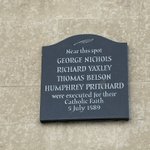
Today is the #FeastDay of the #DouayMartyrs - 156 Catholic priests trained at the #EnglishCollege in Douay and martyred in England 1577-1680. They include several #Jesuits - Edmunds #Campion & #Arrowsmith, Robert #Southwell, Roger #Filcock, Alexander #Briant
David Bell retweeted
29 October 1940 | Dutch Jewish girl, Lida Carla ten Brink, was born in Denekamp.
She was deported to #Auschwitz from #Westerbork in November 1942. She was murdered in a gas chamber after the arrival selection.
---
A short video about the first two gas chambers created near Auschwitz II-Birkenau: youtu.be/Rr6lF75fDmU
David Bell retweeted
28 October 1942 | SS men executed by shooting some 280 Poles at the German camp Auschwitz I. The execution took place at the Death Wall located at the courtyard of Block 11. Some were killed when they tried to resist in the corridor inside the block.
This was a retaliation for sabotage and partisan actions carried out in the Lublin area, and the victims of the executions were mainly prisoners deported from prisons in Lublin and Radom in 1941 and 1942.
Watch a short video about Block 11 and its yard where shooting executions were held: youtu.be/3hjDCsqgGY0
Captain Witold Pilecki wrote about this execution in his report:
"On 28 October 1942 in the morning roll-call, clerks (Schreiber) in various blocks began to summon some numbers of prisoners and told them they should go to the “Erkennungsdienst” for a verification of photographs.
In total, two hundred forty and several people were summoned - exclusively Poles - as we found out later, mainly of the Lublin region, including one fourth of Poles who had nothing in common with the Lublin transports, and were carried initially to block 3, which itself aroused our suspicions why not to block 26 at once, where the “Erkennungsdienst” was located – the sham reason of the summon.
We were called by a bell to our “Arbeitskommando” and then we went outside the camp as usually, each commando bound for its work place. At work, our colleagues in all commandos were seething - we did not know then if they were in some danger. Later, news was spread that they were to be executed. Two hundred and forty fellows – mainly evident inhabitants of the Lublin region, to whom some numbers of those whose activity, energy was evident, were added - apparently having selected them from all over the camp through Grabner's "curs". We did not even get to know by what they were guided, maybe the mere "sweet will" of the two scoundrels was decisive. Yet it was called a "pacification of the Lublin region", which re-echoed in such way in the camp… Such high number of prisoners had not been executed at once so far….
Our colleagues murdered on 28 October 1942 knew of what was in store for them. In block 3 they were told they would be executed by firing, they throw paper scraps to their colleagues who were to live, asking them deliver to their families. They made a decision to die “in a joyful spirit”, so that they would be told about well in the evening. Let somebody say, we Poles cannot do that.... Those who saw that picture told they would never forget it. From block 3, between 14 and 15, between the kitchen and blocks 16, 17 and 18 and further straight on between the hospital blocks, they went in a column in their fives, they carried their heads up in quiet, smiled faces here and there. They went without any escort. Behind them Palitzsch with rifle on slide and Bruno, both of them smoking cigarettes, talking about irrelevant matters. It sufficed if the last five did “about turn” and the existence of those two butchers would be ceased..
So, why did they go on? Were they in fear for themselves? What should they fear in such moment, when they were walking to death anyway? It looked like psychosis. But they continued to go, because they had some reason for them. Informations, announced in advance by the authorities, confirmed by colleagues coming from freedom, that the whole family was held responsible for a prank of the prisoner, produced the desired effect. It was known that Germans were ruthless in application of repression and they kill families, showing in such cases as much bestiality as they could bring themselves to. How did bestiality look like? - was there anyone who knew it better than we?
To know or to see that your wife, mother, children were in such conditions, as women here in Brzezinka, was enough to paralyse any desire to attack the butchers…
So they went on... Near the canteen (a wooden one in a small square behind block 21), the column going between block21 and 27, seemed to stop, to hesitate, was near to go straight on. But it was one short moment, it turned square to the left and went just to the gate of block 11, just to the jaws of death. Not before the gate had closed after them and they were left there for several hours - they were to be executed in the afternoon - under the influence of an anticipation of death, various doubts began to come out of recesses of mind and there were five colleagues who incited to seize the whole camp, to start action here. They barricaded the gate and more serious things could probably occur, as the Germans had not reinforced the guard and all our commandos were waiting for a signal, were it not that the protest against death did not go beyond block 11 at all. Except for that five, nobody allowed to be carried away and a Silesian, a functionary of that block, informed SS-men of the seeds of mutiny, so Palitzsch accompanied by several SS-men arrived at the block and disposed of those several prisoners, killing them first of all and leaving the rest for later on… In the afternoon, they all were dead.”
David Bell retweeted
28 October 1940 | During the afternoon roll-call, one prisoner was found missing. A penal roll-call was ordered at noon. Prisoners had to stand “at attention” in their uniforms but without coats, sweaters, hats, or shoes. It was sleeting all day.
The roll-call was called off around 9 pm after the missing prisoner was found. He had tried to hide from the rain and died in his hiding place in the camp. After the roll-call, over 120 dead, unconscious, or sick prisoners were collected from the roll-call square.
Watch our short video about the roll-call square: youtu.be/jUKduX1NiHY


