

Investor | Disruptive Growth Tech & Markets Focused All Things Stocks and Finance Not Financial Advice.
Joined January 2013
- Tweets305
- Following86
- Followers972
- Likes284



China restrictions are creating an execution test for neoclouds.
CNBC reported that Nvidia chip sellers are warning neocloud providers against renting GPU capacity to Chinese customers.
The BIS remote-access rule adds another layer of pressure.
For $CRWV $NBIS $IREN, the challenge is clear: redirect affected capacity, bring GPU clusters online, and keep utilization high.
Securing power and signing contracts are only the first steps. Turning that capacity into revenue and cash flow is what matters.
AI demand isn't disappearing. The winners will be the ones that execute.
Which company is best positioned to turn capacity into cash flow?

Google wants even MORE compute from SpaceX. And that's telling us something important about the AI infrastructure market.
Musk said Saturday that Google has expressed interest in renting additional capacity. No size or timing has been disclosed.
They already have a massive multi-year deal:
Google pays SpaceX $920 million per month from October 2026 through June 2029 for roughly 110,000 Nvidia GPUs, plus supporting hardware.
A June filing also showed SpaceX's combined compute agreements with Google and Anthropic exceeding $70 BILLION.
Here's where things get interesting.
Musk recently noted that prices for large, coherent, high-bandwidth training blocks are rising, while allocations below 5,000 GPUs are declining.
Hyperscalers themselves are still willing to pay up for the former.
And that creates an important opportunity for AI infrastructure companies.
$NVDA $CRWV $NBIS $IREN only capture that opportunity if they can deliver the same kind of tightly interconnected capacity—not just more megawatts on paper.
Prepayments and massive backlogs mean very little until the clusters are actually live, connected, and delivering usable compute at scale.
Demand from the biggest buyers is not the question. Who can actually deliver the large coherent blocks is.
The real question is:
Which of these companies can turn compute scarcity into sustainable cash flow before capital costs eat into the upside?
That's where the real winners in AI infrastructure will emerge.

How much of $NBIS revenue can you actually annualize?
About a third of its Q3 revenue came from a contribution the company called non-recurring.
Nebius’s Nov. 12 shareholder letter reported:
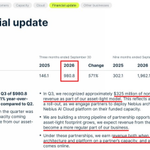
• $980.8M in total Q3 revenue.
• Approximately $325M of non-recurring revenue from its asset-light model.
That leaves roughly $656M outside that specific contribution. It does not mean the entire remainder is recurring subscription revenue.
The asset-light model has a useful purpose: partners fund capacity while Nebius provides its architecture and cloud platform. That could expand the business without Nebius funding every site itself.
But revenue recognized when enabling a partner’s infrastructure has a different pattern from revenue earned as customers consume compute.
Nebius also said these partnership revenues could become more regular as the model expands. That remains something to verify.
The next earnings checkpoint is the revenue mix: how much comes from operating capacity, how much from enabling partner deployments, and whether both produce repeatable economics.
Applying the same valuation multiple to every revenue dollar skips that distinction.
Which deserves the higher multiple: deployment revenue or ongoing compute revenue?
I post daily on NeoClouds and AI infrastructure. Follow if you want the names that can actually deliver.

$CRWV financing bill deserves as much attention as its backlog.
CoreWeave Nov. 10 earnings release reported $207M of Q3 GAAP operating income against $846M of net interest expense.
That’s the gap the growth story needs to close.
Customer prepayments can reduce the need for additional borrowing. They also come with obligations to deliver compute. They aren’t profit.
The next earnings test: does operating income grow faster than net interest expense as deployed capacity starts earning revenue?
A bigger backlog helps only if financing and delivery leave enough value for shareholders.
What improves first: operating earnings or the financing burden?

A market rebound doesn’t reset $IREN delivery deadline.
Nasdaq-100 futures were up 2.8% in CNBC’s Nov. 27 update.
That’s a better trading backdrop. It’s not evidence of faster delivery.
$IREN Nov. 5 release moved its more than $4B operating ARR target from year-end to January 2027, potentially late February.
The target depends on commissioning, testing and customer acceptance. ARR is an operating metric—not recognized revenue.
At the open, separate a sector-wide bounce from any new delivery disclosure. A stronger share price can signal improving sentiment. Accepted capacity is what validates the revenue timeline.
Which matters more here: the next contract or the next commissioned cluster?

Jensen addressed the biggest fear around NeoClouds at GTC Berlin in October.
Are $CRWV, $NBIS, and $IREN going to die?
His answer was clear: a shakeout is unlikely because demand is still far ahead of supply.
He pointed to $SPCX (Elon said demand is multiples of their already large capacity and they’re still expanding), $CRWV, $NBIS, and Nscale — all in the same boat. Orders are there. Capacity isn’t.
The real bottleneck isn’t demand. It’s the lag.
GPUs ship, but it can take months before they start generating revenue. The capital float on these builds is massive.
That’s why he pushed DSX Pod — cutting deployment time from months down to as little as 14 days at a prepared site. His logic is simple:
The sooner the compute starts producing tokens, the sooner the capital starts getting paid back.
Demand solves the survival question.
Execution speed and capital efficiency will decide who actually wins big.
This clip is still worth watching twice.
Stop calling Elon Musk’s support for Jensen Huang an act.
Look at the video of Jensen personally visiting Elon at SpaceX last year. Their relationship goes back much further than most people realize.
It was built 10 years ago, before NVIDIA became the AI giant it is today.
Back in 2016, Jensen unveiled the DGX-1, the world's first AI supercomputer.
It was the most advanced machine of its time.
But when the launch event ended, the room was silent. Not a single order.
Well, almost.
Last October, Jensen brought the latest DGX Spark to SpaceX and reminded Elon of that moment.
He still remembered exactly what happened:
"The entire room was silent. Except for one person. And that person was you."
Elon immediately replied:
"I thought it was a great idea."
That one early vote of confidence helped put the original machine into the hands of OpenAI — contributing to the beginnings of the AI revolution we see today.
Now fast-forward to November.
November 13: Jensen's return was still uncertain. Elon publicly stepped forward and signed a petition supporting him.
November 23: Jensen was officially reinstated. His response?
"It is done."
And shortly after, Elon showed up at NVIDIA headquarters to celebrate alongside him.
Think about those two moments.
One happened when the product had no customers.
The other happened when Jensen hadn't even made his comeback.
Both times, Elon showed up before the outcome was certain.
Most people wait until the dust settles before choosing a side.
But real conviction is showing up when the outcome is still uncertain.
That's what makes this relationship worth paying attention to.
The strongest partnerships aren't built after success. They're built before anyone knows who's going to win.
$IREN latest cooling video illustrates a closed-loop water system: the same water is recirculated rather than continuously drawing on fresh water.
But the video leaves out the numbers that matter most to investors — specifically, what this design means for the actual cost of delivering compute.
That's a more interesting question than how much water it saves.
Investors closely track how many MW a company has secured, how many GPUs it has ordered, and how much data center capacity is under construction.
But secured power is an input. Turning that power into reliable, economically productive compute is the output.
And cooling is one of the critical systems connecting the two.
$IREN closed-loop approach could reduce dependence on continuous freshwater supply and provide greater flexibility in resource management.
But recirculating water doesn't eliminate heat rejection, nor does it automatically translate into lower operating costs.
To understand its actual economic value, I'd focus on three things:
1. Resource efficiency
How much water is actually consumed relative to the computing capacity delivered? WUE is a useful starting point, but the real question is how much freshwater the facility requires under normal operating conditions.
2. Energy efficiency
How much electricity does the cooling infrastructure consume? If better water management comes at the expense of significantly higher cooling power, some of the potential benefit could be offset.
3. Capital efficiency
What additional infrastructure investment is required, and how much computing capacity can it support? The economics matter just as much as the engineering.
This is why I wouldn't call closed-loop cooling a competitive moat on its own.
Its value will ultimately depend on whether it improves resource efficiency, supports higher-density computing, and enhances operational reliability — without introducing disproportionate capital or energy costs.
The bigger investment question isn't simply how many MW an AI infrastructure company can secure. It's how much reliable, revenue-generating compute it can deliver from each MW — and at what total cost.
That's where infrastructure engineering starts to translate into competitive economics.
$NBIS: Revenue Up 571%. Shares Still Sold Off. Here's What I'm Watching.
Nebius grew Q3 revenue 571% YoY and beat expectations. Shares still fell sharply after the results, as neocloud stocks broadly sold off.
I can't know exactly why the market reacted that way. But I think the more useful question is this:
Can Nebius turn massive AI infrastructure demand into durable returns, without infrastructure costs, delivery delays, and financing needs consuming the upside?
Here's how I see the opportunity, the risks, and what would change my view.
1. The headline is impressive. The revenue mix matters.
Q3 2026 revenue was $980.8M, up 571% YoY. Adjusted EBITDA was $465.8M.
But about $325M, roughly one-third of the quarter's revenue, was non-recurring revenue from partner-funded, asset-light capacity. That revenue also helped lift reported margins.
Net loss from continuing operations was $37.5M.
I'm not dismissing the growth. I'm asking how much of it is repeatable. Recurring revenue, cash generation, and the economics of each new deployment matter more than the headline growth rate.
2. Execution is the immediate test.
Nebius targets $12–13B in 2027 revenue, roughly four times its 2026 outlook.
But the delivery timeline has already moved:
• Third-party data center delays pushed some capacity into Q2 2027.
• 2026 revenue guidance was narrowed to $3.0–3.2B, from $3.0–3.4B.
• The milestone of $7B+ annualized run-rate revenue slipped from December to February.
ARR was $6.4B at the end of September, a strong trajectory. But run-rate is not revenue already earned.
Demand is strong. The challenge is converting it into live capacity on schedule.
3. The capital requirements are enormous.
Expected CapEx:
• 2026: ~$27B
• 2027: $40–45B
Management expects prepayments and asset-backed financing against investment-grade customer contracts to cover 75–85% of 2027 CapEx. On Q3 deals, prepayments covered more than 100% of the associated CapEx.
That's a real funding advantage. But two things are worth keeping in mind:
• The remaining 15–25% of $40–45B is roughly $6–11B that must come from other sources (my estimate; management measures coverage on contracts of one year or longer).
• Financing isn't free capital. Asset-backed financing creates obligations, and prepayments come with commitments to deliver capacity and services.
The real test is whether the infrastructure generates enough cash to justify the capital deployed.
4. The bull case: strong contracts and improving economics.
• Q3 contract pricing exceeded $25M per MW.
• Expected payback on comparable deals improved to 1 year 7 months, from 1 year 10 months in Q2.
• Revenue backlog reached $132.5B, up 138% YoY.
Backlog is a strong demand signal, but it is not recognized revenue.
Attractive deal economics still need to translate into attractive company-wide returns. Utilization, operating costs, financing costs, and deployment timing will decide that.
5. There's a business beyond GPU capacity.
Nebius is building an integrated AI cloud platform, including its managed inference offering, Token Factory.
Per Q3 reporting, Token Factory is approaching a multi-hundred-million-dollar annual run rate, and its contract value grew about 17x quarter over quarter. That 17x refers to Token Factory's contract value only, not company-wide revenue or backlog.
If AI workloads keep shifting from training to real-world inference, this could become a significant source of demand. It's compelling, but contract value and run rate are not yet recognized revenue or cash flow.
6. What I'm watching over the next 12 months
• Delivery: Do delayed third-party projects come online on the revised timeline?
• Revenue: Can Nebius deliver on its $12–13B 2027 target?
• Utilization: How quickly does new GPU capacity become productive?
• Cash conversion: Does EBITDA growth turn into cash as CapEx rises?
• Profitability: Does management reach its pre-tax breakeven target by the end of 2027?
These will tell us more than another quarter of headline growth.
7. My view: what would make me more bullish or more cautious
I'm constructive on the long-term AI infrastructure opportunity. Nebius has meaningful demand, a large backlog, improving contract economics, and a platform that goes beyond GPU rental.
But a strong growth story isn't the same as a proven capital-efficient business.
I'd get more bullish if:
• Delayed capacity comes online on schedule.
• Utilization rises without sacrificing pricing.
• Contract-level payback shows up as stronger company-wide cash generation.
• More of the growth comes from repeatable business rather than one-off contributions.
I'd get more cautious if:
• Infrastructure delays continue.
• CapEx keeps rising faster than new capacity can be monetized.
• Financing needs increase.
• EBITDA growth fails to turn into cash.
My central question isn't whether Nebius can grow. It's whether it can turn that growth into sustainable returns on the enormous capital it's deploying.
If you could track one metric for the next two years, which would it be: revenue growth, GPU utilization, or cash conversion/ROIC?
I'm leaning toward the last one. That's where real business quality will show.
Source: Nebius Q3 2026 results (Nov 12). Not investment advice. Do your own research.

“Which stock do you think has been the most unfairly punished?”
“In the semiconductor space, I’d say Nebius $NBIS and TSMC $TSM.”
From a TheStreet interview with Mark Newton on the NYSE floor. Mark is Head of Technical Strategy at Fundstrat, previously a strategist at Morgan Stanley, with over 25 years of Wall Street experience.
He sees a paradigm shift underway and argues the market has over-punished certain AI infrastructure names.
Nebius $NBIS, the former Yandex reborn as a pure-play AI cloud and GPU infrastructure company, has been especially hard-hit despite its direct exposure to the ongoing build-out of AI compute capacity.
Newton groups it with TSMC as one of the cleaner ways to express the view that the sell-off in the semi/AI complex has gone too far.
Most neoclouds are still selling capacity that doesn’t exist yet.
After the Blue Tsunami, the market will separate the ones that can actually build from the ones that can’t.
Here’s the current breakdown:
• $NBIS: ~3.1GW total pipeline, 32% active or under construction. 1.2GW announced in friendly states, 1.0GW in hostile states.
• $CRWV: ~4.7GW total pipeline, 68% active or under construction. 0.2GW announced in friendly states, 1.2GW in hostile states.
• $IREN: ~4.5GW total pipeline, 35% active or under construction. 1.6GW announced in friendly states, 1.4GW in hostile states.
• $APLD: ~1.75GW total pipeline, 74% active or under construction. No announced capacity in hostile states.
A gigawatt already generating revenue or under construction is worth far more than one that still needs permits, financing, and power before it can be monetized. That’s where the real separation happens.
💡I post daily updates on neoclouds and AI infrastructure. Follow if you want to track which names can actually deliver.

Jensen Huang is back. The AI party isn’t over.
While most people were still debating whether the cycle was done, NVIDIA just confirmed the buildout continues.
These 5 names still have serious 10x upside from here:👇
1. $NBIS
The best positioned Neo-Cloud.
- 500% revenue growth YoY
- Backed by $NVDA
- $50B+ Backlog


⚠️Who said neoclouds don’t have a technical moat?
Databricks co-founder Patrick Wendell:
“We are VERY CAREFUL about where compute runs and so far we’ve only found a single neocloud we think has robust enough isolation to ever have a chance at running our customer workloads.”
High confidence this refers to $NBIS.
Nebius was named in Databricks’ Q3 shareholder letter after a rigorous evaluation (November 12).
Anyone can rent GPUs.
Getting approved to run customer workloads is a different bar.
Isolation and trust are harder to copy than capacity. That’s the real differentiator.
Isolation and enterprise trust are harder to scale than raw capacity. If more platforms start treating Nebius as one of the few viable options for sensitive workloads, that changes the long-term picture.
I post daily updates on $NBIS and AI infrastructure.
Follow if you want to track how this plays out.


🚨HE'S BAAAAAACK
$NVDA board just reinstated him as President, CEO, and Board Director.
This is not a minor governance update.For $NBIS and the rest of the AI infrastructure / neocloud names, this matters more than most people realize.
Jensen has been the single strongest force behind aggressive GPU deployment and the long-term data center buildout thesis.
His full return removes uncertainty around NVIDIA’s pace and strategy.
When the person most committed to flooding the market with AI compute is firmly back in control, the entire infrastructure stack benefits — power, land, cooling, and the new cloud platforms built on top of it.
Sentiment just improved.


🚨 $IREN IS BUILDING FOR THE NEXT AI COMPUTE BOOM — WHILE OTHERS ARE STILL WAITING FOR POWER.
Sweetwater 1 update:
• Second 200MW IT structure foundations now underway.
• Structure 1 Data Hall 1 waiting on CUP → electricals, MERs & generators next.
• $6.7B of VR200s set to start arriving in ~8 months.
This is the flagship site of IREN's 2GW West Texas hub and a core NVIDIA DSX deployment location.
While others are still hunting for 2027 power, IREN is already building for Vera Rubin at scale.
Physical progress. Real infrastructure. The next catalyst is execution.

