Generalist, Adventurous, Curious.
Ogbomoso, Nigeria
Joined December 2018
- Tweets10K
- Following2.1K
- Followers1.2K
- Likes14.9K
F.A retweeted

Made an app for learning electricity, step by step.
How everyday things in your home work, what keeps you safe, and a few tricks that feel like magic.
37 lessons. 21 languages.
how-its-wired.vercel.app


F.A retweeted

How did Anthropic rewrite the API all Claude tokens from Python to Rust, why did eng teams remove coding interviews, and why do devs spend a LOT more time building internal tools than before? Super interesting details from @katelyn_lesse
Timestamps:
00:00 Intro
03:09 Stripe
07:04 How the Claude API works
10:21 The Rust rewrite of the Claude API
23:40 Verifying the rewrite with shadow traffic
31:11 Onboarding new hires with Claude
44:35 Building Claude Managed Agents
53:59 How engineering teams work at Anthropic
58:43 What agents handle on their own
1:04:47 Human code review
1:06:41 Oncall with Claude
1:09:31 Product managers shipping to production
1:16:25 Anthropic’s software factory
1:24:13 Phasing out traditional coding interviews
1:28:24 Levels, promotions, and performance reviews
1:33:21 The software engineer identity crisis
1:47:23 Book recommendation
1:48:12 Closing takeaways
Brought to you by:
• @turbopuffer – a vector and full-text search engine built on object storage. It’s fast, cheap, and extremely scalable. Anthropic is one of their many customers. turbopuffer.com/pragmatic
• @AntithesisHQ – verify your system’s correctness without human review or traditional integration tests – and avoid bugs or outages. Check out their coding agent plugin and use the code PRAGMATIC50 to get 50% off your first month at antithesis.com/pragmatic
• @GoEntire – The Git forge for agent-human collaboration. Built for the scale and throughput of agentic coding. Mirror your repo with one click (or move over fully) at entire.com/pragmatic
Three interesting details from inside this leading frontier AI lab:
1. The rewrite was done without Rust experts on the team or strict code reviews.
A year earlier, the same team picked Go for their new services because it was a language that team members knew how to read and write. But by 2026, they felt that Claude was good enough at Rust, and Claude helped engineers learn more about Rust during the rewrite. Katelyn estimates that engineers looked closely at only ~20% of the code generated:
“As long as you can really boil something down to make it verifiable in some way, then you don't have to look at every single line of Rust code that's getting written.”
2. A Claude agent is paged before a human for API oncall.
For months, a Claude agent has been shadowing the API oncall rotation of the API team for training. As the team have gained confidence that Claude can tell if an alert is “real” or “noise,” they now let this agent categorize an incoming alert first. The long-term goal is for Claude to handle actual incidents without waking up a human – but they’re not there yet.
3. One thing that has not changed since "pre-AI" is two-pizza teams.
Teams at Anthropic are still two-pizza teams of around 5-8 people. Katelyn says it’s because this is the right size for understanding a complex system and staffing an oncall rotation. Teams still own systems, and get paged. And it is a team – not an individual – that’s responsible for each system!
F.A retweeted

Principles of Outcome Engineering
In 2027 the the most effective engineers will channel their craft into defining outcomes
My attempt at defining what working this way looks like:
outcomeengineering.systems


F.A retweeted

Anthropic engineer, Addy Osmani (ex-Google):
"Google hired me at $600K–$1.2M a year because I know how to make AI agents write code that doesn’t break."
In this 41-minute workshop he shows exactly how to build that system from scratch
Claude Code → Prompts → Agent Skills → AI agents → Harness → Agents That Ship Without You
step 1 → Refine the idea - drop in a vague thought, the agent interviews you and comes back with 3 directions
step 2 → Write the spec - success criteria, stack and open questions locked before a single line of code
step 3 → Plan in small tasks - each one gets acceptance criteria and a list of files it's allowed to touch
step 4 → Build test-first - red to green, slice by slice, so nothing that already works breaks
step 5 → Verify and review - the agent opens the app in a browser, checks security and simplifies its own code
He open-sourced all 24 skills, and the repo is close to 100K stars
Google calls this "agentic engineering"
95% people spend weeks building this by hand
You don't have to
Bookmark it and watch it rn
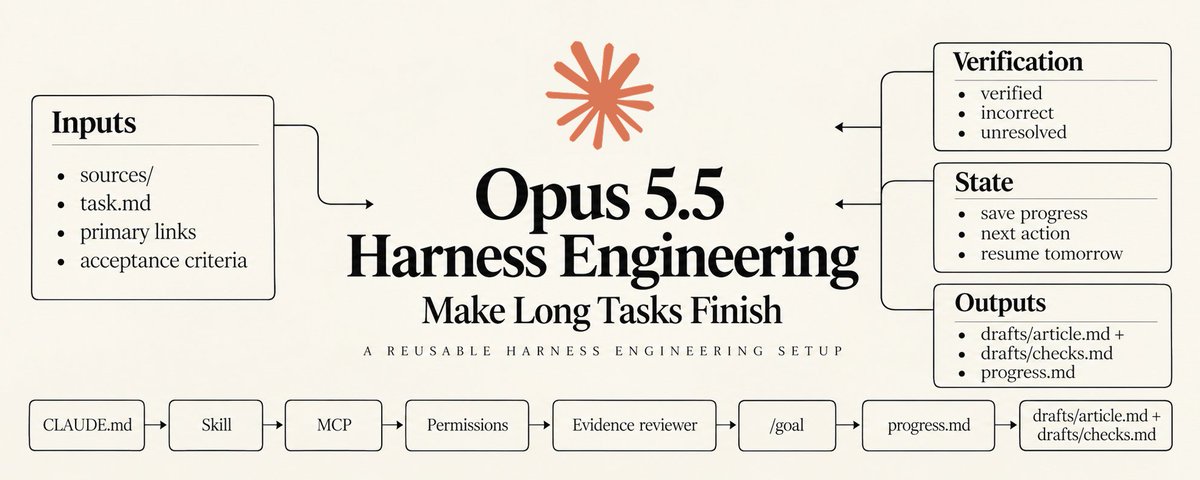
Then read the full Opus 5.5 harness engineering guide below ↓


F.A retweeted

Instagram can hand out 1024 new IDs every millisecond on every shard without a single ID server
They were writing 25 photos and 90 likes a second and had started splitting Postgres across a bunch of machines. Once several databases take inserts at the same time, a normal auto incrementing key on one database stops working
They looked at Twitter's Snowflake but didn't want to run ZooKeeper and a whole ID service on top. Feels like a lot of how they scaled with so few engineers was just avoiding new moving parts
So Postgres makes the ID itself at insert time. It's 64 bits. The first 41 are milliseconds since their own epoch, which is good for about 41 years, and that's why the IDs are already sorted by time. The next 13 say which shard the row lives on, so the ID tells you which database to go to. The last 10 are a counter that resets every millisecond
I love the shard part. Those 13 bits name a logical shard, and there are thousands of them, each just a Postgres schema, sitting on far fewer machines. To add a machine you move some logical shards over and no ID ever changes
Source: medium.com/instagram-enginee…

F.A retweeted

keep pushing forward.
blog.stackademic.com/keep-pu…

F.A retweeted

It is why I always laugh when people say “ancient city of Ibadan”.
Of the big Yoruba cities and towns, Ibadan is probably the newest.


F.A retweeted

Day 3 of the Scaling & Architecture series.
Today: Caching.
I'll discuss the actual 5 layers where caching happens in a production system.
Most engineers know maybe 2 of them. The other 3 are doing work behind the scenes that you've probably never configured and thought about.
One of them is invisible. Your OS is doing it right now without you asking.
Thread below 👇
F.A retweeted

Every engineer should read this.
databricks.com/blog/what-540…


F.A retweeted

I usually stick to posts about software testing on this platform, but I just have to share that I got baptized yesterday, and that God is so good! 😃
F.A retweeted

Everyone building platform product should read this again.
When you think you've understood it, read it again. joelonsoftware.com/2002/06/1…

F.A retweeted

At my NYSC placement, staff clocked in by sending a video to a WhatsApp group. Someone downloaded each one and typed the name into Excel.
One day, I was given that job. It was enough to know it had to go.
F.A retweeted
This is kinda blogs I pay my internet bills for.
uber.com/us/en/blog/protecti…

F.A retweeted

If you can build these 12 Forward Deployed Engineer (FDE) projects.
You're hired.
Project 1: Enterprise SSO & Agent Delegation Broker
OIDC/SAML bridge issuing 5-minute, strictly scoped JWTs to agents acting on a user's behalf, with automatic revocation.
→ Shows: You can pass enterprise security reviews and manage non-human identities
Project 2: One-Click Air-Gapped Helm Deployer
Terraform/Helm scripts deploying the full AI stack (DB, Vector Store, LLM) into an isolated VPC with zero public egress.
→ Shows: You can deploy to banks, hospitals, and governments that ban public cloud APIs
Project 3: Unstructured Legacy Ingestor
OCR + mainframe DB connector turning 10 years of messy, scanned PDFs and COBOL exports into a clean, chunked vector store.
→ Shows: You can fuel AI with the messy, unstructured reality of enterprise data
Project 4: Row-Level Secure RAG Engine
Retrieval pipeline enforcing document-level RBAC so a junior employee's query physically cannot retrieve executive M&A chunks.
→ Shows: You prevent catastrophic internal data leaks at the retrieval layer
Project 5: Raw MCP-to-ERP Bridge
JSON-RPC Model Context Protocol server wrapping a 15-year-old on-prem SAP/Oracle SOAP API so agents can safely read/write records.
→ Shows: You give AI standardized hands to touch the customer's actual systems of record
Project 6: Deterministic PII Unmasking Proxy
Middleware swapping SSNs and credit cards for UUIDs pre-inference and restoring them post-generation with immutable audit logs.
→ Shows: You satisfy strict compliance teams without breaking the model's reasoning
Project 7: Async Temporal Approval Gate
Durable workflow pausing a high-stakes agent action (like a $50k PO) until a human clicks "Approve" in Slack, surviving server crashes.
→ Shows: You build legally accountable, crash-resilient autonomous systems
Project 8: Local Quantized Triage Node
AWQ 8B model running on a single customer-owned GPU for zero-latency, offline PII screening and triage before cloud routing.
→ Shows: You know how to bring the model to the data when the data is too hot to move
Project 9: Department-Level FinOps & ROI Dashboard
Telemetry pipeline attributing exact token spend, API costs and time-saved per customer team to mathematically prove product value.
→ Shows: You prevent enterprise churn by quantifying ROI in the customer's own metrics
Project 10: Historical Shadow Replay Harness
Pipeline replaying 500 real, messy past customer support tickets through the agent in shadow mode to prove accuracy pre-launch.
→ Shows: You prove the AI works on *their* data not just generic public benchmarks
Project 11: Automated Architecture Scoper
Framework converting vague executive "we want AI" requests into a scoped 4-week SOW with threat models, diagrams and success metrics.
→ Shows: You translate business hype into executable engineering reality
Project 12: Self-Serve Customer Admin Portal
UI letting the customer's internal IT manage prompts, view OpenTelemetry traces and update configs without filing a support ticket.
→ Shows: You build scalable product deployments, not permanent consulting traps
(Bookmark this)
happy building...

If you learn Forward Deployed Engineering, you will never be unemployed again.
I'd do this.
Stage 1: Enterprise Identity & Agent RBAC
SSO (SAML/OIDC), SCIM provisioning, Row-Level Security (RLS), Agent-to-Human delegated OAuth, scoped JWTs for tool execution.
Stage 2: Air-Gapped & VPC Inference Deployments
Terraform/Helm for private VPCs, air-gapped container registries, strict egress filtering, on-prem GPU provisioning, zero-trust networking.
Stage 3: Legacy Data Extraction & ETL
OCR pipelines, mainframe DB connectors, unstructured PDF parsing, messy CSV normalization, Airflow/dbt orchestration, data reconciliation.
Stage 4: Permission-Filtered RAG & GraphRAG
Document-level RBAC, hybrid search, metadata tagging, cross-tenant isolation, citation grounding, multi-hop graph traversal, abstention logic.
Stage 5: MCP & Legacy System Integration
Raw JSON-RPC MCP servers, SOAP/REST translation, headless browser fallbacks, on-prem SAP/Oracle connectors, strict API rate-limit handling.
Stage 6: PII Cryptography & Guardrails
Deterministic UUID swapping, NER redaction, pre/post-flight unmasking proxies, format-preserving encryption, immutable audit logging.
Stage 7: Human-in-the-Loop (HITL) & Durable Workflows
Temporal{dot}io state machines, async Slack/Teams approval gates, workflow checkpointing, crash recovery, legal accountability trails.
Stage 8: Edge & On-Prem Local Inference
vLLM/TensorRT-LLM on customer hardware, AWQ/GGUF quantization, offline fallback routing, local SLM triage, zero-latency PII screening.
Stage 9: Telemetry, ROI & Customer Health
OpenTelemetry for LLMs, cost-attribution per department, time-saved dashboards, silent failure alerting, usage-based billing meters.
Stage 10: Shadow Evals on Customer Data
Golden dataset creation from historical logs, trajectory grading in shadow mode, LLM-as-a-judge calibration, custom business metric design.
Stage 11: Technical Discovery & SOW Scoping
Stakeholder interviewing, architecture diagramming, gap analysis, translating executive "AI hype" into scoped 4-week deployment plans.
Stage 12: The Handoff & Self-Serve Admin
Runbook automation, internal IT enablement, chaos testing in customer VPCs, admin portals for prompt/config management without FDE intervention.
Most people stay stuck watching tutorials.
Builders get hired.
(Bookmark it)
F.A retweeted

If you are thinking of applying today:
- Talk to people who have applied **recently**. Talk to those who got rejected and those who got accepted.
- If you think that you won't get it, come up with a plan to address the gaps with the aim of trying within a reasonable timeline.

Last year, Nigerians paid ₦1.5B in UK Global Talent endorsement fees. 97% were not endorsed.
Home Office data analysed by Condia show Tech Nation endorsed 42 of 1,303 Nigerian applicants for the UK's Global Talent visa in 2025-26, the lowest success rate of any nationality.
Read More: thecondia.com/tech-nation-gl…