
Asst Prof of Practice, PhD, RDN @CornellMPH @Cornell 🇩🇴/🇺🇸 advocating for more equitable food systems || Views my own || She/her
- Tweets877
- Following678
- Followers508
- Likes1.9K
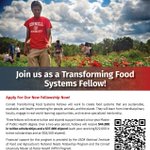
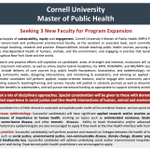


ALT Flyer with photo of student in a Cornell shirt in a field. The flyer reads: Join us as a Transforming Food Systems Fellow! Apply for Our New Fellowship! Cornell Transforming Food Systems Fellows will work to create food systems that are sustainable, equitable, and health-promoting for people, animals and the planet. They will learn from interdisciplinary faculty, engage in real-world learning opportunities, and receive specialized mentorship. Three fellows will receive tuition and stipend support toward a 2-year Master of Public Health (MPH) degree. Over a two-year period, Fellows will receive $44,000 in tuition scholarship and a $37,000 stipend (each year receiving $22,000 in tuition scholarship and an $18,500 stipend). Financial support for this program is provided by the USDA National Institute of Food and Agriculture's National Needs Fellowship Program and the Cornell University MPH Program. Learn more at publichealth.cornell.edu/TFSfellowship


ALT “Children are often the focus of behavior change research, but not involved in designing or evaluating interventions,” DiGiorgio points out. “There is evidence to show that children’s development depends on the opportunity to be agents in their own dietary patterns,” she says. DiGiorgio believes children’s perspectives should be included both to improve research and “to empower kids to be involved in their roles in the food system.” Her interviews with 3rd-5th graders found that their school food priorities were often less about the food itself, and more about seeing friends from other classes, decompressing from the busy school day and just “having fun” at lunch. These priorities don’t always align with those of parents or administrators, of course, which DiGiorgio says illustrates “why we need to factor in kids’ perspectives” in school food policy decisions. -Francesca DiGiorgio, Cornell MPH '22

ALT “Some parents shared how school lunch supports their families and routines,” says Lockhart. She interviewed parents who both did and didn’t have kids participating in the school lunch program. Lockhart found that parents cared most about cost, time and convenience, the quality of food and nutrition, the variety of food choices offered, and their children’s preferences and dietary restrictions. “This research is not at all a way to tell a school how to run their food program better,” she points out. One of her recommendations was for schools to “promote the wins” to the larger community, showcasing “all the positive things they are doing.” She also found that reframing the cafeteria as a space for learning, rather than just a place to “get food and move on with the day,” could appeal to parents. -Sonja Lockhart, Cornell MPH '22


