
Telecommunications Network Analyst
UK
Joined May 2012
- Tweets4.3K
- Following106
- Followers89
- Likes4.1K





Richard Dominy retweeted

If the UK Government decides to make it £4,000 more expensive to hire someone on the minimum wage, it really shouldn’t be surprised at all by the decline in entry level jobs.
Then when the UK Government adds huge risks and stupid legal complexity onto employers across the country through new employment rights laws, they should not be surprised when employers completely go off the idea of hiring new staff.
While the RMT is striking, the other major drivers' union, ASLEF, has accepted Transport for London's proposals and is not participating in the walkouts.
Someone explain that 🙄
42
Richard Dominy retweeted

A LABOUR GUIDE TO SCREWING THE LABOUR MARKET:
Step 1 - increase cost and risk of employing people by taxing businesses silly, empowering unions and introducing new labour laws until nobody wants to hire.
Step 2 - stoke employment crisis among young people. Launch a review to get to the bottom of it - time for after the Budget, just in case tax changes are recommended.
Step 3 - conclude instead that the solution is for the state to pay businesses money to take on said young people.
Step 4 - get Labour MPs to vote for the plan by reassuring them that cutting the welfare bill will actually cost LOTS of money #bekind
Step 5 - seek more money for the plan by taxing businesses.
Once cycle is complete, repeat until the state controls everything. Et voilà!
thetimes.com/uk/politics/art…
Richard Dominy retweeted

And there is the kicker that will be glossed over.
The “public sector”
The dumping ground for the unemployable - at our expense - and has been for decades!
The public sector should be slashed in half and business should be given the opportunity to grow with low taxation and low regulation.
But no!
Expand the “public sector” and dump them there instead and make us pay.
Richard Dominy retweeted

Failure to take forward the Oxford Cambridge arc illustrates all too well the neglect of investment, regulatory gridlock and myopic policy making that hold us back.
thetimes.com/article/d98e878…

Richard Dominy retweeted

Spending on new regional water authorities will not build a single reservoir or sewage pipe. We need big investment and new construction in water to catch up with the big rise in population, not more talking shops.
Richard Dominy retweeted

I find articles like this hilarious. They're written as though there's this thing happening that we can't explain.
Look at the data... quiet quitting is particularly pronounced among Gen Z and younger millennials.
Then look at the backdrop to their careers. These people have watched their futures being spent on bailouts, lockdowns and furlough.
Even if you work extremely hard and earn promotions (which is far from guaranteed), wages in the UK are so crap, and the cost of living so high, that the rewards often amount to very little.
The extra pay can be negligible. The extra effort and responsibility are not.
And if you've worked hard, trained and made your way up the greasy corporate pole, there's a good chance you've watched entry-level wages creep ever closer to yours. You might reasonably be asking yourself why you bothered in the first place.
Since the pandemic began, the National Living Wage has increased by nearly 55%. If you're someone with years of experience, training, progression and hard work under your belt, and your wages haven't kept pace, why wouldn't you question the value of all that effort?
The incentive has been inverted.
This is wage compression, and we're now witnessing the second- and third-order effects governments seem so oblivious to. When the financial reward for taking on more responsibility diminishes, so does the incentive to do it.
And this is what's happening. People are moving the dial they actually have control over… how much they give a shit about their job. And I don't blame them.
I think people are also starting to realise that much of the reward for their hard work is swallowed up by the ever-growing, increasingly wasteful blob that is the British state.
It's like having someone sitting on your shoulders, stealing half your food, getting heavier by the day, and repeatedly slapping you around the face as you try to go about your life.

'Quiet quitting' could be hitting the economy - here's why bbc.in/4ijTORZ

Richard Dominy retweeted

La gauche est déjà au pouvoir ! Au conseil constitutionnel, à la cour des comptes, les magistrats les enseignants . C'est foutu .
Richard Dominy retweeted

You're so right to raise the loss of social trust. My mother had a horrific experience with a rogue tenant who scammed her out of tens of thousands of pounds. What struck me most was the way the state essentially connived in her misery; e.g. the council advised the tenant to stay put and keep rinsing an honest person, presumably to avoid them becoming responsible for housing her. Police refused to help when the tenant caused extreme property damage and even broke into my mother's property, saying 'it's a civil matter'.
Once you've experienced that kind of anarcho-tyranny it makes you distrustful not just of the state but basically everyone you don't already know and trust. More and more people will come to feel that way and behave accordingly, which probably means more clan-like in their dealings with others. It's hard to quantify but something very precious is being destroyed
Richard Dominy retweeted

France is sliding toward a debt crisis through a slow, self-reinforcing trap rather than sudden collapse. Public debt stands near 119% of GDP. The interest bill is projected to rise from roughly €79 billion in 2026 to €91 billion in 2027 and €126 billion by 2030, exceeding some entire education or defense budgets. Political paralysis blocks escape. The 2024 snap elections produced a hung parliament; successive governments have fallen or been blocked from passing real budgets. Structural reforms, pension changes, spending restraint, tax-base broadening, require majorities that do not exist. Modest consolidation measures are repeatedly diluted or defeated. Limited savings will be more than offset by rising debt service as low-rate bonds are refinanced at higher yields and the debt stock grows.
Recent protests and riots compound the problem. They damage business and consumer confidence, cause immediate losses for retailers and hospitality, and trigger travel advisories and cancellations that hit tourism, a key revenue source. Investment is deferred, activity slows, and tax receipts weaken when most needed. The shortfall forces more borrowing, raising interest costs and fueling further unrest.
The arithmetic is unforgiving. When the effective interest rate exceeds nominal growth, the debt ratio rises even with a balanced primary budget. France is already in or near that zone, and gridlock prevents the primary surpluses needed to stabilize it. Without a durable majority willing to act before markets force the issue, the trajectory remains upward.


Richard Dominy retweeted
I sympathise with this sentiment, but what exactly do we want everyone to do?
I talk about the insanity of the welfare bill on here quite a bit. But I’m also torn, because I’m not entirely sure what we’d get everyone doing if we managed to get them all into work.
And as the comment this was responding to points out, the roughly 9 million working-age people who are economically inactive aren’t all welfare recipients. Some are students, some are carers, some are retired early, and some are simply choosing not to work because they can afford to support themselves.
The bigger question is whether our economy can actually provide enough productive employment for everyone who wants it.
We’ve hollowed out much of our productive economy, and there simply aren’t enough opportunities in many parts of the country. Even among the jobs being advertised, some aren’t genuine vacancies.
Meanwhile, we’re witnessing a growing tidal wave of AI and automation, with companies increasingly looking to do more with fewer people. My LinkedIn feed is absolutely horrendous at the moment, with the sheer volume of redundancies being announced.
And then listen to the experiences of people desperately trying to get a foothold in the labour market. Hundreds of applicants for individual vacancies, automated screening and interviews, endless applications, ghosting. It’s a nightmare.
We’ve also made employing people increasingly expensive. Higher employer NI contributions, rising minimum wages and enormous energy costs all influence whether businesses can afford to hire.
And it’s not as though we’re creating the conditions for new industries to emerge and replace the opportunities we’re losing.
We’re a heavily populated island, with limited domestic energy and mineral resources relative to our needs, expensive energy, mountains of debt, excessive regulation and an economy heavily dependent on services, many of which are increasingly exposed to automation.
So where exactly is all this work supposed to come from?
I don’t disagree with the principle that those who can work should contribute. But there’s a fundamental difference between wanting everyone to work and building an economy capable of employing them.
If we want more people working, we need to create the conditions for productive businesses to start, grow, invest and hire.
Otherwise, persistent unemployment and economic inactivity aren’t simply failures of individual responsibility.
They’re increasingly features of how we’ve chosen to run the country.

Richard Dominy retweeted

They can't build a railway. They can't even build a reservoir and that's literally a hole in the ground. – at City of London, London
Richard Dominy retweeted

Why have so many youth protests suddenly erupted across Europe? bbc.co.uk/news/articles/cm2k…

Richard Dominy retweeted

The answer: keep it simple. Don’t add special allowances and exceptions. Resist the urge to be clever.
No more complexification.
Richard Dominy retweeted

This post goes some way to explaining the dire financial straits the UK is in...
"Britain has almost run out of taxpayers, or at the very least, it’s slowly running out of people who pay enough taxes to plausibly finance the state."
"...in 1998, about 43 per cent of British earners paid sufficient tax to cover the Government’s average per-capita spending. During Covid, that figure fell to an absolute low of circa 20 per cent, then by 2025 recovered modestly to 26.6 per cent."
No wonder if fewer than 27% of people are net contributors to the state
It's stats like this that make me want to leave. Big new project in the US in the next few months might be just the springboard I need
@griffitha @LiamHalligan
open.substack.com/pub/ieains…
Richard Dominy retweeted
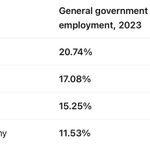
Due to popular demand, below the same data for some other European countries. Finland and Belgium have already crossed the point of no return, where the majority of voters have a vested interest in preventing any meaningful reforms of absurd state spending. Another two countries enjoying the socialist party as long as someone else is willing to finance it. At some point markets will say enough is enough though, like they did with France, and will stop buying their bonds at affordable rates forcing spending cuts.
The longer it takes, the more painful the necessary cuts will be. Enjoy the party while it lasts, it won’t last forever.

The point of no return by Richard von Mises is worth reading:
"A state becomes almost unreformable when the majority of the population is financially or structurally dependent on the state (state employees, civil servants, recipients of subsidies, grants, or transfer payments, etc.). As soon as those who net benefit from or are supported by the state outnumber those who do not, the system blocks reforms, since the majority votes out of self-interest for the preservation or expansion of state services."
Does this sound familiar? Some European countries, France, Belgium, Finland are already way beyond that point, closely followed by Germany, Spain, Austria and Italy. It works for a while, as long as markets buy more sovereign debt at reasonable interest rates. The party ends when they stop though. For France, they stopped this month, Belgium will be next.
The longer the socialist illusion persists, the more painful the inevitable cuts and adjustments will be. It’s pure arithmetic. Good luck Europe, good luck Euro. Buckle up, it won’t be pretty.

Richard Dominy retweeted
This is, of course, the point where I say that the Tax Policy Associates tax calculator is much better
Everything is calculated locally on your device. No personal data goes over the internet. Always free. No advertising. All our code is open source and checkable.
Richard Dominy retweeted

Back in August, I wrote in @Telegraph that "La Belle France could edge Britain in the bond market ugly contest".
Despite the UK's ongoing fiscal incontinence since the summer, that prediction could yet come true.
But if the French sovereign bond market does blow up before Britain's, it will be "no time for schadenfreude - or joie maligne as they say in France".
Because a market implosion in Paris would almost certainly quickly spread to London.
My latest "Economic Agenda" column @Telegraph
🧵1/6
telegraph.co.uk/business/202…

Richard Dominy retweeted
This chart shows really well the path the UK economy and society are on.
Higher taxes throttle the UK’s growth, investment and innovation. When the tax take rises faster than the economy, returns on risk-taking shrink, capital becomes scarcer and incentives to build something new weaken. Countless entrepreneurs, founders and high-skill workers are already leaving or planning to. What’s the left’s response? They seriously demand a wealth tax.
A wealth tax would accelerate that flight. International experience and recent UK analysis show such a levy is fragile, a small number of departures can erase most of the projected yield, while the long-term damage to investment and dynamism is real. Far from solving the fiscal gap, it risks shrinking the tax base.
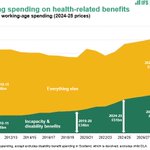
Spending is exploding. Welfare caseloads have swollen by millions since the mid-2010s, „health“-related claims alone rise by roughly a thousand people every working day, and out-of-work benefit numbers now stand near unbelievable 6.7 million.
The UK does not have a revenue problem, tax as a share of GDP is already at multi-decade highs and still climbing. It has a spending problem. Restoring a culture in which most people of working age expect to work for a living, rather than depend on an ever-expanding welfare state, is the only sustainable route back to fiscal health and stronger growth. Why is it deemed inappropriate to expect people to work for life?
