

YouGov data journalist • Elections, polls, voting systems • "I like people, places and things"
Joined August 2023
- Tweets4K
- Following160
- Followers4.6K
- Likes4.9K




Dylan Difford retweeted
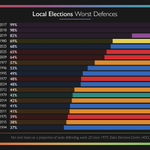
Ultimately, the key story of this election is the crumbling of the two main parties - who now hold the fifth and sixth worst defence rates in modern local elections (68% for Cons, 65% for Labour). Only UKIP implosion years and post-1979 SNP were worse.

Dylan Difford retweeted
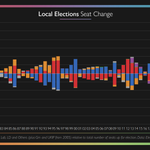
Seen some draw parallels between Reform and UKIP, but they are just different beasts. Not just do Reform have a stronger projected share than peak-UKIP (30% and 10pt lead vs 23% and 7pt trail), but their gains (41% of all seats) are seven-fold UKIP's best (6%, 2013).
Dylan Difford retweeted
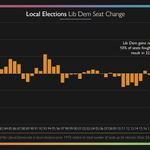
It's a good year for the Lib Dems, with total gains representing almost exactly 10% of all seats fought, making it proportionally their best set of locals since 1993 and their second-best since local government reform in the 1970s.

Dylan Difford retweeted
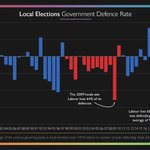
Indeed, when instead looking at the government's defence rate, it is clearer the scale of Labour's losses. In net, they lost 65% of their defences, well above the average 16% loss for governments and eclipsing their 64% loss rate in 2009, the year before the last lost power.

Dylan Difford retweeted
The other hand to Reform's gains are the Tories' horrific losses (41% of all seats). Not just poor for the opposition, but relative to total seats, it is the worst set of local election results for any party in British history, surpassing the Tory result in 1971 (38%).

Dylan Difford retweeted
🧵 / The 2025 local elections in historical perspective
Reform's gains were undeniably seismic, shaking the party system to its core and central to a level of turnover unseen in any post-reform local elections. The net partisan churn is 54%, approaching double 1981's 30%.

Dylan Difford retweeted

Which factors do Britons say are a major factor in determining social class?
Job: 53% see it as major factor
Household income: 53%
Personal income: 52%
State or private school: 45%
Own their own home: 36%
Parents' jobs: 33%
Activities participated in: 29%
Went to university: 19%
Their accent: 19%
Party they vote for: 17%
Where they are from: 15%
Ethnicity: 7%
yougov.co.uk/society/article…

Dylan Difford retweeted
Britons see Tories as more for the middle classes, while associating Labour and Reform UK more with the working classes
Conservatives: +60 net middle class score
Greens: +27
Lib Dems: +24
Reform UK: -19
Labour: -33
yougov.co.uk/society/article…

Dylan Difford retweeted
Which activities are middle or working class?
Owning shares: +73 net middle class score
Playing golf: +65
Hosting a dinner party: +63
Visiting a museum: +39
Going on holiday abroad: +20
Eating foreign food: +16
Watching TV: -22
Living in the North: -34
Attending a football match: -36
Drinking in the pub: -38
Reading a red-top newspaper: -55
Being a member of a union: -55
yougov.co.uk/society/article…

Dylan Difford retweeted
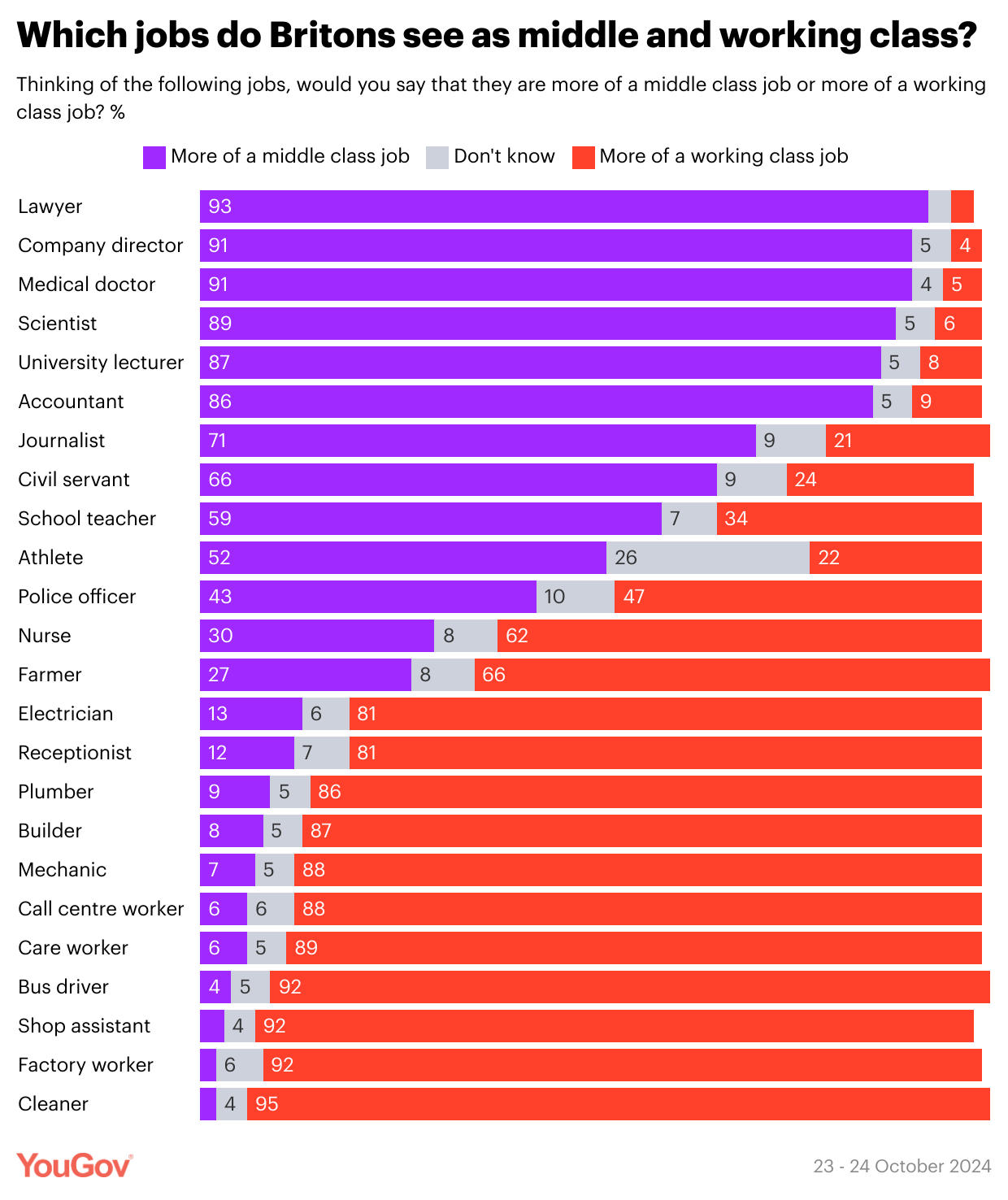
Which jobs are middle or working class?
Lawyer: 93% say middle class vs 3% say working class
Company director: 91% vs 4%
Doctor: 91% vs 5%
Scientist: 89% vs 6%
Lecturer: 87% vs 8%
Accountant: 86% vs 9%
Journalist: 71% vs 21%
Civil servant: 66% vs 24%
School teacher: 59% vs 34%
Athlete: 52% vs 22%
Police officer: 43% vs 47%
Nurse: 30% vs 62%
Farmer: 27% vs 66%
Electrician: 13% vs 81%
Receptionist: 12% vs 81%
Plumber: 9% vs 86%
Builder: 8% vs 87%
Mechanic: 7% vs 88%
Call centre worker: 6% vs 88%
Care worker: 6% vs 89%
Bus driver: 4% vs 92%
Shop assistant: 3% vs 92%
Factory worker: 2% vs 92%
Cleaner: 2% vs 95%
yougov.co.uk/society/article…
Dylan Difford retweeted
Ideology is an idealised political belief, policy is the compromise of that belief with political reality, policy outcomes are the compromise of that policy with actual reality.
Dylan Difford retweeted
The flow of the vote over two decades, between the 2005 and 2024 elections.

ALT Chart showing the estimated flow of the vote between the 2005 and 2024 general elections, based on data from the British Election Study.
Dylan Difford retweeted
Case in point. Several Euro right of centre parties have tried the radical right lite path, but it has always failed because radical right voters aren't interested in some maybe insincere halfway house from a party with a record of 'failure' on immigration
xitter.cf/timothy_stanley/status…

Dylan Difford retweeted

@BritPollingCncl Next Gen Pollsters just hosted its first online training session, where @Dylan_Difford shared his Data Viz wizardry.
He covered everything from the basics, to providing demos of how to achieve complex info graphics just using PPT.
Excited for what's next!

Dylan Difford retweeted
One year until the next German election, support for the three parties in government has collectively fallen 21 points since 2021, while CDU/CSU, AfD and BSW make gains
CDU/CSU: 32% (+8, vs 2021 election)
AfD: 18% (+7)
SPD: 14% (-12)
Greens: 13% (-2)
BSW: 8% (New)
FDP: 4% (-7)
The Left: 4% (-1)
yougov.co.uk/international/a…

Dylan Difford retweeted

Three (very) old proposals for House Of Lords reform copied from the Dod's Companion:-


Dylan Difford retweeted
Only one in eight Britons think that party conferences look like interesting events
Very interesting: 1%
Fairly interesting: 12%
Fairly uninteresting: 36%
Very uninteresting: 40%
yougov.co.uk/politics/articl…

Dylan Difford retweeted
How similar do voters perceive the main parties to be?
Most similar according to Labour voters:
Conservatives and Reform UK: 65% say they are similar
Labour and Lib Dems: 42%
Lib Dems and Greens: 40%
According to Conservative voters:
Lib Dems and Greens: 42%
Conservatives and Reform UK: 36%
Labour and Lib Dems: 36%
According to Reform UK voters:
Lib Dems and Greens: 57%
Labour and Lib Dems: 52%
Labour and Greens: 44%
According to Lib Dem voters:
Conservatives and Reform UK: 66%
Lib Dems and Greens: 50%
Labour and Lib Dems: 43%
According to Green voters:
Conservatives and Reform UK: 51%
Labour and Lib Dems: 47%
Conservatives and Labour: 37%
yougov.co.uk/politics/articl…

Dylan Difford retweeted
Central to why Con seat totals were so low, their vote distribution was unprecedentedly poor.
Con Q3 share (32%) was lower than Lab's *median* share was in 2019 (33%) and the first time it had fallen below 40% for a major party ever.
But, IQRs for both narrowest since 1970s.

ALT Box and whisker plot showing Conservative and Labour vote share distributions in GB at general elections sine 1945.
Dylan Difford retweeted
Nigel Farage has seen his favourability ratings take a knock over the last week, and now has a negative net favourability score among Leave voters for the first time (-4, compared to +7 on 30-31 Jul)
His score has fallen particular among Tory voters (from -10 to -27) – among the wider public it has gone down from -35 to -42
yougov.co.uk/politics/articl…
