

Ambassador @Autheo_Network & @tryquantio | Previously @zama | DM for paid promo/Collab.
Joined March 2020
- Tweets52.5K
- Following8.7K
- Followers12.5K
- Likes54.4K




Pinned Tweet
Just checked my Sorsa Score… 612
Quality > quantity.
Feels good to see the real network showing up.
Real growth, no shortcuts
Building in public + open for solid collabs.
What’s yours at?
Drop it below 📷 @SorsaApp


Finally hit 500 @SorsaApp score 🔥
Tier 3 Credible unlocked
Real growth, no shortcuts
Building in public + open for solid collabs.
Share yours 👇

Oliver retweeted
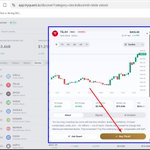
Everyone is chasing trending meme coins. I used Quant AI to research something off the radar.
My Discovery: Tesla xStock - TSLAX - $404.87
This asset is NOT dominating my crypto timeline. It's a tokenized Tesla stock wrapper, rank #335, market cap only $75.36M, volume $6.08M. That's why I decided to investigate it inside @tryquantio AI.
The Research Fundamentals & Market Conditions:
TSLAX tracks TSLA equity 1:1 - TSLA closed at $405.50, TSLAX at $404.87 = 0.15% tracking error. Tight.
Underlying fundamentals are wild: TSLA is $1.55T market cap, but trailing P/E 430.35x, forward P/E 179.63x, operating margin compressed to 2.56% because R&D exploded +69% YoY to $2.8B for AI, Cybercab, Optimus.
The Potential - Why it could be interesting:
Catalysts: Q3 earnings beat - $0.48 EPS vs $0.45 expected, deliveries beat by 5.3% at 486,532 units. Megapack sold out through 2027. Barclays upgraded Oct 26 from Equal-Weight to Overweight, target $370 -> $450. Piper Sandler $475. Only 5 of 60 analysts have Sell - lowest in 11 years.
Trader edge: TSLA is high beta 1.916 - moves 2x market. Plus TSLAX trades 24/7, unlike Nasdaq. You can hedge weekend gaps and react to news when traditional market is closed.
The Risks - Why it's overlooked for good reason: Valuation risk is extreme. If FSD/Robotaxi timeline slips, this de-rates from AI multiple to auto multiple. 430x P/E leaves zero room for error.
Wrapper risk: TSLAX depends on custodian (Backed/Securitize) solvency, no voting rights, off-hours spread widens when Nasdaq closed.
Competition: BYD beating Tesla in volume, product lineup aging, capex cut raising questions.
My Verdict:
Does it deserve a spot on my radar? YES, but as a tactical watchlist, not a blind buy.
I asked Quant AI:
> "What are the fundamentals surrounding this asset?"
> "Are there any upcoming catalysts worth monitoring?"
> "What are the biggest risks or reasons the market is overlooking it?"
Quant AI answer: Bullish momentum short-term, Neutral structurally. Don't chase at $406+. Wait for pullback $391.50-$395 zone with stop $372, targeting $450-$460.
It's not a hidden gem meme. It's an overlooked bridge - Web3 access to the biggest physical AI story.
I used Quant AI to research an asset that isn't getting much attention. Want to discover your own off-radar opportunities?
Try Quant AI through my link : app.tryquant.io/?ref=ST8NM9Q…
@tryquantio #QuantAIPioneers

Oliver retweeted
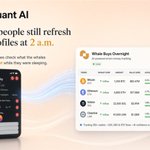
Some people still refresh old profiles at 2 a.m.
The smarter ones check what the whales actually bought while they were sleeping.
One habit keeps you stuck in the past.
The other keeps you ahead of the market.
@tryquantio makes the second habit effortless.
Try it through my link :
app.tryquant.io/?ref=ST8NM9Q…
@tryquantio #QuantAIPioneers


Some people check their ex's profile
Some people check what whales bought overnight
Quant makes the second one a lot easier lol 👇
bit.ly/48h22US
Oliver retweeted

Why does the language matter?
Every smart contract platform picks a language that forces you to describe the world as numbers and booleans. Solidity gives you IF/THEN against fixed data.
@GenLayer picked Python, and that single choice is where Intelligent Contracts actually begin. Python means the contract can use requests to fetch a live page, BeautifulSoup to parse it, and a language model to interpret what it found.
A smart contract sees a booking confirmation as a string. An Intelligent Contract opens the page, reads the cancellation policy, and answers whether the refund condition holds.
The validator mechanism is what makes this trustworthy. Five independent validators each run the same Python contract with their own models.
If most say YES and one says NO, the system registers consensus. If they split evenly, a new leader proposes again and anyone can appeal to expand the validator set.
I discovered this watching the video's booking example. The contract called gl.nondet.web.get and exec_prompt to check whether a booking was refundable and under two hundred dollars.
That is not a smart contract following a rule. That is a contract reading a page and making a judgment.
A crafted page can still mislead a single model. But misleading five independent models running different versions is a different attack surface than compromising one oracle feed.
The closing line hit differently after seeing Python in action: smart contracts follow the rules, Intelligent Contracts understand them. Python is how they learned to read.
What is a judgment call you wish a contract could make on its own: approve a claim, verify a delivery, interpret a policy? Describe the call and what evidence it would need to read.
🤝 Paid partnership

Oliver retweeted

Under $200 is a number check. Refundable is a reading task.
To settle if a booking is refundable, you usually have to trust an outside middleman. That is the oracle, and the exact point where decentralization ends.
Or you let a single model read it, giving one AI the final word.
The third path is what @GenLayer shows in the video.
An Intelligent Contract written in Python fetches the booking page itself and asks a language model that exact question.
The part I will not skip is the consensus.
Instead of relying on one model, multiple validators run the check with their own models.
If they disagree, a new leader tries again or anyone can appeal. It replaces blind trust with a verifiable process.
My new rule is simple.
If a condition is a number, someone can hand it over.
If it is a sentence, the contract has to read it.
Which DeFi condition looks like a simple number but is actually a complex sentence, and what is yours?
Everyone is chasing trending meme coins. I used Quant AI to research something off the radar.
My Discovery: Tesla xStock - TSLAX - $404.87
This asset is NOT dominating my crypto timeline. It's a tokenized Tesla stock wrapper, rank #335, market cap only $75.36M, volume $6.08M. That's why I decided to investigate it inside @tryquantio AI.
The Research Fundamentals & Market Conditions:
TSLAX tracks TSLA equity 1:1 - TSLA closed at $405.50, TSLAX at $404.87 = 0.15% tracking error. Tight.
Underlying fundamentals are wild: TSLA is $1.55T market cap, but trailing P/E 430.35x, forward P/E 179.63x, operating margin compressed to 2.56% because R&D exploded +69% YoY to $2.8B for AI, Cybercab, Optimus.
The Potential - Why it could be interesting:
Catalysts: Q3 earnings beat - $0.48 EPS vs $0.45 expected, deliveries beat by 5.3% at 486,532 units. Megapack sold out through 2027. Barclays upgraded Oct 26 from Equal-Weight to Overweight, target $370 -> $450. Piper Sandler $475. Only 5 of 60 analysts have Sell - lowest in 11 years.
Trader edge: TSLA is high beta 1.916 - moves 2x market. Plus TSLAX trades 24/7, unlike Nasdaq. You can hedge weekend gaps and react to news when traditional market is closed.
The Risks - Why it's overlooked for good reason: Valuation risk is extreme. If FSD/Robotaxi timeline slips, this de-rates from AI multiple to auto multiple. 430x P/E leaves zero room for error.
Wrapper risk: TSLAX depends on custodian (Backed/Securitize) solvency, no voting rights, off-hours spread widens when Nasdaq closed.
Competition: BYD beating Tesla in volume, product lineup aging, capex cut raising questions.
My Verdict:
Does it deserve a spot on my radar? YES, but as a tactical watchlist, not a blind buy.
I asked Quant AI:
> "What are the fundamentals surrounding this asset?"
> "Are there any upcoming catalysts worth monitoring?"
> "What are the biggest risks or reasons the market is overlooking it?"
Quant AI answer: Bullish momentum short-term, Neutral structurally. Don't chase at $406+. Wait for pullback $391.50-$395 zone with stop $372, targeting $450-$460.
It's not a hidden gem meme. It's an overlooked bridge - Web3 access to the biggest physical AI story.
I used Quant AI to research an asset that isn't getting much attention. Want to discover your own off-radar opportunities?
Try Quant AI through my link : app.tryquant.io/?ref=ST8NM9Q…
@tryquantio #QuantAIPioneers
Oliver retweeted

A smart contract can enforce a deal. But can it tell whether the deal was actually fulfilled?
Imagine a DeFi escrow tied to a seller’s written terms on a website. The funds are locked, and the release condition is coded in advance. But what if fulfilling that condition requires reading the terms and interpreting evidence? The contract can execute its instructions perfectly while still depending on someone else to say what happened.
That’s the part of decentralization worth questioning.
@GenLayer’s Intelligent Contracts can access the live web and use language models to evaluate conditions that ordinary smart contracts cannot interpret on their own.
And the decision doesn’t simply rest on one model’s answer. Validators independently run the contract using their own models. If they disagree, another round can follow, and the decision can be appealed.
This doesn’t make mistakes impossible. It means the system has a process for checking a judgment instead of blindly accepting one report.
For me, that’s the real distinction: automating a transaction is one thing. Evaluating the conditions behind it is another.
If you were locking funds in an escrow, what evidence would you want the contract to examine before releasing your money?
Some people still refresh old profiles at 2 a.m.
The smarter ones check what the whales actually bought while they were sleeping.
One habit keeps you stuck in the past.
The other keeps you ahead of the market.
@tryquantio makes the second habit effortless.
Try it through my link :
app.tryquant.io/?ref=ST8NM9Q…
@tryquantio #QuantAIPioneers
Some people check their ex's profile
Some people check what whales bought overnight
Quant makes the second one a lot easier lol 👇
bit.ly/48h22US
Oliver retweeted

I counted the contracts my money sits in and asked how many can see the world without help. Zero. Every one waits for a witness to type first.
Each contract reads exactly one room, the chain. The event, the delivery, the policy live in the other room, and we hired messengers.
The door is where decentralization ended. The @GenLayer video gives it a key, Python that calls the live web and a language model. Smart contracts lack that key.
One validator proposes, others rerun with their own models, and only a match passes. No match sends a new leader. Without appeal, funds move.
The hard part is not the reading. It is a reader inside the vault, and a bad read moves funds. That is why I watch the appeal window.
That rerun is the gap between renting a witness and owning the looking. A rented witness had one client. The page never had this many readers.
DeFi users, which outside fact does your favorite position believe unchecked, price, expiry, or a payout flag? One line is enough. I read every reply.
Oliver retweeted

I cancelled the cabin booking at 11:47 pm.
Still inside the window the site itself called refundable. The refund never came.
I refreshed the booking page three times.
Status: Cancelled, refund eligible.
Confirmation email in my inbox.
Twenty-three minutes still left on the free-cancellation window.
I closed the laptop sure the money would follow the page. It didn't.
Now imagine that refund sat in a smart contract.
The page already had the answer.
The contract couldn't read it.
It would only know what someone told it.
That someone is an oracle, and right there decentralization ends.
The refund is only as honest as the person reporting the page.
Intelligent Contracts on @GenLayer are written in Python. They can pull the booking page themselves, then ask a language model whether that cancellation was still refundable.
The part I keep thinking about is what happens when the models disagree.
One validator proposes a verdict. The others run it themselves with their own models. If they don't agree, a new leader tries again. Anyone can still appeal, and more validators review it.
That extra round is the cost of not handing the decision to one outside party.
I'd still want to know what happens if the page changes mid-check.
Before a contract moves my money, I want to know:
Who reports the facts.
Who checks them.
What happens when the checkers disagree.
Who would you trust more to decide a refund: one oracle, or a few validators running their own models? Reply with your pick.
Oliver retweeted

My torn black leather slippers were never the real problem.
Imagine taking your favourite black leather slippers to a cobbler. You pay 5 shillings, collect them, and notice that the torn part is still coming apart.
You believe the repair was incomplete. The cobbler insists the job was done.
The problem is no longer just the slippers. It is deciding whether the agreement was actually fulfilled.
That is a challenge smart contracts face when agreements depend on real world facts.
A smart contract can release payment when predefined conditions are met. But it cannot independently inspect a pair of slippers and understand whether the repair meets the agreed standard.
It needs information from outside its system. That is where an oracle often comes in.
An oracle might report that the repair was completed using a photo or confirmation. But evidence that a job was marked complete does not necessarily prove that the work was done properly.
Even a decentralised oracle network cannot automatically resolve every question about what that evidence means.
The contract could execute exactly as programmed while the disagreement remains unresolved.
That is what interests me about @GenLayer.
Its Intelligent Contracts are designed to interpret contextual information, including relevant web data, rather than relying only on rigid, predefined conditions.
Independent AI validators evaluate the available information and help the system reach a decision. Because different models can interpret the same evidence differently, GenLayer uses semantic equivalence checks to assess whether their conclusions agree in meaning, alongside consensus and appeal mechanisms for handling disagreement.
This does not mean AI is always right, or that oracles become unnecessary. The evidence still matters, and the system can only assess what it has access to. The difference is that interpretation becomes part of the process rather than being reduced to a simple condition.
For me, the key distinction is this: recording that a task was completed is not the same as establishing that an agreement was fulfilled.
If you could give an Intelligent Contract one real world dispute to resolve, what would you choose, and what evidence should it consider before deciding who was right?
Oliver retweeted

Some people check their ex's profile
Some people check what whales bought overnight
Quant makes the second one a lot easier lol 👇
bit.ly/48h22US
Oliver retweeted
The Fed decides on rates Wednesday.
CT will have an opinion about it approximately 0.2 seconds later.
Ask Quant what the different outcomes could mean for the market.
app.tryquant.io/chat

Oliver retweeted
Five research tabs. One platform. Here's how I investigated BTC with Quant AI.
I used to have 5 tabs open for one trade - chart, news, sentiment, signals, risk. Today I did it all inside @tryquantio AI.
Asset: BTC - $80,503
Currently consolidating right above the $80K psychological handle after pulling back from $87K October highs. Neutral setup.
Here is my 5-task workflow inside Quant AI:
1. Market Overview
I asked: What's happening with price, key trends and levels?
Quant AI showed: Range compression $79K - $85K, BTC Dominance 60.04%, Fear & Greed 45 Neutral.
Key levels: Support $79K-$80.5K shelf, major support $75,446 (MicroStrategy avg cost), Resistance $82.7K (50-day MA & ETF cost basis
2. News & Catalysts
I asked: What recent news could move BTC?
Bullish: Strive acquired $511M BTC (now 43K BTC), cumulative ETF inflows $57B-$58B with $301.2M weekly inflow ending Oct 23. CLARITY Act pushing in lame-duck session.
PPI inflation 6.3% sticky, 84.7% odds of Dec Fed hike, choppy ETF flows -$635.6M outflow on Oct 22. Market is waiting for Oct 27-28 FOMC.
3. Market Sentiment
I asked: What's sentiment on X and in Signals?
Quant AI: Cautious neutrality. Traders like Altcoin Sherpa asking how long $79K holds. Crypto Tony: range-bound - pumps for shorting, dumps for longing. BUT top traders on Quant perps leaderboard are 100% short - 9/9 traders, $578.96M short notional.
4. Trading Signals
I asked: What signals support or challenge outlook?
Bullish signals: Q3 ETF inflows +$6.3B, Dominance high, equity tailwind SPY +0.90% QQQ +1.45%.
5. Risk Assessment
I asked: What could go wrong?
Biggest risks Quant AI flagged:
$80K liquidation cascade: dense stops just below $79K, $440M longs liquidated recently
ETF run: multi-day outflows >$500M/day removes bid depth
My Conclusion:
Doing this in one Quant AI session saved me hours. BTC is healthy consolidation, institutionally supported, but technically vulnerable at $79K-$80K until FOMC clears. I'm not chasing mid-range. I'm waiting for $79.2K-$80.5K dip with hard invalidation or breakout above $82.7K.
I researched one market across five areas using Quant AI. Want to simplify your own trading research?
Try it through my link :
app.tryquant.io/?ref=ST8NM9Q…
@tryquantio #QuantAIPioneers
Oliver retweeted

The automation stopped exactly where the web page started.
Last year, a hardware vendor owed us a credit whenever a software update shipped with a known bug that hit our devices. The bug was public. The amount was a formula.
Someone still had to open the vendor’s security notice, check that our exact version was listed, and declare the credit due. Their reports came late, the wording got disputed, and once they were out sick.
A smart contract, a program that holds and pays out money by fixed rules, could have kept the funds safe. It still would have waited on that person.
In crypto, a middleman like that is called an oracle. I think of it as the last trusted step. Write any rule you like, but the moment it needs a fact from the web, someone outside the contract gets the final say.
@GenLayer’s Intelligent Contracts go and look for themselves instead of waiting to be told, then ask an AI whether the credit is owed. And no single reader gets the last word: one validator proposes an answer, others check it with their own AI models, and it only stands if they agree. If not, it tries again.
A bad notice is still a bad notice. But a sick day stops being a problem, and a wording dispute becomes several readings instead of one person’s opinion.
Who is the last trusted step in your own work? The one person everything waits on?
Oliver retweeted

The grant pays out once the team shows a working demo, but the demo link returns an error.
That tells the protocol the page could not be reached at that moment. It doesn't tell the protocol whether the demo was completed. A binary pass or fail can confuse an access problem with a failed project.
I'd give the team a short retry window, then check a second source approved before funding.
If neither source verifies the demo, put the funds into review rather than automatically rejecting the team or paying without proof. It takes longer, but everyone knows the fallback before a dispute arises.
Rules like this depend on where the contract gets its evidence. Traditional smart contracts often rely on an oracle to report facts from the web.
@GenLayer's Intelligent Contracts can retrieve web evidence for a language model to interpret.
A designated leader proposes a result, and validators assess it using their own models. If their assessments diverge, a different leader gets another attempt, and an accepted result can still be appealed.
What should count as backup evidence: a recorded demo, a reproducible test environment, or an independent reviewer?
Oliver retweeted
Institutions didn’t remove volatility.
They simply became the new source of it.
The smart move isn’t reacting to the headline.
It’s understanding the shift before the next one hits.
That’s what @tryquantio is built for.
Checkout quant ai :
app.tryquant.io/?ref=ST8NM9Q…
@tryquantio #QuantAIPioneers

$635M left US spot Bitcoin ETFs in a single session, reversing three consecutive days of inflows.
A useful reminder that institutional participation doesn't eliminate volatility.
It changes who participates in it.
Stay curious: app.tryquant.io/chat
Institutions didn’t remove volatility.
They simply became the new source of it.
The smart move isn’t reacting to the headline.
It’s understanding the shift before the next one hits.
That’s what @tryquantio is built for.
Checkout quant ai :
app.tryquant.io/?ref=ST8NM9Q…
@tryquantio #QuantAIPioneers
$635M left US spot Bitcoin ETFs in a single session, reversing three consecutive days of inflows.
A useful reminder that institutional participation doesn't eliminate volatility.
It changes who participates in it.
Stay curious: app.tryquant.io/chat
Oliver retweeted
$635M left US spot Bitcoin ETFs in a single session, reversing three consecutive days of inflows.
A useful reminder that institutional participation doesn't eliminate volatility.
It changes who participates in it.
Stay curious: app.tryquant.io/chat