
A supportive, positive atmosphere for discussing social simulation modelling work in progress. Part of the European Social Simulation Association (ESSA).
Joined August 2021
- Tweets115
- Following22
- Followers117
- Likes9




Pinned Tweet
You can find out more about ESSA@work by checking out our pages on the European Social Simulation Association site, essa.eu.org/essawork/
If you’ve enjoyed the session and wonder what is going on behind the scenes, join the ESSA@work organization team! Contact us to organize the next ESSA@work session together - we’d love to hear from you. essa.eu.org/essawork/contact…

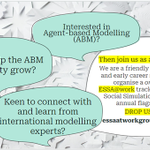
ALT Image of a power point slide which reads: Interested in Agent-based Modeling? Want to help the ABM community grow? Keen to connect with and learn from international modelling experts? Then join us as an organiser! We are a friendly team of ‘ABMers’ and early career researchers who organise a one-of-a-kind ESSA@work track at the European Social Simulation Association’s annual flagship events. Drop us a line: essaatworkgroup[at]gmail.com.
As another great #ESSAatWork session closes, we thank Ruth Meyer and Peer-Olaf Siebers for their expert advice, and our presenters @dhuagao @misschris2202 @hyesop for sharing their #WorkinProgress with us! #ssc2023
Some of the questions for the experts: How to determine temporal granularity of the model; what is the best practice for code of meso-scale simulation - to share or not to share; what to keep in mind when designing policy scenarios.

@hyesop is giving the third and last presentation of #ESSAatWork at this years’ #SSC23: How do changes in traffic flow from low-emission zones affect community health outcomes?
Link to the protocol: link.springer.com/chapter/10…
From the audience: the time scale depends on the health problems that will be investigated - are they short-term or long-term problems? Also, participatory designs should include the affected communities, not just policy makers and experts. #WorkinProgress
They suggest that @misschris2202 build multiple smaller models and supplement them with focus groups, interviews, and participatory approches to tease out the cultural factors inherent in our food choices and inform her modeling choices.
Ruth Meyer asks where the focus of the model is - on the households and their demand, or on the overall trend of an increase in plant-based diets, and seconds the suggestion to start with a simpler model and extend it as necessary.
Peer-Olaf Siebers suggests that the model be purpose-build, simple, and pared down to the bare minimum to answer the research question, rather than going for an overly complicated model with too many input factors.
Our next speaker @misschris2202 presenting a #WorkinProgress on changing food consumption practices. How do households move from an animal-based diet towards plant-based diets? How does the social context, interactions with others, and the availability of different foods matter?
Our next speaker @misschris2202 presenting a #WorkinProgress on changing food consumption practices. How do households move from an animal-based diet towards plant-based diets? How does the social context, interactions with others, and the availability of different foods matter?
Ruth Meyer and Peer-Olaf Siebers suggest to find organizations to work with, interview employees to see if their organizational learning corresponds to the assumptions of the model, and to clarify how the model might inform decisions of managers within organizations.
Our first presenter today is @dhuagao who joins us online and talks about digital artifacts as templates for replicating routines within organizations. He asks how to link fieldwork and empirical inputs to theoretically-driven models. #ESSAatWork
Our first presenter today is @dhuagao who joins us online and talks about digital artifacts as templates for replicating routines within organizations. He asks how to link fieldwork and empirical inputs to theoretically-driven models. #ESSAatWork
ESSA at Work retweeted
⏰⏳-1 to #SSC2023 and #ESSAatWork! See you tomorrow in Glasgow for a great start of a fun week of social simulation @EuroSocSim
The #ESSAatWork session starts in less than an hour on this first day of #SSC2023. Join us to hear our speakers talk about their #WorkinProgress ! This year, we welcome Ruth Meyer and Peer-Olaf Siebers as experts. Excited to hear their thoughts on our speakers’ presentations.
⏰⏳-1 to #SSC2023 and #ESSAatWork! See you tomorrow in Glasgow for a great start of a fun week of social simulation @EuroSocSim
📢Great news! The program for #ESSAatWork at #SSC2023 is online🗓️
Ruth Meyer and Peer-Olaf Siebers will be our experts and provide in-depth feedback to 3 works in progress in #socialsimulation. Don't forget to register to participate in our workshop 👇
ssc23-sphsu.online/programme…
ESSA at Work retweeted

1 week until Social Simulation 2023 starts with a day of workshops (ESSA@work, exascale computing for ABM and alternative models of inequality) then 3.5 days of the main conference: 5 keynotes, 8 special tracks and many general papers etc. #abm #ssc2023 ssc23-sphsu.online/programme…
The line up for the #ESSAatWork workshop at #SSC2023 is finally taking shape. Stay tuned! 👀
We are looking forward to welcoming our speakers and experts in Glasgow!
⏳⏰A few more days to submit your work in progress to ESSAatWork at #SSC2023
Don't forget to complete our application form docs.google.com/forms/d/e/1F…
and feel free to get in touch for any questions!

**Deadline extended!** We are now accepting submissions and applications for #ESSAatWork at #SSC2023 until 12 May. Don't forget that there is a 200 EUR scholarship available if you don't have funding. Contact us with any questions!
ssc23-sphsu.online/74-2/