

Space, Technology, Photography, Environment, News, Sometimes Film and Music... All important news and info... Thanks for dropping by! 🚀📷. #STEM
- Tweets17K
- Following21.8K
- Followers23.4K
- Likes704






ALT Webb’s image of NGC 1512 shows a face-on barred spiral galaxy anchored by its central region, which is circular and shows a bright white point at the center with blue and yellow circles around it. Outside the core is a large bar structure filled with a haze of blue stars, forming a rough parallelogram shape and taking up about a quarter of the area. The bar is crossed by orange filaments made of stars, gas, and dust that extend diagonally to the top left and bottom right. Outside this, the thick orange spiral arms form a rough oval, and within them there are smaller oval areas that appear black. The spiral arms are largely orange, ranging from dark to bright orange and extend beyond the edges of the image. There are many larger blue stars and slightly larger pink points of light spread throughout. Two larger foreground stars with at least six diffraction spikes are at top center and bottom center.


ALT The image is divided horizontally by an undulating line between a cloudscape forming a nebula along the bottom portion and a comparatively clear upper portion. Speckled across both portions is a starfield, showing innumerable stars of many sizes. The smallest of these are small, distant, and faint points of light. The largest of these appear larger, closer, brighter, and more fully resolved with 8-point diffraction spikes. The upper portion of the image is blueish, and has wispy translucent cloud-like streaks rising from the nebula below. The orangish cloudy formation in the bottom half varies in density and ranges from translucent to opaque. The stars vary in color, the majority of which, have a blue or orange hue. The cloud-like structure of the nebula contains ridges, peaks, and valleys – an appearance very similar to a mountain range. Three long diffraction spikes from the top right edge of the image suggest the presence of a large star just out of view.

ALT A crowded galaxy field on a black background, with one large star dominating the image just right of center. Three areas are concentrated with larger white hazy blobs on the left, lower right, and upper right above the single star. Scattered between these areas are many smaller sources of light; some also have a hazy white glow, while many other are red or orange. Even without zooming in, different galaxy shapes are detectable, like spirals, ovals, and arcs.

ALT Webb’s image of NGC 1512 shows a face-on barred spiral galaxy anchored by its central region, which is circular and shows a bright white point at the center with blue and yellow circles around it. Outside the core is a large bar structure filled with a haze of blue stars, forming a rough parallelogram shape and taking up about a quarter of the area. The bar is crossed by orange filaments made of stars, gas, and dust that extend diagonally to the top left and bottom right. Outside this, the thick orange spiral arms form a rough oval, and within them there are smaller oval areas that appear black. The spiral arms are largely orange, ranging from dark to bright orange and extend beyond the edges of the image. There are many larger blue stars and slightly larger pink points of light spread throughout. Two larger foreground stars with at least six diffraction spikes are at top center and bottom center.

ALT The background is mostly dark. At the center is a dark orange-brown circle, surrounded by several blazing bright, thick, horizontal whiteish rings. This is Saturn and its rings. There are three tiny dots in the image—one to the upper left of the planet, one to the direct left of the planet, and the lower left of the planet. These are three of Saturn’s moons: Dione, Enceladus, and Tethys, respectively. There is a slightly darker tint at the northern and southern poles of the planet. The rings surrounding Saturn are mostly broad, with a few singular narrow gaps between the broader rings. There is an innermost, thicker ring, and next to that is a brighter, wider ring. Traveling farther outward, there is a small dark gap before another thicker ring. In the thicker ring, there is a narrow faint band. There is then an outermost, faintest, thinnest ring.


ALT This image shows a field crowded with stars. A large, bright cyan-colored area surrounds the lower portion of a funnel-shaped region of space that is wider at the top edge of the image and then narrows. This funnel-shaped region appears darker than its surroundings. Toward the narrow end of this dark region a small clump of red and white appears to shoot out streamers upward and left. The cyan-colored area has needle-like structures and becomes more diffuse towards the right. The right side is dominated by clouds of orange and red, with a purple haze. Credits: NASA, ESA, CSA, STScI, and S. Crowe (University of Virginia).

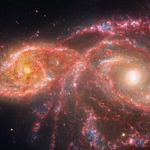
ALT A pair of merging galaxies. The galaxy on the left has a large, single spiral arm curving out from the core and around to below it, with very visible glowing dust and gas. The right galaxy has a bright core but only a bit of very faint material. A broad curtain of gas connects the two galaxies’ cores and hangs beneath them. A few small stars and galaxies are scattered around the black background.

ALT The sun glows yellow in the center of the image, partially hidden by the horizon. Deep red hues envelop the skies and gradually turn into amber oranges above. Below the dark contrast of the horizon, there is a channel of water and another strip of land underneath. Credit: NASA/Dimitri Gerondidakis


ALT Ariane 5 VA260 lifts off from Europe's Spaceport backdropped with blue/grey skies.
