

@jonlen@ecoevo.social @CNRS researcher @UMR_EDYSAN @CNRS_DR18 @INEE_CNRS @upjv #PhD in Forest Sciences #forestry #ecology #biostatistics #climatechange
Amiens, France
Joined December 2014
- Tweets14.3K
- Following427
- Followers2.7K
- Likes16.9K
Pinned Tweet
Accepted paper @JEcology ⬇️ How #LiDAR data acquired from airborne (🚁🛩) sensors can help us unveil ghosts from the past (i.e. ancient human activities) & thus capture time-lagged #biodiversity changes in the #forest understory 🍀☘🌱🌿🌳🌲🌳🌲| A 🧵
📰 bit.ly/3nzLZKY

Jonathan Lenoir retweeted

Conservation cannot only protect habitats where species once lived – it must include the places where they will relocate in a warming world. @shawan_c @EkoLogIt @MonashUni theconversation.com/butterfl…

Jonathan Lenoir retweeted

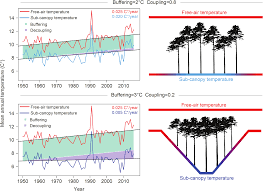
Ainsi, dans le cadre du changement climatique, il y a tout intérêt à limiter le débroussaillement au stricte necessaire pour de pas fragiliser les microclimats, clé de l'adaptation face aux aléas extrêmes.
Jonathan Lenoir retweeted
Les études ont notamment montré que le microclimat forestier est fonction de la hauteur de la canopée, de la densité du sous bois et du contexte édaphotopographique avec une expression totale à partir de 50m de la frange boisée.

I am so proud of this paper ⬇️ recently published in PNAS 🤩 Four years in the making and countless computing hours to get bioclimatic velocities from #SDMs that were tailored to each species & study from which we extracted empirical species range shift rates

Climate niche models underestimate the speed with which species move in response to climate change, according to comparisons between the models and observed shifts for more than 3,500 species. Median rates were four times faster than predicted. In PNAS: ow.ly/86j250YCqtz

ALT Climate niche models correctly predicted the direction of some empirically documented range shifts for bird species in the genus Tyrannus. CREDIT: Jeewantha Bandara.
Jonathan Lenoir retweeted

Climate niche models underestimate the speed with which species move in response to climate change, according to comparisons between the models and observed shifts for more than 3,500 species. Median rates were four times faster than predicted. In PNAS: ow.ly/86j250YCqtz
ALT Climate niche models correctly predicted the direction of some empirically documented range shifts for bird species in the genus Tyrannus. CREDIT: Jeewantha Bandara.
Genetic diversity matters for species on the move in response to climate change ⬇️
We found that genetic diversity interacts w/ the velocity of climate change to explain the velocity at which species shift their range positions over time
shorturl.at/682E3

Thermophilisation of plant communities in response to #CC is 5× faster on alpine summits than in forests or grasslands across 🇪🇺
This corroborates former findings on the greater likelihood for upslope than poleward range shifts of plants 🌳🌲☘️🌾🪻🌼
shorturl.at/gc0TJ
Climate change has already reshaped the bioclimatic space of extreme events in the Arctic 🌐❄️ Arctic biodiversity has entered a new era of bioclimatic extremes w/ more droughts, greater winter-warming 📈 & more rain-on-snow events 💧❄️
shorturl.at/pQsVP
Just published ⬇️

The CESABINAR #12 featuring the BIOSHIFTS group will start in about 2 hours (at 3 pm CET). Here are the info you need to join the webinar:
Zoom link:
us06web.zoom.us/j/8295073328…
Secret key:
486426


On Thursday 11th December, at 3 PM CET, we will present results from our #CESAB working group #BIOSHIFTS on species range shifts in response to climate change 🌡📈🌳🦔🦉🐝🦎🐟🐚🦈
CESABINAR #12
Find the Zoom link on the webpage of #FRB below & attend 😊
shorturl.at/p7J2R
On Thursday 11th December, at 3 PM CET, we will present results from our #CESAB working group #BIOSHIFTS on species range shifts in response to climate change 🌡📈🌳🦔🦉🐝🦎🐟🐚🦈
CESABINAR #12
Find the Zoom link on the webpage of #FRB below & attend 😊
shorturl.at/p7J2R
Study area shape matters when tracking species range shifts & we may underestimate longitudinal range shifts to the benefit of latitudinal range shifts, potentially undermining drivers other than T°C 🌡
🌐🌏🌎🌍🧪🐠🐍🦋🦉🦇🌳🌲
shorturl.at/prp63

Jonathan Lenoir retweeted

In our new article (Midolo et al., Ecology Letters), we show that plant species richness in European plant communities generally decreased between the 1960s and 1980s. However, since the 1990s, this trend seems to have stopped or even reversed. dx.doi.org/10.1111/ele.70248

Jonathan Lenoir retweeted

How to not be swamped by microclimate data?
The rise of microclimate data may have opened Pandora’s box. Gone are the days of simple bioclimatic variables — now heads spin trying to summarize these timeseries.
A much-needed paper by Krystof Chytry:
🔗 the3dlab.org/2025/11/11/how-…

Yesterday, we had a webinar organised by the #PEPR #FORESTT on the use of species distribution models #SDMs w/ application in forestry 🌳🌲 You can watch 📹 16 talks, including 1 on the impacts of microclimatic processes for species (re)distribution ⬇️
tinyurl.com/4yerk68n

Happy to have contributed to this nice study just published in #GCB on plants' phenological shifts across 🇨🇳: we used data from herbarium specimens to generate time series of 🌸 time at the species level & infer phenological shifts
🌺🌸💮🏵🌎🌐🍁🍂
shorturl.at/26dwH

Our University #UPJV just made it, this year, for the very 1st time, to the Shangai ranking of universities 🌎🌐
It turns out that the only academic subject appearing on the list of subject ranking is #Ecology 🌳🍁🪻🌱🦌🦔🦇🦉
We are pretty proud of us at #EDYSAN 😀
@UPJV_Univ


Jonathan Lenoir retweeted

Do biodiversity drivers have no long-term effects? 🚨Still the dominant assumption.
We propose a paradigm shift in Trends in Ecol & Evol: 🔗 doi.org/10.1016/j.tree.2025.…
Many thanks to @EkoLogIt , @RonanMarrec, @FranzEssl1, @IngolfKuhn, @t_ergon
Why relying on the "equlilibrium assumption", i.e., biodiversity being in an equilibrium state w/ its environmental conditions, to model biodiversity changes?
➡️ We propose a paradigm shift: embracing the quasi-permanent non-equilibrium state 🤯
shorturl.at/qU99d

I made a 20-min 📽 on the relevance of #microclimates for modelling the distribution of #forest species living beneath the 🌳 canopy
shorturl.at/zvLm7
This is part of a webinar series organised by the PEPR FORESTT w/ a Q&A session scheduled on September 22nd
shorturl.at/sJF1s
@inrae-france.bsky.social
@cnrsecologie.bsky.social
@cnrs-hautsdefrance.bsky.social
@cnrs.fr
Funded by #ANR France 2030
@AgenceRecherche
This talk features a paper we published in 2023 in Ecology Letters & led by Stef Haesen & Koenraad Van Meerbeek
shorturl.at/6ea8o
@haesenstef.bsky.social
@kvanmeerbeek.bsky.social
@evagril.bsky.social
@jlembrechts.bsky.social
@pieterdefrenne.bsky.social
