Today, we released a report examining two #climate & #energy policy pathways: Continued US leadership & #Project2025.
Our modeling finds that these future policy pathways result in stark differences for our health, pocketbooks, economy, & climate.
energyinnovation.org/publica…
🔌💡 Our partners at the India Energy & Climate Center (IECC) are hosting a #webinar tomorrow to explore how #India's landmark #renewableenergy auction could reshape the economics of reliable #cleanpower.
👉 Register here berkeley.zoom.us/webinar/reg…
💻 Join us on October 30th at 1:00 PM ET for a joint #webinar with @RockyMtnInst for an overview of the 48 state models' new functionality, data, and policy settings.
Register here: energyinnovation.zoom.us/web…
🔌💡 How ongoing federal policy has impacted the energy landscape, health of citizens and national economy:
thepowerline.substack.com/p/…
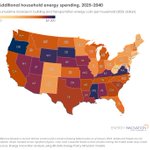
🔌💡 "Households in the contiguous United States will pay thousands of dollars more for #energy through 2040 because of federal policy changes."
@APNews's @JenMcDermottAP reports 👇
apnews.com/article/climate-e…
🚨 Spending more on #energy hurts more than your wallet.
New modeling shows federal policy decisions will increase energy costs, slow economic growth & increase air pollution and healthcare costs
energyinnovation.org/report/…
Energy Innovation Policy & Technology retweeted
Per new @EnergyInnovLLC analysis, Trump's energy policies will cost North Carolinians an extra $56/mo by 2035 and $64/mo in 2040, cost us 150,000 jobs over the next decade, and slash our state GDP billions of dollars each year. Are we great again yet?
energyinnovation.org/report/… – at Wendell, NC
Energy Innovation Policy & Technology retweeted
Some context for our findings:
@GasBuddyGuy says the Iran war has cost Americans $75B in added gasoline costs. We find federal energy policy will add an additional $920B to household costs through 2040. 📈💸
With @EnergyInnovLLC
Households in the contiguous United States will pay thousands of dollars more for energy through 2040 because of federal policy changes since President Trump returned to office, according to modeling released Friday by a nonpartisan think tank.
abcnews.link/H2EJmpb
Households in the contiguous United States will pay thousands of dollars more for energy through 2040 because of federal policy changes since President Trump returned to office, according to modeling released Friday by a nonpartisan think tank.
abcnews.link/H2EJmpb
Energy Innovation Policy & Technology retweeted
This week on eTown: Nashville indie rock meets LA folk and a conversation about the future of the environmental movement. @brookandbluff and Lucy Clearwater make their eTown debuts, plus Silvio Marcacci of @EnergyInnovLLC talks with Nick. On air all week + podcasts anytime.
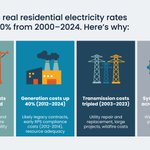
🔌💡 California's real residential electricity rate rose over 50% from 2000-2024.
We spoke with @GridLabEnergy's @RicOConnell8 to learn about the factors contributing to the energy affordability crisis & what officials can do to solve it 👇
thepowerline.substack.com/p/…
⚡ California’s electricity rates are now the 2nd-highest in the U.S.—more than 50% above the national average.
Elected officials have a duty to act. Here's how:
energyinnovation.org/report/…
🔌💡 @leahstokes has been researching and reporting on #climate and #Energy policy for well over a decade. Our Shannon Stirone spoke with her about her latest book and her experience covering #climateChange.
👉 thepowerline.substack.com/p/…
🔌💡 New report found that the amount of new capacity in the pipeline doubled from January to July of this year, fed by the data center boom.
👉 heatmap.news/energy/10-bigge…
🔌💡 Bring Your Own Power: How Data Centers Can Solve Their Own Energy Problem
👇 energyinnovation.org/expert-…
Energy Innovation Policy & Technology retweeted
New report by @EnergyInnovLLC shows that more #solar, wind, and batteries put more money in Texans’ pockets by creating more low-cost, home-grown energy.
energyinnovation.org/report/…
#SolarEnergy #TexasSolar #AffordableEnergy
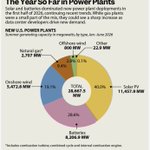
"The story of power plant completions in the first half of 2026 was mainly about utility-scale #solar and #batteries."
Our @EricGimon spoke with @insideclimate's Dan Gearino about small- and mid-size utility-scale solar projects.
insideclimatenews.org/news/1…

ALT Graphic showing "The Year So Far In Power Plants". It shows a pie chart of new U.S. power plants - summer generating capacity in megawatts by type from January to June 2026. It reports that there was a total of 28,667.5 MW generated. Solar PV (40%), Batteries (28.6%), Onshore Wind (19.1%), Natural Gas (9.4%), Offshore Wind (2.8%) and Other (0.1%)
🔌💡 Our recent report finds that renewable energy can power data center facilities at a lower cost than fossil fuels.
app.publicnewsservice.org/st…
🔌💡 Federal policy decisions favoring natural gas and keeping #coal plants open are forcing households to pay higher #electricity bills.
Our @robbieorvis explains
thepowerline.substack.com/p/…

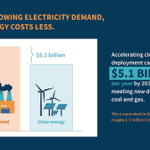
ALT Graph showing modeling from Energy Innovation, which shows how federal energy policy decisions across America: 152 gigawatts’ (GW) lost clean energy capacity additions through 2030 and 637 GW through 2040, an extra $650 billion in energy costs for households, and $2.3 trillion in lost GDP between 2026 and 2040.
🔌💡 Clean energy and batteries are a cheaper alternative to operating 99% of the U.S. coal fleet.
canarymedia.com/articles/fos…
🔌💡 Recent EIA data reports that residential rates rose 7.3 percent between April 2025 & April 2026.
Our analysis projects that by 2035, households could be paying an additional $460 per year on average for their energy.
newsweek.com/map-electricity…