The trader posting a 40% year while you are generating 20% is probably running a completely different system, with different capital, a different drawdown tolerance and a different life to yours.
A strategy that suits someone with 6 hours a day at the screen and a stomach for deep drawdowns can break a trader with a full-time job and a 20% drawdown tolerance. Not because the strategy is bad. Because it does not fit YOU.
The only comparison that matters is between your results and your own plan.
Find out what fits you with the free Trader Personality Test: enlightenedstocktrading.com/…
1
73
You can look back over 30 years of market history and conclude a risk is small enough to ignore.
Long-Term Capital Management's problem: those 30 years did not include a position as big as theirs. Their size changed the risk.
A backtest can only show you markets that existed without you in them. Once your size starts to matter, check whether the history still applies.
Save this for the next time a backtest makes you feel safe.
69
Down 44% from September 2007 to February 2009, with less leverage than last time.
After Long-Term Capital Management collapsed, John Meriwether started another fund running the same kind of strategy, this time with less leverage. Spreads blew out, funding dried up, and the fund closed.
Less leverage delayed the blow-up. It did not fix the strategy.
If something in your portfolio has a flaw you already know about, sizing it down only buys time. The real decision is whether to switch it off.
Save this for your next portfolio review.
98
87% return one year. Wiped out within a couple of days the next.
Peloton Partners was levered about nine times, long AAA mortgage securities and short subprime. Lenders cut how much they would lend against those securities. Margin calls forced selling, the selling pushed prices further the wrong way, and that triggered more margin calls.
If you ever hand money to someone to trade for you, a strong track record only proves they have survived so far. Keep asking about risk until you are satisfied they have it under control.
What to ask is in the free How to Evaluate a Signal Service course, inside the FREE Trader Acceleration Bundle:
enlightenedstocktrading.com/…
91
After LTCM, John Meriwether ran the same kind of strategy in a new fund with less leverage. It still fell 44% and closed.
Less leverage delayed it. If a system in your portfolio has a flaw you already know about, sizing it down buys you time. Switching it off is the actual decision.
2
226
A gold trading system with a 0.02 correlation to the Nasdaq 100 made 36% through the GFC, while the Nasdaq lost 53%.
On 5 November the Nasdaq 100 fell 6.4% in a day while a long volatility system in the EST portfolio gained 17%.
If every position you own rides the same theme, they all fall at once. Strategy correlation is what traders should be most focused on.
Full breakdown in The Enlightened Trader: linkedin.com/pulse/nasdaq-ju…
1
92
If your largest position gapped 40% through its stop overnight, how much of your account would go with it?
Then check what other positions would move with it. A trend following system can load up on one hot sector without you ever deciding to. If the leader gaps, the rest follow.
It will hurt. The test is whether you are still trading the next day.
The Portfolio CPR cheat sheet in my free bundle walks through fixing a concentrated portfolio: enlightenedstocktrading.com/…
87
Built a system on the Nasdaq? Before you trust it, run it on 4 more markets.
The S&P 500.
The Russell.
Canada.
Australia.
Same system. Each market where the edge holds up gives you more confidence that it is real, and not something that only exists in the one data set you built it on.
Save this for your next backtest.
65
Your trading costs change shape as your account grows.
Small positions: slippage is low, but commission eats a big percentage of every trade.
Large positions: commission shrinks toward your broker's percentage rate, but slippage starts to climb.
Somewhere in between, the two added together are at their lowest.
Track commission and slippage separately, as a percentage of each trade, so you know which one you are actually dealing with.
1
130
Two of your systems want to buy the same stock on the same day.
Most of the time, take both at normal size and follow the systems.
Run two systems with five positions each and that double-up is a big share of your capital in one stock. Run 15 systems holding several dozen positions and it barely registers.
So if a double-up makes you nervous, look at how many systems you run before you cut the position size. The more diversified you are, the less any single trade matters.
enlightenedstocktrading.com/…
80
One order has a huge margin requirement, and it is blocking two or three other trades your systems want to take.
You cannot get it to fit. What now?
Skip that one and take the others.
When you cannot trade the ideal portfolio, get as close to it as you can. Missing one trade does less damage than missing three because a single order refused to fit.
Save this for the next time your broker rejects an order you were sure would go through.
93
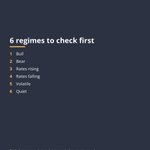
6 market regimes I check before I try to improve a trading system:
Bull. Bear. Rates rising. Rates falling. Volatile. Quiet.
Most systems only make money in some of them.
Find out which ones yours works in first. Then focus your optimisation and improvement effort on those regimes, not on the whole history at once.
The full testing process:
enlightenedstocktrading.com/…
66
A system that trades 500 times a year pays costs 1,000 times: once on the way in, once on the way out.
Commission, slippage, spread. Each looks tiny on a single trade, which is why they get left out of backtests.
Multiply them across a year and a system that looked profitable can become one that mainly makes money for the broker. Short-term systems with small average profits per trade are the most exposed.
Put every cost into the backtest before you judge it. If the edge does not survive realistic costs (including commissions AND slippage), it is not a real edge.
enlightenedstocktrading.com/…
72
Before you let AI run your backtesting on its own, do it the slow way a few dozen times. Your AI does not know how to backtest correctly - you have to train it (That is what I have done with the EST AI Trading Toolkit). If you don't understand the process yourself, you can't check the AI's work. How many systems have you taken all the way through your process before getting AI to help?
AI Backtesting unlocks a whole new level for private traders, but you MUST know how to backtest the right way first, and have the skills and processes to guide your AI to backtest correctly.
Start here: enlightenedstocktrading.com/…
74
A takeover was announced at $28 a share on 30 January. The price had already jumped two weeks earlier, in the middle of January.
The move showed up in the price before the news reached the market.
A systematic trader does not need the information, because the information arrives as price, and price is the only thing the rules read.
You do not have to know why a stock is moving to be positioned in it.
Why systematic beats guessing at the reasons: enlightenedstocktrading.com/…
51
Spend weeks on a system and when it fails you will say "let me just try 1 more thing" and re-optimise it again.
That one more thing is where curve fitting starts.
Make testing quick and cheap and the pressure disappears. A failed system cost you very little, so you let it fail and move on to the next idea.
Speed saves time. More importantly, it removes the sunk cost that tempts you to bend your own rules.
Want to learn how to backtest and build reliable trading systems with 1/50th the effort using a proven AI process?
Comment "AI Backtesting" and I'll show you the steps
71
You are holding a stock and it hits its stop. Sell that system's shares and move on without another moment's thought.
Trading gets much easier once you stop questioning every small detail and just follow the rules.
84
Broker says insufficient funds, but you have the cash?
Look at the margin on your open orders. A market order placed before the open on a volatile stock can need far more margin than the trade is worth.
Switching it to a limit order, even a generous one, usually fixes it.
98
A rule does not have to be in your backtest to be objective.
I have a written rule: if a system gives me a buy signal on a stock that is subject to a takeover, I do not buy it.
There is no judgement in that. It is either a takeover stock or it is not.
Compare it with deciding the stock "still has room to move". That is a fresh opinion every time, and it is discretionary trading.
Do you have any rules that sit outside your backtest?
96
2 date windows decide whether your backtest is honest. Set both before you run a single test.
In-sample: where you build and improve the system.
Out-of-sample: used once, at the very end.
Then hold them firm. If the out-of-sample result disappoints and you nudge the dates or re-optimise, you have spent it. It is now just more in-sample data.
Run each step once. If the system fails, let it fail and move to the next idea.
enlightenedstocktrading.com/…
1
1
122