







xitter.gq/jrminingnetwork/status…
Pan continuing along, finally Cerro de Oro gets permitted. Definitely worth watching… $mai.v $MAI.TO

Minera Alamos $MAI.V pipeline at $5,000 gold (ex-Santana):
🟨 Pan (35k oz/yr) → $175M revenue (already producing)
🟨 Copperstone (45k oz/yr) → $225M revenue | restart capex ~$36M
🟨 Cerro de Oro (40k oz/yr) → $200M revenue | dev funding ~$25M
🟨 La Fortuna (25k oz/yr) → $125M revenue | capex low-tens of millions
🟨 Gold Rock (55k oz/yr) → $275M revenue | capex low-mid tens of millions
Total potential: ~200k oz/yr = ~$1 BILLION annual revenue at $5,000 gold.
All from brownfield / permitted assets.
If gold stays above $5k here… Pan FCF at end of 2025 ($86M + existing $36M) will be enough to cover every single project
This isn’t even counting Santana projected 30k oz b/c I have no idea what’s happening there
9
798

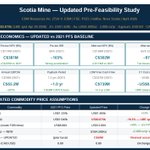
Why EDM Resources is in a better position now than in 2021: $edm.v
Compared to the 2021 PFS:
- Zinc price +23% → US$1.50/lb
- DMS boosts Zn head grade +18.4%, Pb recovery to 99.7%, cuts mill feed 25%
- New gold stream (assumed, highly conservative): ~2,000 oz/yr at $4,500/oz = C$11M new revenue/yr
-Gypsum price +40% → US$12/t
- C$59M tax losses shield years 1-3
- Opex -14% from DMS waste rejection
Slight headwind:
- Lead price -16% → US$0.87/lb (cuts ~C$3.6M revenue/yr)
- CAPEX now C$50M (assumed)
Net result: After-tax NPV more than doubles to C$302M.
Still dramatically better overall, aside from dilution over past couple years waiting on approval.
What’s left to go? Final approval from fisheries, financing confirmation, and updated PFS…. All within < 3 months.
2027 Q1 production if stars align
Market cap $23 million Canadian

4
568
$fri.v Freeport Resources (Massive potential copper mine)
AI data centers are the demand that arrives before the mines do. Everyday copper demand was already outrunning new supply. Now we’re layering hyperscale compute on top of an already tight market while the acid supply shrinks. The transition isn’t delayed - the materials arithmetic doesn’t close.

Green energy + AI can’t scale as planned: we simply don’t have enough #copper, or the sulfuric acid needed to mine more of it.
Everyday demand already outruns new supply; #AI piles on extra. Fully replacing fossils needs ~4.5 billion tonnes of copper - at today’s 25 Mt/year rate that takes ~187 years (and known reserves are only 880 Mt).
The catch: ~80% of sulfuric acid is an involuntary byproduct of refining fossil fuels and smelting metals. The more we shut those down, the less acid we have - exactly when we need more acid to extract the extra copper. Under scarcity it prioritises defence, food and chips first.
So the transition only gets the negative leftovers. The green energy plan isn’t late - it’s unbuildable.
322
Copper #zinc $zinc nickel
Unsexy base metals potential to get nutty with this sulfuric acid shortage?
$edm.v going to benefit greatly
Producers rely heavily on acid in smelting and refining
Combine this with a base metal break out happening at the moment
Roughly 70% of global newly mined #silver is produced as a byproduct of copper, lead, and zinc mining
That has the potential to truly go BONKERS if this keeps up
4
701
Why EDM Resources is in a better position now than in 2021: $edm.v
Compared to the 2021 PFS:
- Zinc price +23% → US$1.50/lb
- DMS boosts Zn head grade +18.4%, Pb recovery to 99.7%, cuts mill feed 25%
- New gold stream (assumed, highly conservative): ~2,000 oz/yr at $4,500/oz = C$11M new revenue/yr
-Gypsum price +40% → US$12/t
- C$59M tax losses shield years 1-3
- Opex -14% from DMS waste rejection
Slight headwind:
- Lead price -16% → US$0.87/lb (cuts ~C$3.6M revenue/yr)
- CAPEX now C$50M (assumed)
Net result: After-tax NPV more than doubles to C$302M.
Still dramatically better overall, aside from dilution over past couple years waiting on approval.
What’s left to go? Final approval from fisheries, financing confirmation, and updated PFS…. All within < 3 months.
2027 Q1 production if stars align
Market cap $23 million Canadian
$edm.v showing impressive resilience today despite a commodity sell off.
Near-term producer potential in a Tier-1 jurisdiction, tiny ~$23M market cap leaves huge runway once milestones hit.
The 2021 Scotia Mine PFS delivered a pre-tax IRR of 69% (after-tax 65%) - and that’s without any gold adder or including Zincs price increase.
Gold exploration is now underway as a potential by-product or standalone value boost on top of the strong base metals economics.
#gold #silver #gypsum #zinc #lead

$EDM.v
Red Dog, the US’s largest zinc mine in Alaska, is in structural decline from ore depletion and falling grades. Production dropped 9% year-over-year in early 2026, with guidance showing 375–415 kt #zinc in 2026 falling to 330–370 kt in 2027 and further in 2028. The mine faces closure around 2031–2032 despite extension efforts.
A restart at EDM.V’s Scotia Mine delivers key benefits for Canada and the USA in critical minerals. It provides tariff-free, secure North American supply under USMCA, reducing dependence on volatile foreign sources for steel galvanizing, infrastructure, EVs, and defense. It creates jobs and tax revenue in Nova Scotia while supporting domestic processing at facilities like Teck’s Trail smelter and lowering overall supply chain costs through shorter, reliable routes.
Main zinc concentrate imports from Peru, Australia, and Asia to North America face significant logistics risks. Peru experiences frequent protests, strikes, and blockades that halt production and exports. Australia contends with cyclones and long-haul shipping disruptions. Asia and China add geopolitical export restrictions, Red Sea diversions adding 10–30+ days and freight spikes, plus policy volatility. These create delays, cost surges, and shortages versus stable Canadian supply.
EDM.V Scotia output of roughly 15,900 tonnes zinc and 6,800 tonnes lead in concentrates annually, plus substantial gypsum, offers modest but strategically valuable near-term supply. This directly helps fill the Red Dog shortfall in a North American market where the US imports about 73% of its refined zinc needs.
Base metals are in a strong breakout as of late April 2026. The LME Base Metals Index sits near record highs, led by copper at all-time peaks around $13,000+/t, with zinc participating firmly near $3,476/t. The rally is fueled by supply constraints, rising electrification and infrastructure demand, and investor flows, creating a supportive environment for projects like Scotia.
3
910
$EDM.v
Red Dog, the US’s largest zinc mine in Alaska, is in structural decline from ore depletion and falling grades. Production dropped 9% year-over-year in early 2026, with guidance showing 375–415 kt #zinc in 2026 falling to 330–370 kt in 2027 and further in 2028. The mine faces closure around 2031–2032 despite extension efforts.
A restart at EDM.V’s Scotia Mine delivers key benefits for Canada and the USA in critical minerals. It provides tariff-free, secure North American supply under USMCA, reducing dependence on volatile foreign sources for steel galvanizing, infrastructure, EVs, and defense. It creates jobs and tax revenue in Nova Scotia while supporting domestic processing at facilities like Teck’s Trail smelter and lowering overall supply chain costs through shorter, reliable routes.
Main zinc concentrate imports from Peru, Australia, and Asia to North America face significant logistics risks. Peru experiences frequent protests, strikes, and blockades that halt production and exports. Australia contends with cyclones and long-haul shipping disruptions. Asia and China add geopolitical export restrictions, Red Sea diversions adding 10–30+ days and freight spikes, plus policy volatility. These create delays, cost surges, and shortages versus stable Canadian supply.
EDM.V Scotia output of roughly 15,900 tonnes zinc and 6,800 tonnes lead in concentrates annually, plus substantial gypsum, offers modest but strategically valuable near-term supply. This directly helps fill the Red Dog shortfall in a North American market where the US imports about 73% of its refined zinc needs.
Base metals are in a strong breakout as of late April 2026. The LME Base Metals Index sits near record highs, led by copper at all-time peaks around $13,000+/t, with zinc participating firmly near $3,476/t. The rally is fueled by supply constraints, rising electrification and infrastructure demand, and investor flows, creating a supportive environment for projects like Scotia.
pm.gc.ca/en/news/news-releas…
Few weeks back - Canada and Nova Scotia sign a new agreement to get major projects built faster
Decision to be made June / July regarding final approval of this restart project.

1
2
213
xitter.gq/enriquemulds/status/13…
What a snipe 🎯

Since 2020:
+903%: Bitcoin
+380%: Silver
+234%: Gold
+213%: Technology
+165%: Nasdaq
+131%: Industrials
+131%: S&P 500
+111%: Consumer Discretionary
+71%: International Stocks
+67%: Consumer Staples
+6%: Bonds
1
216
What happens when you combine 6 years of structural deficits and then disrupt the supply chain of the largest producing country?

Just when you thought the supply of silver was tight enough, a cartel war closes the largest silver export market in the world.
Without Mexican silver, the spot price should push over $100.

1
1
326
It presents a dystopian future where AI becomes extremely capable and abundant far faster than society and the economy can adapt, leading to massive economic disruption rather than broad prosperity.
The core paradox: What if our AI bullishness continues to be right... and what if that’s actually bearish?
Central thesis: Explosive AI progress destroys the economic value of human intelligence (the "intelligence premium unwind"). White-collar work gets automated at scale, creating a self-reinforcing negative loop: companies cut jobs → save money → buy more AI → displace more jobs → reduce consumer spending power → slower growth/deflationary pressure → more pressure to automate.
Key mechanism — "Intelligence Displacement Spiral": AI agents eliminate intermediation and friction across many sectors (SaaS, payments, real estate, travel, insurance, etc.). This leads to "Ghost GDP" — economic output counted in stats but not circulating through human hands (machines don't consume discretionary goods/services). Consumption (about 70% of GDP) collapses as white-collar workers lose income; no equivalent new human jobs emerge (unlike past tech revolutions).
Cautionary "left-tail risk" exploration — not a firm prediction, but a warning that AI abundance could be economically poisonous if it outpaces human adaptation and institutional response.

JUNE 2028.
The S&P is down 38% from its highs. Unemployment just printed 10.2%. Private credit is unraveling. Prime mortgages are cracking. AI didn’t disappoint. It exceeded every expectation.
What happened?
citriniresearch.com/p/2028gi…

213
BC faces a $13.3B deficit, but sits on massive mining potential that could help:
• 51 proposed projects worth ~$49B (Major Projects Inventory)
• 24 northern projects alone: projected $69B economic activity, $40B construction, $10B+ gov revenues
Need to speed up the process

BREAKING: BC budget projects $13.3B deficit for 2026-27 — largest in province's history
westernstandard.news/news/br…

1
239
Myrmikan Research “Just the Beginning”
Core thesis: The #gold bull market — $1,600 → $5,600 since 2022 — is still in its *early* phase.
We’re only in Phase 1.
Much higher prices ahead.
Three phases ahead:
1. Current: Steady foreign central bank buying as dollar weaponization pushes nations to gold.
2. Next: Fed forced back into massive QE to fund deficits & cap rates.
3. Final: Full-blown Treasury crisis → explosive gold move.
Dollar reserve status is cracking - BRICS hate it, China/Russia dumping UST, even Trump admin wants it weaker.
Result: U.S. must monetize debt domestically → inflation spike.
Currencies don’t fade quietly in over-indebted systems… they collapse.
Fed already quietly buying ~$40B Treasuries in Dec 2025 to ease reserve scarcity.
QE is coming back, bigger, under new leadership.
Gold needed to “cleanse” Fed balance sheet: $8,400–$12,600/oz (or more) based on historical gold/asset ratios.
Gold miners remain absurdly cheap:
• Senior market cap/NPV ~0.17x (historic lows)
• Ongoing ETF outflows *despite* gold +250%
Early bull = margin expansion + multiple re-rating + M&A frenzy incoming.
Volatility will be ahead, but the asymmetry is also massive.
Physical gold very strong, miners offer leveraged upside in a multi-phase bull driven by unsustainable U.S. fiscal/monetary reality.
Full report: myrmikan.com/pub/Myrmikan_Re…
188
“Looking ahead, as the gold price moves further and further above the cost of production per ounce, each additional increase in the gold price has a smaller impact on net present value (NPV).
For example, if a gold mine has production costs of $1,900 per ounce and the gold price rises from $2,000 per ounce to $3,000 per ounce (a 50% increase), the profit margin increases 11 times, from $100 to $1,100.
If the gold price then rises another $1,000, the margin increases by only 91%. Even if gold rises another 50% to $4,500, the margin increases only 3 times, not 11 times.
Because the gold price is now so far above production costs, the next major source of returns is expected to come from valuation multiple expansion rather than just higher gold prices.
Over the past few years, mergers and acquisitions (M&A) for development-stage companies have typically occurred at about 0.4 times NPV. Most junior mining companies currently trade well below that level, often much lower.
Not only do we expect company valuations to rise as the gold price increases, but we also expect M&A multiples to rise. In a market mania, the average multiple could reach 1 times NPV.
When you combine rising valuation multiples with the leverage of NPV to higher gold prices, this suggests that gold mining stocks could generate explosive returns from here, even though many have already doubled, tripled, or more over the past two years.”
Myrmikan Research “Just the Beginning”
Core thesis: The #gold bull market — $1,600 → $5,600 since 2022 — is still in its *early* phase.
We’re only in Phase 1.
Much higher prices ahead.
Three phases ahead:
1. Current: Steady foreign central bank buying as dollar weaponization pushes nations to gold.
2. Next: Fed forced back into massive QE to fund deficits & cap rates.
3. Final: Full-blown Treasury crisis → explosive gold move.
Dollar reserve status is cracking - BRICS hate it, China/Russia dumping UST, even Trump admin wants it weaker.
Result: U.S. must monetize debt domestically → inflation spike.
Currencies don’t fade quietly in over-indebted systems… they collapse.
Fed already quietly buying ~$40B Treasuries in Dec 2025 to ease reserve scarcity.
QE is coming back, bigger, under new leadership.
Gold needed to “cleanse” Fed balance sheet: $8,400–$12,600/oz (or more) based on historical gold/asset ratios.
Gold miners remain absurdly cheap:
• Senior market cap/NPV ~0.17x (historic lows)
• Ongoing ETF outflows *despite* gold +250%
Early bull = margin expansion + multiple re-rating + M&A frenzy incoming.
Volatility ahead, but asymmetry is massive.
Physical gold strong, miners offer leveraged upside in a multi-phase bull driven by unsustainable U.S. fiscal/monetary reality.
Full report: myrmikan.com/pub/Myrmikan_Re…
There's a new version of this post
1
1
220
Horrible news out of Vizsla Silver $vzla.to
For investors in GR Silver Mining $GRSL.v … the jurisdiction risk is real in Southern Sinaloa
As a reminder, GR SILVER has already had a cartel related security issue in April 2025… just something to keep note of. They are doing great work nonetheless #silver

Mexican mine workers found dead after alleged abduction, Canadian miner Vizsla Silver says theglobeandmail.com/business…

$GOOGL
Alphabet's 2026 CAPEX guidance of $175 to 185 billion, announced in its Q4 2025 earnings, far exceeds Wall Street's $120 billion expectation. This near doubling from 2025 levels focuses on AI infrastructure, including data centers, servers, and chips. It highlights a broader hyperscaler spending race involving Microsoft, Amazon, and Meta.
This explains why AI hardware stocks (NVIDIA, AMD, Broadcom, Micron) have outperformed software companies.
Hardware suppliers gain from direct demand and pricing power, while software firms face slower monetization and disruption risks.
The buildout is driving unprecedented commodity demand, especially electricity and copper. Data center power use is set to double globally by 2030, pushing U.S. consumption to records and boosting prices.
This contrasts with the 2010s software boom (SaaS, apps, cloud), which scaled digitally with minimal new physical resources. Today's AI cycle makes infrastructure the bottleneck, favoring hardware and commodities near term, with software gains likely later. Google's bold guidance signals the race is accelerating.
#commodities

1
1
344
The #AI hardware basket is built through these commodities below, not all are in a supply crisis, but a majority have either geopolitical risk, long lead times, or structural under-investment.
Tier 1 (core inputs)
•#Copper
•Electricity / energy (#uranium, natural gas, grid power)
•#Silicon
•#Silver
Tier 2 (infrastructure and power systems)
•Aluminum
•Steel
•Rare earth elements (neodymium, dysprosium, etc.)
•Nickel
•Cobalt
Tier 3 (specialty semiconductor materials)
•Gallium
•Germanium
•Tungsten
•Tin
•Gold
•Helium
•Neon
•Argon
•Hydrogen
Tier 4 (construction and industrial inputs)
•Concrete / cement
•Water (ultra-pure)
•Plastics / polymers
•Glass
——-
Now in terms of the “death of #SaaS”… this will never be the case because of risk & compliance, governance, and cybersecurity for large enterprises…
There will be even more software for almost everything. Software will grow a lot in the coming years with the implementation of AI in everything


409
Retirement trade pairing (Purchase and forget about forever). 🇺🇸 <> 🇨🇦
Surge Battery Metals $NILI.v: Nevada #lithium clay project with a ~42-year mine life (PEA).
One of the largest U.S. lithium resources, positioned to supply domestic EV & battery demand as North America localizes critical mineral supply.
1
3
494
Canadian Nickel $CNC.v: Ontario #nickel sulphide project with a ~41-year mine life (FS). Produces nickel + cobalt + PGMs, key inputs for high-energy EV batteries and a long-life Canadian supply anchor. This is the largest undeveloped nickel sulphide deposit in North America… being fast tracked by the Canadian government.
1
140
Galway Metals $gwm.v could partner with Dowa as an offtake buyer for both of its key projects.
• Estrades → zinc concentrate (Akita Zinc smelter)
• Clarence Stream → #antimony + gold concentrate (Kosaka smelter)
Same partner, two different metals, two different facilities.
This matters because Dowa is a Tier-1 multi-metal smelter that specializes in complex concentrates.
If they sign deals on both projects, it validates:
✔ metallurgy
✔ concentrate quality
✔ processing pathway
✔ commercial viability
That’s third-party technical proof.
Strategically, it makes sense for Dowa too:
Estrades = long-term zinc feed
Clarence Stream = critical mineral antimony (non-China supply)
Plus gold & silver byproduct credits.
Canada → Japan supply chain with strong ESG
Clarence Stream contains ~11,300 t of antimony — almost half of total annual U.S. demand (~24,000 t).
If developed, even modest production could meaningfully supply the U.S. & reduce reliance on imports from China.
Let’s get deep inside $GayMF Galway Metals 👇
$GWM.V delivering textbook junior progression on Estrades:
Jan 14 → Binding JV term sheet with DOWA (major Japanese smelter): DOWA can fund up to US$25M staged to earn 45%, starting with key exploration (geophysics + drilling).
Jan 21 → Robust PEA drops:
• 33% IRR / $212M NPV5% (consensus prices)
• 61% IRR / $518M NPV5% (spot prices w/ Au ~$4,456)
• Low $117M initial capex (toll-milling base case)
• 8-yr mine: 171koz Au + 245M lbs Zn + 30M lbs Cu payable
Non-dilutive exploration funding secured just in time. 🔥
Next: Optimizations, environmental baselines (Q2'26), DOWA-funded drilling/resource upgrades + exploration.
Estrades is now de-risked & leveraged to metals bull - while 100%-owned Clarence Stream (#gold + #antimony) marches toward mid-2026 resource update (likely well above 3 million oz gold, 30 million + pounds antinomy)
Market cap 107 mil CAD, .86 cents… 125 million shares outstanding
Safe jurisdiction within Canada, near existing infrastructure, fully cashed up for 2026, CEO a massive buyer over the last three years on open market, and sold his last business for $340 million USD🇨🇦
1
6
1,171

🇺🇸🇨🇳US-LISTED SHARES OF RARE EARTH MINERS AND CRITICAL MINERALS UP PREMARKET AFTER REPORT TRUMP ADMIN LAUNCHES $12 BLN MINERALS STOCKPILE TO COUNTER CHINA.
UNITED STATES ANTIMONY UP 6.2%, RAMACO RESOURCES UP 3.8%.
LITHIUM AMERICAS DOWN 4.3%, NIOCORP DEVELOPMENTS UP 3%, SIGMA LITHIUM DOWN 6.2%.
USA RARE EARTH UP 6.7%, MP MATERIALS UP 4.5%, CRITICAL METALS UP 8.4%.
mktnews.com/flashDetail.html…

168
Wouldn’t have it any other way.

> Gold losing an entire NVDA market cap in minutes
> Silver moving 12%+ intraday
> Copper printing candles the Japanese haven't even thought of
> Bitcoin underperforming gold over 5YR
> Oil breaking out finally
> Agriculture futures about to break out
> MSFT down 12%
WTF.

204
Minera Alamos $MAI.v $MAIFF pipeline at $5,500 #gold using reported & study AISCs:
Let’s just see what it would look like if today’s price stayed?
Pan 🇺🇸 (35k oz, AISC $1,604) → $136M/yr FCF
• Pan complex: Already producing (NV)
→ Likelihood: 95-100%
→ Timeline: Ongoing, modest expansion possible 2026-27
Copperstone 🇺🇸 (45k oz, AISC $1,259) → $191M/yr FCF
Copperstone (AZ, underground restart)
→ Likelihood: 85-90% (fully permitted, low capex)
→ Timeline: Restart 2026-27, full production 2028
Gold Rock 🇺🇸 (55k oz, AISC $1,008) → $247M/yr FCF
(NV, open-pit heap leach)
→ Likelihood: 80-85% (federally permitted)
→ Timeline: Construction 2026-27, first pour 2028, full 2029. Located in Pan district which has the current producing mine… lots of synergies here)
Cerro de Oro 🇲🇽 (40k oz, AISC $873) → $185M/yr FCF
(Mexico, heap leach)
→ Likelihood: 90% (permitted, brownfield)
→ Timeline: Construction mid-2026, production late 2027-28
La Fortuna 🇲🇽 (25k oz, AISC $1,000… assumed) → $113M/yr FCF
(Mexico, open-pit)
→ Likelihood: 65-75% (needs permit refresh)
→ Timeline: Feasibility 2026-28, production 2030+
Total: ~200k oz/yr = ~$872M annual mine-level cash flow by 2030
Pan is real data. Others from PEAs. La Fortuna estimated.
Near-term drivers: Pan + Copperstone + Cerro de Oro could 3-4x output by 2028.
It takes less than 100 million to get these all up and running, they are quick construction projects. Nothing extreme. It’s interesting #GOLD
1
16
1,232