

The Permanent Corrosion Protection Solution That Gets Stronger Over Time. Used by the Top Companies in the World to Fight Corrosion. Follow to Learn More.
Fuquay-Varina, NC
Joined September 2010
- Tweets2.8K
- Following314
- Followers404
- Likes2.5K




What if tank-bottom steel arrived with its soil-facing side already protected?
EonCoat's pre-coated steel program moves corrosion protection upstream, before plates are delivered for installation and welding.
Request a Quote:
hubs.li/Q04FZXW80

3
Cooling industrial exhaust can actually create corrosion.
In some combustion systems, acidic compounds condense when surfaces fall below their dew point. It's called acid dew-point corrosion.
Better heat recovery must go hand in hand with suitable materials and equipment design.

7
Offshore wind turbines face marine corrosion risks outside and inside.
Humidity and condensation can create corrosion exposure in internal compartments.
That's why ventilation and dehumidification can be important parts of turbine design.
The tower must survive the sea, too.

1
1
16
A fire sprinkler system may spend years waiting to activate.
But corrosion can still develop in its piping.
Over time, deposits may restrict passages or interfere with components, while localized attack can cause leaks.
Reliability matters even when equipment isn't being used.

1
7
Some fertilizers absorb moisture directly from humid air.
Residue on conveyors, hoppers and steel supports can therefore become more than a housekeeping issue.
Depending on the chemistry, those damp deposits may create corrosive conditions even inside a covered facility.

5
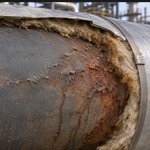
An insulated pipe can look perfectly normal on the outside while the steel underneath corrodes.
Moisture can enter through damaged weather jacketing and remain trapped.
It's called Corrosion Under Insulation (CUI).
Sometimes the most important surface is the one you can't see.

10
Water doesn't have to sit still to cause corrosion.
At pipe elbows and other flow changes, turbulence and suspended particles can disturb protective surface layers and accelerate metal loss.
It's called erosion-corrosion.
Sometimes geometry changes everything.

8
Some bridges are designed to develop a rust-colored surface.
Weathering steel can form a protective patina under suitable wet-dry conditions.
But persistent moisture and chlorides can interfere with that protection.
Not all rust-colored steel tells the same story.

11
Today, we honor the men and women who have served in the United States Armed Forces.
To our veterans and their families, thank you for your service, courage, and sacrifice.
Happy Veterans Day.
From all of us at EonCoat.

5
A heat exchanger can lose efficiency and metal at the same time.
Deposits can reduce heat transfer while creating conditions for localized corrosion beneath them.
What looks like a cleaning problem may also be a material-integrity problem.

1
16
That narrow strip of steel extending beyond a storage tank shell is called the chime.
If water enters through a deteriorated tank-to-foundation seal, it may reach the underside of the floor.
Sometimes a tank-bottom corrosion problem begins with rain outside the tank.

26
Two different metals can create a tiny battery without wires.
When electrically connected in a conductive environment, one metal may corrode faster.
That's galvanic corrosion.
And not all corrosion looks orange. Aluminum corrosion can appear white and powdery.

12
A steel sheet-pile wall can experience several environments at once.
Salt air above.
Splash and tidal wetting near the waterline.
Continuous immersion below.
Different conditions can create very different corrosion patterns on the same structure.

15
Some industrial equipment creates its own rainstorm.
Cooling towers use water and air to remove heat, but the wet environment also creates challenges for structural supports, fasteners, and other components.
Sometimes the operating process creates the corrosion exposure.

8
Concrete can crack because the steel inside it is rusting.
When reinforcing steel corrodes, corrosion products expand and can generate enough pressure to crack or spall the surrounding concrete.
The visible damage may begin beneath the surface.

1
63
Why put soapy water on a new steel tank bottom?
Inspectors use a transparent vacuum box to check welded seams for leaks.
Air passing through a tiny opening creates visible bubbles.
Sometimes the simplest scientific principles make excellent inspection tools.

26
If corrosion had a mascot, it might be a zombie.
Slow. Persistent. Quiet. Always looking for a way in.
It feeds on trapped moisture, deposits, delay, and difficult access.
Don’t feed the corrosion zombies. 🎃

10
Why does the same steel perform so differently from one site to another?
Because steel does not corrode in the abstract.
It corrodes in a specific environment.
Exposure matters.
Moisture matters.
Residue matters.
Inspection access matters.

7
The real cost of corrosion rarely appears in one budget.
It gets scattered across inspection, labor, access equipment, shutdowns, replacement parts, lost productivity, and more.
The better question is not just “What does the product cost?”
It’s “What does the problem cost?"

5
