

Army Combat Veteran. Casual political philosopher (no party affiliation/left of center). If you disagree with me, educate me. Valuable insights appreciated.
Joined March 2022
- Tweets6.3K
- Following772
- Followers340
- Likes5K






Pinned Tweet
Claim: Starting a war with Iran was militarily, geopolitically, and economically incompetent.
Argument: The war in Iran is going to be seen as one of the worst military blunders in US history. The war will be seen as short sighted and impractical. The primary reason being the inability to readily control the strait.
Ostensibly, the US gambled that regime change in Venezuela and a decapitation strike (likely expecting regime change) in Iran would grant the US control of significant portions of energy flowing into China. Venezuela worked out, but Iran did not. Iran proved capable of controlling the strait and the economic consequences of strait closure pitted US interests against the interests of practically the entire world, but importantly Gulf, Asian, and European nations.
Throughout the war military assets were moved from Asian allies and the Gulf states, and into Israel and Jordan. The heads of state for both Japan and South Korea have demanded security assurances, and publicly protested these assets being moved. Our Gulf allies having air defense assets moved away from their countries during the war.
The war to begin with was impractical and military planners calculated any war with Iran to have a low probability of achieving it's strategic aims for various reasons, primarily an inability to counter Irans layered asymmetric defense/offensive capabilities with great efficacy.
Closure of the strait is akin to an economic nuke. Gulf states depend on energy exports for upwards of 70% of their revenue. Strait closure would result in the economic collapse of those nations. Asia imports nearly half of all their energy from the strait with no viable short term alternative. Their economies face severe economic depression in any prolonged closure of the strait pitting their national interests in direct opposition to ours.
When sellers are no longer reliable, buyers seek alternatives. This can result in a permanent loss of revenue in Gulf states.
Opening the strait would require the capability to sweep mines while simultaneously defending our ships and drones during those operations. The physics behind sea mine detection makes this extremely difficult due to the effect water has on electromagnetic waves. Water turbidity, pollution, and thermoclines make other methods of mine sweeping less effective, not to mention the logistics and manpower hurdles of implementing any serious strait clearing operations. The lack of a staging ground in the Gulf due to Gulf states refusing to allow their countries to be used. The lack of allied support. The long supply route over the Atlantic and the lack of seaport access in the strait.
Many suggested that the US take Kharg, however, these operations would take time, time the Gulf states and Asian allies don't have.
War with Iran was cautioned against by military planners for very practical reasons, another example of these reasons are that much of the coastal defense is hidden in tunnels buried deep below granite, requiring heavy ordinance such as the GBU-57s to penetrate. Something that only B-2 bombers can carry at this time. The B-2 has a 35%-40% combat readiness rate meaning that, in the entire world, approximately 6-8 combat ready aircraft are capable of dropping this ordinance. This has direct consequences for any time sensitive military operation, not to mention the logistics hurdles of even just that aspect of the air campaign alone.
This isn't an ideological argument against war with Iran, they are in fact radical islamist clerics, it's a pragmatic consideration. War with Iran was very unlikely to achieve its stated goals: A permanent end to Iran's nuclear program and unconditional surrender.
#IranWar #Iran
Herbert Holmes 🇺🇲 retweeted
Alexander Hamilton (1972 letter to George Washington):
When a man unprincipled in private life desperate in his fortune, bold in his temper, possessed of considerable talents, having the advantage of military habits—despotic in his ordinary demeanour—known to have scoffed in private at the principles of liberty—when such a man is seen to mount the hobby horse of popularity—to join in the cry of danger to liberty—to take every opportunity of embarrassing the General Government & bringing it under suspicion—to flatter and fall in with all the non sense of the zealots of the day—It may justly be suspected that his object is to throw things into confusion that he may “ride the storm and direct the whirlwind.”
Groypers and the DSA are gaining ground. I wonder if either political party can push their extremists out. I won't hold my breath. Partisanship is the worst thing in politics. No wonder the founding fathers didn't like political parties.
Alexander Hamilton (1972 letter to George Washington):
When a man unprincipled in private life desperate in his fortune, bold in his temper, possessed of considerable talents, having the advantage of military habits—despotic in his ordinary demeanour—known to have scoffed in private at the principles of liberty—when such a man is seen to mount the hobby horse of popularity—to join in the cry of danger to liberty—to take every opportunity of embarrassing the General Government & bringing it under suspicion—to flatter and fall in with all the non sense of the zealots of the day—It may justly be suspected that his object is to throw things into confusion that he may “ride the storm and direct the whirlwind.”
Instead of Republicans bending themselves into pretzels trying to quote the so called "radical liberals" of the time (a majority of whom believed in jus soli), out of context, rejecting Stare Decisis, textualism, and originalism in lieu of consequentialism, they should do this.

Some of my colleagues are waiting to see how the politics shake out after the Supreme Court’s birthright citizenship ruling. I don't operate that way.
I introduced my constitutional amendment months ago because I believed then that citizenship in the greatest nation on earth should mean something. It shouldn't be the automatic result of a parent successfully crossing a border illegally. My amendment fixes that by returning the 14th Amendment to its original meaning.
komonews.com/news/nation-wor…

TLDR: The 14th amendment was a radical liberal document that passed only by forcing former Confederate states to accept it or face expulsion from the union.
First a brief history of how it passed followed by arguments from both opponents and proponents of the 14th amendment.
How the 14th passed:
The 14th amendment was considered a radical liberal document at the time of its passing. With respect to the citizenship clause, the anti-immigration/anti-14th amendment side of the debate lost and were not able to pass a provision changing the language. Ultimately, almost every former Confederate state refused to ratify the amendment. Congress placed the former Confederate states under martial law, in spite of President Andrew Johnson who vehemently rejected the 14th amendment and tried to veto the reconstruction acts. Congress conditioned re-entry into the union on accepting the 14th amendment.
Proponents of the citizenship clause:
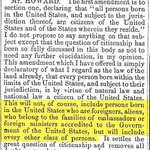
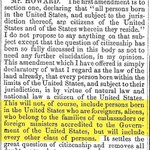
Senator Howard:
• “This amendment which I have offered is simply declaratory of what I regard as the law of the land already, that every person born within the limits of the United States, and subject to their jurisdiction, is by virtue of natural law and national law a citizen of the United States. This will not, of course, include persons born in the United States who are foreigners, aliens, who belong to the families of ambassadors or foreign ministers accredited to the Government of the United States, but will include every other class of persons. It settles the great question of citizenship and removes all doubt as to what persons are or are not citizens of the United States.”
Senator Trumbull:
• “The child of an Asiatic is just as much a citizen as the child of a European.”
• “birth entitles a person to citizenship, that every free-born person in this land is, by virtue of being born here, a citizen of the United States.”
• “We cannot make a citizen of the child of a foreign minister who is temporarily residing here.”
Senator John Conness:
• “The proposition before us... relates simply in that respect to the children begotten of Chinese parents in California, and it is proposed to declare that they shall be citizens. We have declared that by law; now it is proposed to incorporate the same provision in the fundamental instrument of the nation. I am in favor of doing so.”
• “We are entirely ready to accept the provision proposed in this constitutional amendment, that the children born here of Mongolian parents shall be declared by the Constitution of the United States to be entitled to civil rights and to equal protection before the law with others.”
• “the children of all parentage whatever, born in California, should be regarded and treated as citizens of the United States, entitled to equal civil rights with other citizens of the United States.”
Senator Justin Smith Morrill:
• “As a matter of law, does anybody deny here or anywhere that the native born is a citizen, and a citizen by virtue of his birth alone?”
• “the grand principle both of nature and nations, both of law and politics, [is] that the native born is a citizen, and a citizen by birth alone.”
Quotes from key opponents of the citizenship clause:
Senator Cowen:
• “Is the child of the Chinese immigrant in California a citizen? Is the child of a Gypsy born in Pennsylvania a citizen? If so, what rights have they? Have they any more rights than a sojourner in the United States?”
• “Is it proposed that the people of California are to remain quiescent while they are overrun by a flood of immigration of the Mongol race? Are they to be immigrated out of house and home by Chinese?”
•“It is utterly and totally impossible to mingle all the various families of men, from the lowest form of the Hottentot up to the highest Caucasian, in the same society.”
• “I have supposed further, that it was essential to the existence of society itself, and particularly essential to the existence of a free State, that it should have the power, not only of declaring who should exercise political power within its boundaries, but that if it were overrun by another and a different race, it would have the right to absolutely expel them.”
•“I am unwilling on the part of my State, to give up the right that she claims... of expelling a certain number of people who invade her borders; who owe to her no allegiance; who pretend to owe none; who recognize no authority in her government... who pay no taxes; who never perform military service... I mean the Gypsies. They wander in gangs in my State.”
• “These people live in the country and are born in the country. They infest society.”
• “Are the states to lose control over this immigration? Is the United States to determine that they are to be citizens?”
Rep. Andrew J. Rogers:
• “The right to vote is a privilege. The right to marry is a privilege. The right to contract is a privilege. The right to be a juror is a privilege. The right to be a judge or President of United States is a privilege. I hold if [Section 1] ever becomes a part of the fundamental law of the land it will prevent any state from refusing to allow anything to anybody embraced under this term of privileges and immunities."
Senator John Conness:
• “The proposition before us... relates simply in that respect to the children begotten of Chinese parents in California, and it is proposed to declare that they shall be citizens. We have declared that by law; now it is proposed to incorporate the same provision in the fundamental instrument of the nation. I am in favor of doing so.”
• “We are entirely ready to accept the provision proposed in this constitutional amendment, that the children born here of Mongolian parents shall be declared by the Constitution of the United States to be entitled to civil rights and to equal protection before the law with others.”
• “the children of all parentage whatever, born in California, should be regarded and treated as citizens of the United States, entitled to equal civil rights with other citizens of the United States.”
Senator Justin Smith Morrill:
• “As a matter of law, does anybody deny here or anywhere that the native born is a citizen, and a citizen by virtue of his birth alone?”
• “the grand principle both of nature and nations, both of law and politics, [is] that the native born is a citizen, and a citizen by birth alone.”
Rep. Andrew J. Rogers on Section 1’s Citizenship Implications:
• “The right to vote is a privilege. The right to marry is a privilege. The right to contract is a privilege. The right to be a juror is a privilege. The right to be a judge or President of United States is a privilege. I hold if [Section 1] ever becomes a part of the fundamental law of the land it will prevent any state from refusing to allow anything to anybody embraced under this term of privileges and immunities."
It's a strange coincidence that the opponents of the 14th amendment make very similar arguments against birthright citizenship as those who today disagree with the Supreme Court ruling on the 14th amendment. Even the states they belong to are highly correlated with red states.
Most Confederate states initially rejected ratifying the 14th amendment. Those states were placed under martial law and forced to adopt it as a condition for re-entry into the union. The southern states believed this would lead to mass immigration and prevent them from denying birthright citizenship to certain races or groups deemed un-assimilable.
States that initially rejected ratifying the 14th amendment:
• Texas: Rejected October 27,
1866
• Georgia: Rejected November 9, 1866
• North Carolina: Rejected December 14, 1866
• South Carolina: Rejected December 20, 1866
• Virginia: Rejected January 9, 1867
• Mississippi: Rejected January 30, 1867
• Louisiana: Rejected February 6, 1867
• Alabama: Rejected December 7, 1866
• Arkansas: Rejected December 17, 1866
• Florida: Rejected December 6, 1866
McCarthyism 2.0 coming soon...

We need to build a coalition and stop Iran from controlling the strait. We can't do this with just Israel as our only ally here.

NEW: Iran has continued to use force to try to deter the United States from undermining Iranian efforts to control the Strait of Hormuz.
Iran’s strikes against Bahrain may also be part of an ongoing Iranian effort to coerce the Gulf states to accept Iran’s control of the strait and deter them from supporting US efforts to undermine Iran’s control.
MORE ⬇️🧵(1/3)

The US's inability to control the Strait of Hormuz is largely a function of geography and physics. China will face similar barriers in any invasion of Taiwan.
They will face the same physics problems in naval combat—with respect to clearing sea mines. Water turbidity, thermoclines, changing pressure, electromagnetic attenuation and scattering, natural formations, pollution, etc. still remain natural potent physical barriers to sea mine clearance and impact each layer of the sensor suite (optics, radar, sonar, magnetism, pressure sensors, thermal sensors, etc.).
This is without accounting for countermeasures such as acoustic coatings, non-ferrous material, natural formation mimicry, or maneuverability.
The geography creates predictable routes that pass through narrow channels. These routes are determined even by the time of year. While there are no mountains like the Zagros, there is an island chain that acts as a natural defensive position against potential invasion.
It's worth considering how impracticable nature itself can make an invasion.