

TRUSTED BY WATCH ENTHUSIASTS SINCE 1993
Boston, MA
Joined January 2012
- Tweets18.2K
- Following4.2K
- Followers9.2K
- Likes1.9K


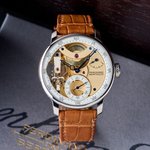



This upcoming weekend at the Phillips watch auction, lot 107 is the Harry Winston Opus One by F.P. Journe. It's one of only six Opus One tourbillons, every one a piece unique, and this is the turquoise dial, made right as François-Paul Journe was launching his own brand.
One of us said 3.5. The other said 1.8–2 million. Who do you think is closer? 👀
Drop your hammer price guess in the comments! We wanna see what you think it'll go for
The dial on this Lange 1 forced the brand to develop a new caliber.
Mother of Pearl is thicker than the German silver that Lange normally uses, meaning the hands sat too low. Lange lengthened the pinions to lift the hand stack clear and called the resulting caliber the L901.4. Same movement as every other Lange 1, adjusted for this specific dial. The case had to grow too. Diameter stayed at 38.5mm, but thickness went up about half a millimetre, entirely to make room for a slice of shell.
And it isn't solid shell. Lange describes its own mother of pearl dials as a very thin layer laid over a solid silver base, which is why the watch still behaves like a Lange 1 underneath.
It arrived in 2001 as one of a pair. This one on a strap, and a second reference, the 160.029, on an integrated white gold bracelet built for Lange by the jeweller Wellendorff. At launch the strap version was 18,700 euros and the bracelet version 29,100, so the bracelet alone cost more than half the watch again.
The plain Mother of Pearl version had the shortest run of the family. Gone from the catalogue by the middle of the decade, while the guilloché version carried on to 2009. And Lange has no Mother of Pearl in the collection at all today.
Available now.


We had the honor to see this beautiful new piece from Ferdinand Berthoud, shown to us at NYC WatchTime.
Pull the crown and the tourbillon stops. Push it back and it resets itself. Flip it over and you can see the lever and snail cam that force it to always move in the same direction.
You can check out the full NYC WatchTime Recap on our YouTube!
There’s a window cut into the side of the case so you can watch the hairspring “breathe”.
That hairspring is cylindrical, something almost nobody attempts outside of in a tourbillon, because standing the spring upright makes it misbehave in the flat positions. Berthoud sent it to COSC anyway, and it came back as the only mechanical movement with a cylindrical hairspring ever to pass.
Getting there took two more years of regulating after the movement was already finished. Both terminal curves are formed by hand and checked at twenty times magnification.
There’s no dial. The mainplate sits in the middle of the movement rather than behind a dial, with six bridges in front of it and ten behind, so the thing you read the time off is the mechanism itself.
It isn’t a limited edition, but the workshop in Fleurier simply cannot build more than 25 of them in a year.
The round case is a tribute. It comes from a decimal watch Louis Berthoud made in 1793, which the company owns and keeps at Fleurier.


EP 20 of ranking EVERY watch brand... G-SHOCK!
Can a hundred dollar watch be ranked against Patek and Lange?
That was Justin’s problem with G-Shock Not where it lands, but whether it belongs on the list at all.
Rob had no such hesitation. He wanted it between A and B and said so straight away. Justin countered with C tier.
But Rob just isn't having it...
Where would you have G-Shock?
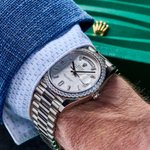
The disc that spells out the day on this watch has seven holes punched through it.
It has to. That disc runs almost the full width of the dial, so left solid it would cover the date disc underneath completely. Seven apertures, evenly spaced, mean the correct date is always sitting in the window at 3 no matter which day is showing at 12.
Rolex patented that design in 1955, and it left a fingerprint. Every Day-Date caliber since has ended in -55. The 1055, then the 3055, then the 3155, and the one in this watch, the 3255.
Now look at what those two windows are cut out of. The crystal pattern in meteorite forms as the material cools by a few degrees every million years, and it cannot be recreated on earth. The Day-Date is the only Rolex that has to take two openings out of a single slice of it.
The Day-Date has never been sold in steel. Not once since 1956. Gold or platinum only, which is why a factory diamond bezel reads as standard equipment here rather than as an addition.
The word President belongs to the bracelet, not the watch. Rolex built the Presidential bracelet in 1956 for the Day-Date launch and has never used the name for the watch itself. That came from somewhere between the bracelet and Lyndon Johnson wearing one.


There is SO MUCH, yet it's so subtle. A split seconds chronograph and a perpetual calendar, in a movement 7.3mm thick.
That’s the whole argument for this watch. The base caliber is 5.25mm, the perpetual calendar module adds another 2.05mm, and Patek has never built a thinner rattrapante perpetual. The case lands at 37mm across and 12.35mm thick, which is small for a grand complication and remarkably small for this one.
Rob’s point was that nothing about it announces any of that. One button runs the chronograph, the dial is black, and the platinum case is something you’d have to pick up to identify. Justin agreed, and it’s already one of his favorite modern Pateks.
This watch is named after the month in which the tourbillon was patented.
Abraham-Louis Breguet patented the tourbillon on 7 Messidor, Year IX, in the French Republican calendar. (Or the 26th of June 1801 for those of you not familiar with revolutionary French calendars…)
Now look at how the cage is held, because it isn’t. There’s no visible connection to anything at all. The drive wheel is sapphire and the upper pivot sits in a sapphire bridge, so the whole mechanism appears to be turning in air.
Breguet filed the patent for that idea in 2004 and launched this watch in 2007. Cartier, the other manufacturer known for this kind of complication, was still six years away from making a mystery wristwatch of any kind.
There’s no seconds hand either. The seconds come off the tourbillon shaft, so the cage turning once a minute acts as the seconds hand. The dial is sapphire, so there’s nothing between you and the mechanism.
The model has never been a limited edition, Breguet simply never made very many. Nineteen years after it launched the watch is still in the catalogue.
Available now on our website!


Kari Voutilainen’s Vingt-8, Dubail Grande Lange 1, Transitional Patek 3970G and many more.
Check out these new pieces we have in-stock on our website now!


EP 19 of ranking EVERY watch brand... FPJ.
Yes, we know... It took us a minute to get to the brand many of you having been waiting for but here we are.
So Rob's argument for putting F.P. Journe in B tier has nothing to do with the watches.
He thinks the hype has gotten so loud that it's doing the brand a disservice. Journe is a genuine artist and one of the best designers working, and Rob's position is that without the fan base shouting over him, he'd be sitting comfortably in A.
Justin isn't having it. His view is that a loud fan base is not Journe's fault, and it shouldn't cost him a tier when the work speaks for itself.
Where do you put him?
Excerpts from the Declaration of Independence are printed tone-on-tone across this parchment-colored dial. You only see it when the light hits it just right.
The only color anywhere is red, and it’s used three times: thirteen calligraphic initials for the thirteen original colonies standing where the minute numerals should be, the line “Life, Liberty, and the Pursuit of Happiness”, and the dates 1776 to 2026.
The 250 is the anniversary, not the edition. They made 25, and every one of them was dedicated to the American market (because of course they were!).
There’s a reason it went that way. When Laurent Ferrier released his first watch in 2010 it won best men’s watch at the GPHG, and it was American collectors who got behind it before anyone else. This is the brand paying that back.
The case is titanium and the hands are 18k white gold, and the dial itself reads cream in one light and ivory in another.
Underneath is the LF116.01, hand wound, 150 parts, 80 hours. The teeth on its winding pawl are cut deliberately long, which does nothing for the timekeeping and everything for how the crown feels turning under your thumb. On a watch this quiet, that is the kind of detail doing the work.
Available now on our website.


There are two seconds hands on this dial and they turn in opposite directions. The lower one runs clockwise, the upper one counterclockwise, and it isn’t a styling decision.
Inside are two complete gear trains, each with its own mainspring barrel and its own escape wheel, feeding a single balance from both sides. A seconds hand sits on the fourth wheel of each train, so the symmetry of the movement is what sends them opposite ways.
The idea goes back to Breguet, who wanted an escapement with the frictionless push of a detent and the self starting reliability of a lever, and built one using two escape wheels released in turn. Almost everyone who has revived it since gears those two wheels together and drives them off a single train, which is far simpler and notoriously fussy, because the teeth have to mesh with almost no margin at all. Lederer took the harder road and gave each wheel its own train, so while one unlocks the other stays locked and neither has to wait on the other.
Fitting all that into a reasonably sized wristwatch is next to impossible and Lederer went further again and built a constant force remontoir into each train. They run staggered, so one releases every five seconds, and you can watch it through the figure eight opening and even hear it in a quiet room. The two rounded triangles turning on the seconds pivots are what times them, a sixth of a turn to the ten second mark.
It won the Innovation Prize at GPHG in 2021. Free sprung balance, overcoil hairspring, 42 hours of reserve, and a triple click on the ratchet wheel so you feel every notch when you wind it. 44mm in white gold and just 25 pieces with this blue dial.
Available now on our website!


Laurent Ferrier ships this one with a scale model of the Porsche he raced at Le Mans in 1979.
But as Rob points out, that is not the same blue...
Although as Justin points out, it doesn’t matter, because Rob is the only watch collector alive who would buy this watch, which makes him the entire market for it.
This watch is named after a 14th century Italian dance.
A saltarello (from saltare, “to jump”) is an Italian dance built on a hopping step. Vacheron made 500 of these across three metals, with only 100 in yellow gold.
The hour on this piece doesn’t sweep. A spring charges slowly for a full hour while a ratchet holds it back, and on the hour a lever lets go and the whole stored charge fires at once, because turning a disc takes far more force than moving a hand.
The minutes do the opposite. They climb a fan-shaped arc and then fly back to zero. This was the first time Vacheron combined a jumping hour and a retrograde minute working together in one wristwatch.
The guilloche plays a key role as well. The ribbed fan cut into the dial traces the exact path the minute hand travels across it, and the pattern is lifted off Vacheron jump hour pocket watches from the 1930s.
This model was also the end of something. Vacheron spent the back half of the 1990s making three genuinely strange watches, the Mercator, the Heures Sautantes and this one, and then moved on to more traditional designs. The Saltarello was the last of them.
Available now.


Justin and Rob on the Vacheron American 1921 Perpetual Calendar.
Everyone knows the 1921 as the tilted one. The driver’s watch, dial turned 45 degrees, crown up in the corner. This is the version where Vacheron turned it back.
The dial sits upright. The crown moved to the left instead, which is where it was on the 1919 original. And because the crown moved, the whole calendar swung round with it, so the moonphase ends up riding near the top of the dial rather than sitting at 6.
The movement is the calibre 1120, built off the Jaeger-LeCoultre 920 from 1967. Same base that goes into a Royal Oak and a Nautilus. With a perpetual calendar stacked on top it’s still only just over 4mm thick.
They made 20. Platinum only, sold through four boutiques: Geneva, Moscow, Hong Kong and Shanghai.
Justin said he’d be shocked to see another one come through the store. Only one example has ever appeared at public auction, and that was the same watch selling twice.
A. Lange & Söhne has almost never built a watch specifically for a retailer. This is one of the 25 it did.
The shop is Dubail, located on Place Vendôme in Paris. The relationship was close enough that Lange engraved the retailer’s name on the caseback, something it does for virtually no one.
Two of the 25 have come up at auction, numbered 23 and 24. The whole edition was built in a single batch and then stopped.
The dial is blue mother of pearl. The translucency and the grain are different on every disc that gets cut, so no two of the 25 look the same despite all being produced at the same time.
Lange doesn’t offer a mother of pearl dial anywhere in the collection today. The Soirée dials belong to the early 2000s, and this blue variant was created for Dubail and nobody else.
There’s a smaller sibling. Before this one Lange built a 38.5mm Lange 1 for the same shop, also blue mother of pearl, also 25 pieces. This is the 41mm continuation of that watch.
Available now on our website!


Taylor with Kari Voutilainen at WatchTime New York and asked him about his process and where the brand goes from here.
Amazing conversation, and we'll continue to have more NYC WatchTime content so make sure you follow to not miss it!
This was the last one. Patek killed the 5140 off one version at a time, and the charcoal platinum 5140P-017 was the final one left standing.
The line launched in white gold in 2006. Yellow followed, then rose, and platinum didn’t arrive until 2010, four years into the collection. By 2016 everything else had gone and this charcoal grey sunburst dial with gold markers was the entire line.
It didn’t last long after that either. By the middle of 2018 Patek had taken it out of the catalogue and the line passed to the 5327.
What it replaced was the 3940, and Patek deliberately changed almost nothing. 37.2mm instead of 36. A convex bezel where the old one had been concave. And of the three subdials only the one at 6 was enlarged, because the date is the part that most people actually read.
There’s a quirk on this dial that Patek quietly corrected afterwards. Look at the date ring. The 5 and the 27 are drawn smaller than every other number, so they sit there looking squashed. On the 5327 they’re all the same size.
It also comes with a second case back. Solid platinum, fitted by Patek, so the movement can be closed away and the back engraved if that’s what you’re into.
Available now on our website.


Rob’s favourite brand is Panerai, and he still couldn’t keep a straight face about this one.
The Mare Nostrum comes with a toy boat.
Which is funnier once you know what the watch was for. Panerai built the original in 1943 for deck officers in the Royal Italian Navy, and the chronograph was there to time torpedo runs. 52mm of steel and an Angelus movement.
The war killed the project before it ever reached production. Depending on the source, somewhere between three and ten prototypes exist, and Panerai had to buy one of its own back at Christie’s in 2005 for 132,000 francs.
Eighty years later the reissue turns up with a model ship in the box.
Mare Nostrum means “our sea.” They committed to the theme.
Philippe Dufour is a legend that has spent his life building some of the finest watches ever made by hand. This is the first new watch he ever bought for himself.
Watch the minute counter on a Datograph. It doesn’t creep forward. It snaps, exactly as the seconds hand crosses 12, and Lange patented the mechanism that does it in 1998.
On the movement, Dufour said this: “The perfect finishing of all the elements jumped out at me, just like a 3D effect.” And then, “in my humble opinion, this watch is a pure masterpiece.”
It’s the calibre L951.1, 405 parts, 40 jewels, four of them sitting in screwed gold chatons, with a column wheel and a balance cock engraved by hand.
Rose gold with a black dial is the version collectors attached his name to. Lange built it for about two years, from 2003 to 2005, and that was the whole run.
The gold bracelet is by Wellendorff, the German jeweller who was Lange’s only bracelet supplier.
Coming to our website soon...


