
🇫🇷 Economist living in 🇺🇸. Raising 3 tiny humans with @ConstanceSoyres. Everything ever said on Twitter, by anyone, is my personal opinion.
Washington, DC
Joined January 2020
- Tweets773
- Following809
- Followers1.1K
- Likes2.8K





François de Soyres retweeted

With yen depreciation again in focus, BOJ Deputy Governor Himino recently pointed to higher earnings of Japanese global firms as one of its potential benefits. Our new paper (with Ryan Kim, Bin Ni, and @_ChoongYang) asks what these overseas earnings mean for activity at home.

This #IFDPPaper shows that when firms serve foreign markets through overseas affiliates, currency depreciation can raise income earned abroad without generating a comparable domestic production boom. federalreserve.gov/econres/i… #EconTwitter

ALT Figure 7: Foreign-Market Organization and Exchange-Rate Transmission
François de Soyres retweeted

Taxes on wealth or unrealized capital gains are a bad idea. Not just because of all the well-known implementation issues. But also in theory.
Our paper, now forthcoming in Econometrica:

When Jeff Bezos's Amazon stock doubles, should his tax bill? No, say Mark Aguiar, @ben_moll and @Florian_Scheuer: optimal taxes target realized net trades plus cash flows—not wealth or unrealized gains—while avoiding lock-in, whatever moves asset prices.
econometricsociety.org/publi…


François de Soyres retweeted
How exposed is the UK economy to the second China shock? ift.tt/27IyR1J

François de Soyres retweeted

“Economic Diversity and the Resilience of Cities” is now published at @JIntlEcon!
We derive a dynamic sufficient statistic with first- and second-order welfare effects and compare worker adjustment across French labor markets, showing how economic diversity provides insurance ↓

New at JIE: "Economic diversity and the resilience of cities" by François de Soyres, Simon Fuchs, Illenin O. Kondo, Helene Maghin
doi.org/10.1016/j.jinteco.20…

François de Soyres retweeted

I prepared piece below on RMB internationalization & reserve currency prospects in the 2026 OMFIF Global Public Investor report. I question if state-led RMB internationalization is viable & see internationalization gains as spotty & record mixed. 👇
omfif.org/2026/07/is-china-p…

François de Soyres retweeted
China Shock 2.0 is the most important trend in international macro! China is much larger than during the first China Shock, so a given proportional shift in trade flows implies a larger global reallocation. The shock is also broader geographically and in terms of sector it increasingl overlaps with advanced economies.
With Ece Fisgin, @AmSantacreu Eva Van Leemput and Kevin Vega.
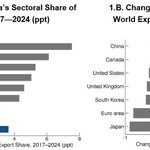
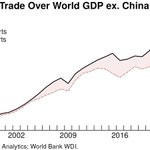
What is different about “China Shock 2.0”? It is not just an export surge: exports are rising much faster than imports, reflecting a more self-reliant strategy and pushing China’s trade surplus to unprecedented levels relative to the world economy. (1/2) federalreserve.gov/econres/n…

François de Soyres retweeted

But I was quite surprised (to put it mildly) that the G7 economist ignored say the Fed's model and other empirical work showing that the dollar's fall was actually central to trade adjustment in the 1980s
5/5
federalreserve.gov/econresda…
François de Soyres retweeted

"Le choc chinois 2.0 ne constitue pas une simple continuation des tendances antérieures, mais une nouvelle phase d’intégration commerciale mondiale"
Ma traduction
👉 annotationsbis.blogspot.com/…

China shock 2.0: How China’s ongoing export surge differs from the early 2000s
(François de Soyres et alii)
federalreserve.gov/econres/n…

François de Soyres retweeted
China shock 2.0: How China’s ongoing export surge differs from the early 2000s
(François de Soyres et alii)
federalreserve.gov/econres/n…
François de Soyres retweeted

Scale matters: China is much larger than during the first China Shock, so a given proportional shift in trade flows implies a larger global reallocation. The shock is also broader geographically and increasingly overlaps with advanced economies. (2/2) federalreserve.gov/econres/n…
François de Soyres retweeted
ICYMI What is different about “China Shock 2.0”? It is not just an export surge: exports are rising much faster than imports reflecting more self-reliant strategy & pushing China’s trade surplus to unprecedented levels relative to the world economy. (1/2) federalreserve.gov/econres/n…
François de Soyres retweeted

Remarkable statement by the person most responsible for closing all nuclear plants. German greens should really face a reckoning for their grand anti-nuclear crusade, which had two main achievements: citizens struggle with high energy costs and the planet is dirtier and warmer.

François de Soyres retweeted
Scale matters: China is much larger than during the first China Shock, so a given proportional shift in trade flows implies a larger global reallocation. The shock is also broader geographically and increasingly overlaps with advanced economies. (2/2) federalreserve.gov/econres/n…
François de Soyres retweeted
What is different about “China Shock 2.0”? It is not just an export surge: exports are rising much faster than imports, reflecting a more self-reliant strategy and pushing China’s trade surplus to unprecedented levels relative to the world economy. (1/2) federalreserve.gov/econres/n…
François de Soyres retweeted
Does slower population growth and near-zero job gains make the labor market more cyclically fragile? Given limited precedents in the aggregate U.S. economy, this #FEDSNote examines evidence from U.S. states and other countries. (1/2) federalreserve.gov/econres/n…

François de Soyres retweeted
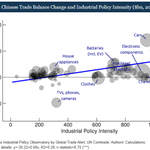
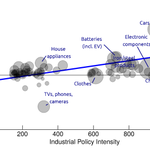
Interesting paper, and good to see the IMF pushing further on trade and industrial policy (IP) in the context of global imbalances.
That said, I think it misses key elements… 🧵

Global imbalances are widening again, raising risks for economic growth and financial stability. Tariffs and narrow industrial policies rarely help, as our latest blog details. Rebalancing starts at home, with sound macroeconomic policies.
imf.org/en/blogs/articles/20…

François de Soyres retweeted

Food for thought!
"Is the Inflation Process in Advanced Economies Different After the Pandemic?" by François de Soyres, Avani Pradhan, and Zina Saijid.
"Even as headline inflation returns to or nears central bank targets in advanced economies, according to the approach we have followed here, the composition of price pressures remains different from the pre-pandemic era. A larger share of CPI categories now experiences inflation above 3 percent, while deflation has become rarer. In some countries, the relationship between inflation and the breadth of price changes may have shifted, but more data will be needed to assess whether this shift represents a lasting change in the inflation process."
federalreserve.gov/econres/n…

François de Soyres retweeted
ICYMI: New #FEDSNote: Is the Inflation Process in Advanced Economies Different After the Pandemic?: federalreserve.gov/econres/n…

François de Soyres retweeted

New Fed paper showing that underlying inflation dynamics have shifted since COVID. Across countries, a greater share of prices are now rising >3% per year - partly because wage inflation has been persistently higher.
federalreserve.gov/econres/n…