

Highlighting events and people that influenced the central bank of the United States, with a new theme each week. (Maintained by @stlouisfed. RT≠endorsements)
USA
Joined March 2013
- Tweets6.4K
- Following22
- Followers20K
- Likes6







In 1970, the bankruptcy of railroad company Penn Central caused a commercial paper crisis. The latest Fed History essay examines the Fed's role as the lender of last resort in this crisis bit.ly/4hqpkMp

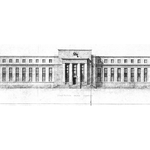
In the early 1940s, an unusual court case helped clarify the status of the Federal Reserve headquarters building. The latest Federal Reserve History essay explores the dispute that arose following the building's opening in 1937 bit.ly/4p6NuPf

ALT Architectural drawing of the Federal Reserve building on Constitution Avenue in Washington, D.C.
Since the 1970s, money market mutual funds (MMMFs) have become important parts of short-term money markets. Read one of our newest essays to learn about the history of MMMFs: bit.ly/4q9OgdK

The payment of interest on reserves held with Federal Reserve Banks was first debated in the 1970s. Learn more about interest on reserves in one of our newest essays: bit.ly/4s45F9q

Interest rate controls were implemented after the Great Depression to prevent ‘excess competition’ among banks. Learn more about interest rate controls, also known as Regulation Q, in our newest essay: bit.ly/49NHEgr
The Federal Home Loan Banks were established in 1932 to advance funds to home mortgage lenders that did not have access to the Federal Reserve System. Our newest essay explores the history of the FHLB: ow.ly/S8AV50U3g5V

In the early 1970s, the Fed considered building infrastructure for credit cards and other electronic point-of-sale payments that were still in development, such as debit cards. Learn more in our newest essay: ow.ly/VpNX50TwjQV

Along with the tragic loss of life, the 9/11 attacks caused major dislocations in financial markets. A new essay explores the Fed’s key role in responding to the crisis, using its authority to limit the economic fallout and support the US financial system ow.ly/qscs50TkAlB

New on Fed History: Our most recent essay explores bank capital standards throughout the Fed's history ow.ly/2ucU50QX4NM

Just added to Fed History: Our newest essay examines the Home Ownership and Equity Protection Act of 1994, which addresses unfair, deceptive, or abusive mortgage lending practices ow.ly/SAVa50QyuBZ
New on Fed History: Our most recent essay explores the history of the Fed's cash services, which ensure that currency and coin in circulation are sufficient to meet public demand ow.ly/Mk9W50QhCi0

Fed Reserve History retweeted

Did social networks speed up the bank runs of 2023? Federal Reserve historian Jonathan Rose talks about factors behind the runs. See the full video: ow.ly/WN9V50Q3Ctn
Subsequent laws have built on the foundation of the Community Reinvestment Act of 1977 in order to further support the banking needs of communities including low- and moderate-income neighborhoods ow.ly/q3Cs50PT1Zz
Community stakeholders, bankers, and policymakers have continued to debate whether the 1977 Community Reinvestment Act is necessary and whether it's efficient ow.ly/N8vL50PT1Yh

Since the passage of the Community Reinvestment Act of 1977, there's been a lot of debate about its effects on bank profits, access to credit, and homeownership. In 2018, the @USTreasury issued a report on reforming CRA regulations ow.ly/ApQ750PT1Se

The Community Reinvestment Act requires regulators to take a bank's lending to "its entire community" into account when considering applications for mergers and new branches ow.ly/C8MO50PT1OW
Senator William Proxmire argued in 1977 that in return for the benefits of a public charter, "it is legitimate for public policy and regulatory practice to require some public purpose" of banks ow.ly/MXOT50PT1LF

In the 1970s, discrimination wasn't the only factor inhibiting lending in low- and moderate-income communities, as then-Fed Chair Ben Bernanke discussed in a 2007 speech about the CRA ow.ly/OGHj50PT1J6

Laws in the 1960s and early 1970s prohibited housing and lending discrimination, but many people believed redlining persisted despite these laws ow.ly/KPn350PT1I4
The Community Reinvestment Act was a response to the practice of many banks to not market their services in low- and moderate-income communities, a form of "redlining" ow.ly/gHJ050PT1Gw
