

Intelligence shaped by you
San Francisco
Joined December 2024
- Tweets302
- Following3
- Followers606
- Likes632





Read our full study along with code and data here: usefeyn.com/blog/press-enter…

1
10
Models are improving fast at noticing things. That's mostly why they're getting better doing the jobs.
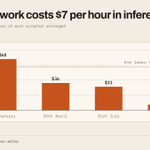
January's models attempted only a quarter of planned work. The latest models attempt more than half.

1
1
15
This work was cheap too. The latest models cost $7 per hour of finished work.
The average human labor hour costs $58

1
2
20
Security is a big focus for Critic. All prompts sent by critic run in a forked thread with read-only tools. That way, a Critic initiated prompt can only answer questions about the change at hand, and nothing else.
1
2
29
Critic is for agents too.
Through the bundled MCP, your agent can pull a diff with the author’s reasoning attached, ask the authoring agent questions, and work through decisions directly.
Let your agents talk to to each other
1
2
44
See which changes need your attention. Open a diff to read the change narrative written by the authoring agent.
Have a question? Ask the agent that wrote it without ever leaving review
1
2
103
Today we're releasing Critic, a platform to review the code your agents write. Try it out at critic.run
Since agents started writing our code, it has become harder to understand the scope of a change. Your AI has all the context behind the code but you don't.
Critic lets the agent explain what changed and why, and answer questions from anyone reviewing its work.
Read more about MultiMatte xitter.gq/status/209779722711277… or build with it using NoBg.
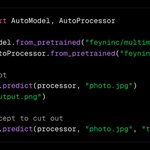
MultiMatte is open source. Check it out on HuggingFace: hf.co/feyninc/multimatte

3
40
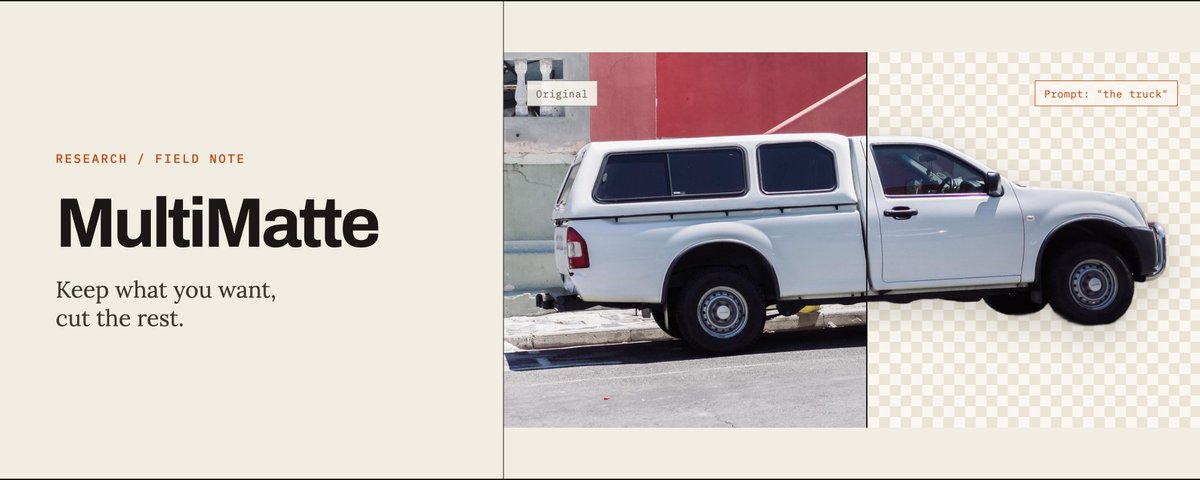
MultiMatte is built on Meta's SAM 3. Our biggest win came from converting binary masks that classify each pixel as being inside or outside an object, to alpha mattes that assign an opacity value to every pixel. This allows MultiMatte to better understand hair, motion blur, translucency, and fuzzy boundaries.
Across all our measured benchmarks, MultiMatte shows a step improvement over SAM 3. On DIS5K, S-measure rises from 0.674 to 0.908 (a 34.6% relative gain), and on DUT-OMRON from 0.792 to 0.901 (13.7%).

1
4
106
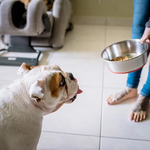
Introducing MultiMatte, a background removal model you can aim with words. Name an object in your image, MultiMatte keeps just that thing and cuts the rest.
Same photo, three prompts: the dog, the dog bowl, the jeans.
Try it out: usefeyn.com/multimatte


This could be you usefeyn.com/interest/


Feyn retweeted
Building FeyNoBg also exposed a tooling problem. Image matting models usually live in isolated repos with different interfaces.
So we built NoBg, a Python library for running, training models, and evaluating image mating models. Currently, it supports BiRefNet with more architectures coming. We hope you use it to build something exciting.
github.com/feyninc/nobg

FeyNoBg and NoBg are both open source.
- Model: huggingface.co/feyninc/FeyNo…
- Try it: huggingface.co/spaces/feynin…
- NoBg Library: github.com/feyninc/nobg
- Technical Blog: usefeyn.com/blog/feynobg/

2
116
Building FeyNoBg also exposed a tooling problem. Image matting models usually live in isolated repos with different interfaces.
So we built NoBg, a Python library for running, training models, and evaluating image mating models. Currently, it supports BiRefNet with more architectures coming. We hope you use it to build something exciting.
github.com/feyninc/nobg
In training, a diverse data mix matters. Our first fine-tune used one dataset. It improved performance on camouflage images, but regressed elsewhere.
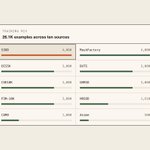
We took this as a data problem and built a 26.1K-image mix from 10 datasets covering camouflage, crowded scenes, high-res subjects, portraits, and anime.

1
1
130
