

MN Twins, other sports, & US dissident posting
Minnesota
Joined February 2023
- Tweets10.2K
- Following929
- Followers481
- Likes60.4K


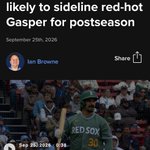


It sincerely pisses me off to see shit like this right after seeing that it sure looks like Audra Martin was canned by the Twins.
Al Michaels is not entitled to this. There are many, many people better than him who aren’t getting their chance cause he refuses to hang em up.

1
1
203


Flyover Twins retweeted
Congressman Maxwell Frost (D-Fla.) has unveiled legislation aimed at securing the rights of video game owners.
The bill is aimed at curbing the negative effects of digitizing games, and the ability of gaming conglomerates to essentially take away what gamers have already purchased.
The Protect Our Games Act would ensure gamers have playable versions of the video games they’ve bought, even as technology advances, and require video game developers to give consumers access to their own video game servers if online services are discontinued.
Frost introduced the bill during the “The Future of Game Ownership Town Hall” with The Players Alliance HQ.
Incredible that in 2027 the Vikes are going to lose the Super Bowl by a few points, the Wolves are going to be NBA champs, Wild are going to be NHL champs, Twins are going to go 79-83 and be 1 game short of a wild card spot, and Lynx and Loons are gonna do things 🔥
1
53


Flyover Twins retweeted

We gotta stop throwing America’s sons and daughters into the damn meat grinder of war just so Raytheon and the military industrial complex can make a shiny penny.
Flyover Twins retweeted

"Make no mistake: the thousands of dollars that come out of your paycheck each year to pay for health insurance is a tax, just one paid to a private insurer rather than the federal government. Medicare for All would actually lower your taxes."
ow.ly/8Zom5105rFA

Flyover Twins retweeted

Mayor Zohran Mamdani officially signed the Community Opportunity to Purchase Act (COPA) into law today.
The bill gives tenants, land trusts, and other vetted community organizations the first right to buy eligible buildings — and thus to decommodify their housing.

Flyover Twins retweeted

Why should Congressional Democrats investigate corporate America if their mandate is to deliver real economic change? Because investigations are a key catalyst for securing reform and legislation. For much of the last century, Congress used to be the main institutional player working to secure an economy that serves working people. A key tool was oversight. Lawmakers routinely investigated complex markets and major corporations, identifying problems and exposing wrongdoing. A major goal of these investigations was to learn what was driving certain problems and figure out how to fix them.
After Democrats took back the House during the first Trump administration in 2019, I joined the House Judiciary Committee as a staffer on the Antitrust Subcommittee. Under the terrific leadership of @RepJerryNadler and then-Rep @davidcicilline, we pursued an 18-month investigation into Amazon, Apple, Facebook, and Google, securing key evidence of how their business practices were undermining competition and harming people, setting the basis for both lawsuits and proposed legislation.
A few lessons from that experience:
1. The quality of legislative oversight depends on the staff and the support of top members to confront power. Committee and Subcommittee Chairs that are focused on getting answers and unafraid to take on powerful corporate interests will make the difference between oversight that doesn’t surrender to their evasion tactics and oversight that aims low or flames out.
Even a relatively small number of dogged, talented lawyers ready to dive in can make a big impact. In the 1930s a single congressional lawyer, Ferdinand Pecora, helped reshape our entire banking system by subpoenaing records and interrogating top financiers, including J.P Morgan. The investigation exposed self-dealing, market manipulation, and tax avoidance, and laid the groundwork for foundational New Deal legislation, including the Glass-Steagall Act and the Securities Exchange Act.
2. Eliminating bottlenecks to moving investigations forward is key. For example, the House should make sure that Subcommittee Chairs can issue subpoenas rather than needing the sign-off of the full Committee or its Chair. A credible threat of sending subpoenas is critical for credible oversight.
3. Ensuring that members can develop the muscle to effectively interrogate CEOs requires investing in real preparation. In the lead up to the hearing with Bezos, Pichai, Cook, and Zuckerberg, the Antitrust Subcommittee spent months reviewing millions of documents collected from the firms, interviewing affected parties, briefing members on key evidence, and conducting practice hearings. Members came into the hearing deeply informed and able to rebut and call out CEO dissembling. The result was some of the most effective member questioning of executives we’ve seen in decades. @TheProspect wrote up a great overview: prospect.org/2020/07/30/triu…
4. For decades, institutional capacity in Congress has been extremely weak. Much of this traces back to the Gingrich Revolution, which was effectively the 1995 DOGE-ing of Congress. Republican leadership fired over 600 professional staffers, eliminated the Office of Technology Assessment, and gutted research capacity. None of that capacity was ever meaningfully restored.
As a result, members have way fewer resources to develop serious expertise or go deep on a new topic. Members should start rebuilding that capacity so the institution can fully play its Article I role, where Congress can again do serious policy development and legislating and serve as a real check on the executive and judicial branches.
5. AI markets should be high on the list of investigations. The business decisions of the major AI firms have huge public ramifications, yet the public is at a severe informational disadvantage when it comes to how these markets work and the choices these firms are making. A congressional investigation will help ensure future legislative action is based on a more complete view of what is going on rather than selective and partial corporate disclosures.

Flyover Twins retweeted

To protect competitive balance, it may be time for MLB to implement a cap on owner profits


Flyover Twins retweeted

Watch this clip from Talarico - and then let me tell you a story.
In 2024, @levernews took a big risk: We launched a reporting project aiming to unearth the never-before-reported details of the secret 50-year plot to legalize corruption in America. It was the kind of huge investment in deep reporting that most news outlets don’t make. But we made it, because I've spent almost my entire adult life focused on money-in-politics reporting - and this was the biggest money-in-politics story in American history.
Two years later, our podcast and book MASTER PLAN did not merely win the National Press Club Award — what we unearthed and exposed is now a central theme in the 2026 election.
As you can see, Talarico is recounting — and promising to fight — the master plan that we exposed. And he’s making that promise in one of America’s most high-profile Senate races.
Find the podcast and book at MasterPlanPodcast [dot] com - and pass it on.

.@JamesTalarico: 50 years ago, a corporate lawyer named Lewis Powell circulated a memo around DC — a blueprint for how corporations could amass political power, reverse the gains of the Great Society and the New Deal, and rig the system for themselves.
The Powell memo outlined a strategy. Unite corporate special interests, privilege corporate perspectives in the media, appoint sympathetic judges to the court, and buy politicians in both political parties.
And it worked. Republicans and some Democrats sold the false gospel of trickle-down economics. Trickle-down economics is not a theory, it is theft.
Since the late 1970s, mega donors and corporate special interests have been buying politicians in both political parties. And then those politicians turned around and rigged the economy to benefit their wealthy donors at our expense.
We have an affordability crisis because we have a corruption crisis.
Flyover Twins retweeted

We're going to keep hearing stories like this until the executives of these cancerous corporations start facing prison time. Financial penalties on the companies are not enough

Major chemical companies knew plastic particles could infiltrate human tissue and remained silent for decades as they accumulated in our bodies, according to a Stanford epidemiologist who reviewed internal industry memos obtained by The Times. Read the full story
latimes.com/environment/stor…


