

Food Tank is the world’s fastest growing global non-profit community working towards positive transformation in how we produce & consume food.
Washington DC
Joined November 2012
- Tweets37.3K
- Following50.5K
- Followers197K
- Likes76.3K

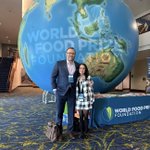


“Cities and good public policy can become extraordinary laboratories for change. They can show that reducing emissions, improving public health, supporting farmers, creating economic opportunity, and strengthening communities are not competing goals. They're part of the same vision.” -@DaniNierenberg, Food Tank

Greetings from Des Moines, Iowa! I'm here for the World Food Prize and Borlaug Dialogues, and I have a confession. I love coming to this gathering.
I've been attending since the early 2010s, often as one of the few sustainable agriculture advocates in rooms filled with scientists, policymakers, and Big Ag executives.
I've had some fascinating conversations over the years, including one at a hotel bar where two men accused me of criticizing their organizations. I hadn't. Their explanation? "People like you do."
I'm now friendly with both of them. I even made it onto one's Christmas card list!
That's part of why I keep coming back. We need to spend more time in rooms with people who disagree with us. And we need to listen.
But I also think we need to ask harder questions about the World Food Prize itself.
During the International Year of the Woman Farmer, why couldn't a woman farmer be the person we gather to honor?
I think about Esther Penunia in the Philippines, Elizabeth Nsimadala in Uganda, and Mariam Sow in Senegal. Women whose work organizing farmers, advancing agroecology, and strengthening rural communities deserves much more attention.
A breakthrough in a laboratory can change lives. So can protecting seed diversity, restoring degraded land, or helping women gain control over their incomes.
I want us to broaden our understanding of what agricultural progress looks like, whose knowledge matters, and who gets recognized.
And I want more smallholder farmers, farmworkers, Indigenous food leaders, and grassroots organizers in these rooms. Being invited is one thing. Being able to afford to participate is another.
I'll keep coming back because I believe these conversations matter. But I also want us to ask more of the institutions bringing us together.
My latest reflections for Food Tank:
foodtank.com/news/2026/10/on…

“For generations we've rewarded agriculture for producing more. More acres. More bushels. More kilograms. More efficiency. What if we also rewarded nourishment? What if value included healthier soils, healthier ecosystems, healthier farmers, healthier communities, and healthier people?” -Danielle Nierenberg, Food Tank

Looking for your next great read? Food Tank's Fall 2026 Reading List is here, featuring 27 books exploring everything from farming, food justice, and nutrition to culinary traditions, climate change, and the future of our food system.
This season's books remind us that food is about so much more than what we eat. It's about our health, our histories, our communities, and our relationship with the land.
We're excited to highlight these incredible books and authors: 📚 A Practical Farmer’s Journey by Ronald Rosmann; Agri-Energy by Rebekah Pierce; All Hours by Kwame Onwuachi with Joshua David Stein; Banking on Groundwater by William Alley and Rosemarie Alley; Beans, Greens & Lentils by Hari Pulapaka; Black Farm Boys by Bobby J. Smith II, Ph.D.; Black Farmers in America by Mya Price; Captive Consumers by Chin Jou; Cooking Thai by Pim Techamuanvivit with Andrea Nguyen; Depression Cooking by Sonali Menezes; Famine in World History by R. Douglas Hurt; Food Heritage edited by Loic Bienassis and Fabio Parasecoli; Food Is Medicine by Dariush Mozaffarian MD DrPH; Food Sense by Christopher Gardner; Fundamentals of Flavor by Nik Sharma; Foods of La Frontera by Pati Jinich; Happy Snacking, Don’t Die! by Alexis Nikole Nelson; How to Cook Everything Vegan by Mark Bittman; Medicine for All People by Geeta Maker-Clark, MD, ABOIM (she/her); Plant Teachings from My Auntie by C’tasi, Geraldine Manson and Nancy Turner; Reining in the Bulls by Michael Marx; Saved by Seeds by Chris Smith; Seeding Hope by Jack Algiere; Sugar Coated by Marion Nestle and Lisa Sutherland; Sustainable Agriculture in Ukraine by Sergiusz Pimenow, Olena Pimenowa, and Lubov Moldavan; The Ecology of Food edited by Nicolas Bricas, Damien Conaré, and Marie Walser; and Wine Liberated by Adam Huss.
From the science of nutrition to the stories of farmers and the joy of cooking, there's something here for everyone.
Explore all 27 books and find your next read: foodtank.com/news/2026/10/fo…

“Nourishing the world expands our focus beyond how much food we produce to consider its quality, the health and dignity of those who produce and eat it, and the ecosystems that sustain it.” -Selena Ahmed is the Global Executive Director of The Periodic Table of Food Initiative (PTFI) and Dean of Food EDU based at the American Heart Association.
Read her op-ed on Food Tank: foodtank.com/news/2026/10/op…

“Everything in food is connected, but we've often organized our institutions as though none of those connections exist. Agriculture over here. Nutrition over there. Medicine somewhere else. Climate in another room entirely. But our bodies don't experience the world that way. Neither does nature. Food connects them all.” -@DaniNierenberg, Food Tank

Greetings from Des Moines, Iowa! I'm here for the World Food Prize and Borlaug Dialogues, and I have a confession. I love coming to this gathering.
I've attended since the early 2010s, often as one of the few sustainable agriculture advocates in rooms filled with scientists, policymakers, and Big Ag executives. I've had some fascinating conversations, including one at a hotel bar where two men accused me of criticizing their organizations. I hadn't. Their explanation? "People like you do."
I'm now friendly with both of them. I even made it onto one's Christmas card list.
That experience reminded me how quickly we decide we already understand someone else.
And why we need to spend more time listening to people who disagree with us.
I believe deeply in the World Food Prize Foundation and its mission. But I also think we need to ask harder questions about whose knowledge counts, who gets invited, and what kinds of leadership we recognize.
For me, a Green Evolution means putting farmers' livelihoods, healthy soils, biodiversity, and nutritious diets at the center of how we measure progress.
This year, during the United Nations International Year of the Woman Farmer, I wish we'd seen a woman farmer recognized with the Prize itself.
Think about leaders like Esther Penunia in Asia, Elizabeth Nsimadala in Uganda, or Mariam Sow in Senegal. Women helping farmers organize, protecting agricultural biodiversity, and advancing agroecology.
Their work changes lives. It deserves the world's attention.
I'm glad the World Food Prize is evolving under Thomas Vilsack and Mashal Husain. And I'm glad the Dialogues are bringing more diverse voices into the conversation.
But participation means more than an invitation. Smallholder farmers, farmworkers, and grassroots organizers need the resources to actually be in these rooms.
I'll keep coming back because I believe conversations across differences matter. I've changed my own mind over the years, and I've seen relationships change too.
But I also want us to ask more of the institutions that bring us together.
Who gets invited? Who can afford to come? Whose knowledge counts? Who gets recognized? Who has the power?
I'm looking forward to listening this week. And to asking, and being asked, some uncomfortable questions.
Read my entire piece: foodtank.com/news/2026/10/on…

“One of the things I've learned after more than two decades of visiting farms is that farmers are rarely asking for someone else to solve their problems. They're asking for partners. Partners who listen. Partners who invest. Partners who understand that every healthy farm is producing far more than food. It's producing healthy soil. It stores carbon. It protects water. It supports wildlife. It sustains local economies. And it preserves knowledge that has often been built over generations.” -@DaniNierenberg, Food Tank

“Farmers have shown us that they are willing to innovate. The question is whether the rest of us are willing to innovate alongside them. Because farmers cannot carry the climate transition alone. If we want healthier soils, if we want cleaner water, if we want to protect biodiversity, if we want nutritious food, if we want thriving rural communities. Then we have to build an economy that rewards the people making those outcomes possible." -@DaniNierenberg, Food Tank


“A Better Food System requires listening. Listen to farmers instead of assuming we know what they need. Listen to workers and communities. Listen to scientists and researchers. And listen to people who disagree with us, because sometimes those conversations teach us the most.” -@DaniNierenebrg, Food Tank

“Reducing food waste can cut emissions. It can save businesses and households money. It can conserve land, water, and energy. It can create economic opportunities. And it can make our food systems more resilient. That’s an extraordinary opportunity.” -Danielle Nierenberg, Food Tank

What does the future of sustainable protein look like?
Join us on October 29 for a special Food Tank conversation and Q&A with Rohan Shirwaiker of the Bezos Center for Sustainable Protein at NC State and @BruceGFriedrich of @GoodFoodInst.
An opportunity to ask questions, exchange ideas, and connect with others working toward a more sustainable food system.
Become a Food Tank Member to join the conversation!
FoodTank.com/Join

Farmers markets are so much more than places to buy fresh food. They're gathering spaces, economic engines, and essential parts of strong, resilient communities.
On the latest episode of Food Talk with Danielle Nierenberg, Dani sits down with Catherine (Cat) Oakar, Executive Director of @FRESHFARMDC, to talk about the growing pressures facing families and farmers, the impact of federal funding cuts, and why investing in local food systems matters more than ever.
Plus, we explore new approaches to childhood obesity, the exploitation of food workers, growing global hunger, and efforts to get more nutritious seafood into food banks.
🎧 Watch and listen to Episode 576 of Food Talk with Dani Nierenberg here: youtube.com/watch?app=deskto…


Food Tank retweeted

In partnership with @FoodTank, we convened leaders across agriculture and food systems to discuss farmland protection, farm viability, and regenerative agriculture at #ClimateWeekNYC.
The playlist is now available, featuring conversations on:
🚜 Farmland access for a new generation of farmers
🏛️ State policies accelerating farm conservation
🏫 How farm-to-school can support farmers
🌾 Regenerative grazing and the future of beef
🌱 Women in agriculture
📺 Watch the full playlist and join the conversation: bit.ly/4rPyHtJ.

Young people want to farm. The question is whether we will give them the chance.
Access to land, capital, and resources will determine who gets to grow our food and what the future of farming looks like.
As Karen Washington reminds us, the next generation is ready. Now we need to make sure the path is open.

Food belongs in every classroom.
It connects science, history, culture, climate, health, economics, agriculture, and so much more. Yet for too long, food education has been treated as something extra instead of something essential.
It’s time to change that.
As @DaniNierenberg says, “Food might be the most interdisciplinary subject we have.”

Mentorship is "fundamental in culinary education." -Chef Marcus Samuelsson, Eight-Time James Beard Award-Winning Chef, Restaurateur, Author, and Founder of Red Rooster Harlem
Tune in live! youtube.com/live/528p0wNnikE #ClimateWeekNYC

“Teachers need skills in addition to the content that they’re teaching, and they need permission to be creative.” -Caitlin Arens, Food Education Fellowships Director, Pilot Light
Tune in live! youtube.com/live/528p0wNnikE #ClimateWeekNYC
