

Researching energy and defence. Physics and data science background. Happy getting into the weeds.
Sydney, New South Wales
Joined March 2025
- Tweets4.4K
- Following142
- Followers6.1K
- Likes3.9K



Pinned Tweet
This is the story of how a fund chaired by former Labor PM Julia Gillard acquired a wind farm project just six days before Labor Energy Minister Chris Bowen underwrote its future revenues with taxpayer money.
Today we've learned Julia's fund is trying to flip it. For a profit.
HMC Capital's 'Energy Transition Fund' rushed to acquire the Neoen Victoria portfolio. They hadn't even raised any money in their fund. They closed with almost a billion dollars worth of borrowed money and IOU's.
Less than a week later, Chris Bowen announced Kentbruck Wind Farm to be successful in the first round of the Capacity Investment Scheme. My rough calculations suggest they will receive something like a billion dollars from taxpayers (and maybe much more) over 15 years.
Sweet deal. A billion dollars of fancy financial monopoly money one week. A billion dollars of promised taxpayer dollars the next.
I want to emphasise that I have no evidence of anything illegal or improper taking place. Rather, I want to point out how odious and repugnant the official, proper, legal business of renewable energy has become.
Yesterday Chris Bowen announced he wanted to supersize the CIS subsidy scheme, yet again.
Today Ross Garnaut seemed to cheer this on, whilst pointing out "There are now virtually no new investment commitments for solar and wind generation that do not have CIS or other Government underwriting,"
What happened to a sense of propriety? Since when do we celebrate people rushing to put their snouts in the trough? Or rushing to fill the trough even higher?
Unlike the UK who publish a 'going rate' for technology subsidies, our renewables are subsidised through a secret tender process. Every project gets to ask for whatever revenue they want to proceed. @AEMO_Energy facilitates a secret beauty pageant, where they award points for things like indigenous participation or community engagement, alongside financial value.
And Chris Bowen makes the final call.
The bids remain secret. There's no cap to the pay-outs. Since AEMO is a private company, there is no scope for an FOI request, and AEMO aren't not subject to parliamentary oversight through Senate Estimates.
So no-one can ever prove an allegation that Bowen has bestowed special favour on a friend's project if that was what he did. But equally, he can never prove that he selected strictly according to merit. We are just expected to trust the black-box of Bowen's subsidies.
So I'm going to say out loud, with full voice, that I hope everyone can agree on:
If this is what the future of 'clean energy' looks like in Australia, it looks absolutely FILTHY.
Any firm that talks about ESG seriously should start taking the "G" a bit more seriously and steer clear of projects that thrust their snouts into Bowen's hopelessly opaque, bottomless trough of government funds.
Or at the very least, purge their boards and senior leadership of all the former Labor staffers, donors, and industry lobbyists who have had a hand in designing the trough, and filling it up.
The reality is that there are no natural profits to be made in generating renewable electricity in Australia.
Every dollar of profit in this industry is really a cheque signed by a politician, with Chris Bowen signing all the biggest cheques, worth untold billions, in the next three years.
It's all legal. It's all official. And it's absolutely obscene.
Mega-thread below.
(It'll come in stages)
1/

So… AEMO has apparently disappeared from the Senate Estimates program for today. I didn’t save a copy when they were listed. The change seems to have taken place on Friday at 4:58pm. That’s a time that qualifies as “last week”… when no-one would notice.

Late night ramble… it’s Senate Estimates in a few hours. There’s just so much that could/should be tackled. Hard to know where to start. But having AEMO there makes it quite special. They don’t normally appear. So here are some thoughts.
I think this is evidence of our government-owned energy generator, Snowy Hydro, unethically gouging consumers. It might be legal. Maybe. But I think it's wrong. Electricity consumers and taxpayers should be furious.
I pulled this data with the help of AI. This would be days or weeks of work a few years ago. Now getting all the data in the ideal format to understand takes just minutes. Much harder is figuring out what it actually means.
I should hasten to say, I'm pro-market enough to hate it when people rail against 'price-gouging'. Provided the market isn't rigged, there's nothing wrong with sellers charging what they can. Prices are important signals. If the market's functioning properly, it will bring in new supply from competitors, and/or allocate limited supplies to those with greatest need.
But in this case, I think the actions taken by Snowy Hydro show absolutely masterful exploitation of failures in our energy market, in particular transmission constraints and poor system design, which competitors have no means of correcting through new supply. Because the supply is fixed by a badly designed transmission build-out, competition is held away.
The damning thing here is the change in the ramp-down rates. That's what makes the whole thing go from smart, and brutally self-interested manipulation of the market, to something that seems to me to be dishonest. That, set in the context of the counterprice flows, and the market intervention by @AEMO_Energy to impose constraints that would affect other competitors ability to provide power in the market.
You see, the first thing you'd think of for re-bidding behaviour that's potentially profit-maximising, and hurting consumers, is raising your bids to higher prices, when you know that there's a shortage.
That's child's play compared to what's going on here.
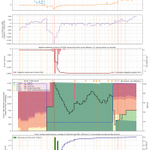
At rebid 6, Snowy drops their bid down to negative values for half their capacity. (See green block start on bottom panel) Ie, "I'll pay people to take away my power". Surely lower bids helps lower prices right?
Usually right, but here it's wrong. And this is where Snowy Hydro's market team shows they're true ninjas. They know that there's a bottle-neck so a bunch of power in Southern NSW can't reach Sydney, and push down prices at the reference point. So they bid super-low. Negative $1000. The minimum. That guarantees they get dispatched. The plebs in the wind-farms trying to get every MW they can out at a positive price would never take that kind of risk. So they bid negative, massively, to ensure that their power is flowing to market ahead of any other generator in Southern NSW.
But that's only the opening move, and Snowy Hydro are thinking many steps ahead already.
They would know the network well enough to know that turning their own pumps on in this part of the network will force power over the border into Victoria against price signals. Victoria has negative prices, NSW positive, at 13:40. Prior to this point, before Tumut 3 turns on, a bit of power is flowing from Vic to NSW, which is helpful. Their negative prices helps bid down NSW's positive prices. Which is good. Until...
Tumut 3 turns on nearly 900MW in far-South NSW with their crazy-low bid. Then power starts flowing the wrong way, from positive prices to negative, over the Vic border. Promising generators they'd get paid to generate, then promising Victorian consumers they'd get paid to consumer NSW's excess.
This "negative residue" starts to build up slowly at first. But as prices rise in NSW, as the afternoon heat builds, it speeds up a little. Then comes Snowy Hydro's next big move. Rebid 7 in the table. They push their entire 1.78GW generation capacity down to the floor price, so it gets dispatched. And this pushes a mass of electricity across the border at a pretty big counter-price delta.
Snowy Hydro knows perfectly well what this does. It pushes the cumulative residues over a level where AEMO has a policy to intervene, imposing a constraint on the market to stop these negative residues building up too high, racking up bills for high priced generation in one state that no-one in the other state where the power landed agreed to pay for. Effectively the idea is to 'clamp' the interconnector to stop power flowing the wrong way across it. But you can't actually stop electrons by clamping the interconnector. You have to adjust the pushes and pulls of generators and loads to prevent the electric fields pushing power the wrong way. That means directing generators to switch off.
And here's the real cunning in Snowy Hydro's plan. Because they had so obviously caused the mayhem by pushing nearly 2GW into the grid in a place where the power flowed over the border away from where it was really needed, surely AEMO's new constraints to prevent that flow would switch that generator (Tumut 3) straight back off? It was dispatching nothing an hour earlier. Surely they get switched off?
Anticipating this, right back at rebid 6 Snowy had adjusted their ramp-down rates registered with the market operator. This is the step which crosses a line in my mind. Because I strongly suspect that nothing at all changed in the technical capability of Tumut 3 that meant that it couldn't be ramped down as fast as they had told the market they could do minutes before, and would tell the market they could do again just a few hours later. The reasons given mention nothing about technical problems. So this is done as a market move. They know this can make them money, but the truth is that their machinery could ramp at the same (high) rate throughout this episode, I assume.
But by lowering their ramp rate down so far, to just 18MW/minute, they effectively meant that AEMO couldn't turn them off. They can only be gradually ramped down. They should've been the first ones turned off to prevent the counterprice flows, but they'd manipulated their ramp so that they couldn't be switched off.
Consequently, all the other generators in Southern NSW got switched off in preference. And this drove prices sky-high, because Sydney needed energy. Prices reached over $20,000/MW in a couple of increments soon after.
And, apparently, because the most badly positioned generator (Tumut 3) that was pumping out energy near the Victorian border couldn't be ramped down quickly, enormous 'negative residues' accrued, with a couple million in the 5 mins after AEMO notified the market of the constraint to (attempt to) limit the counterprice flows. And, more than a million ten minutes later.
These 'residues' just get lumped onto network charges, and end up being paid by consumers. So it's pretty clear that Snowy Hydro's re-bid limiting the ramp rate caused those additional negative residues to arrive, hurting consumers directly.
But also very likely, though there are few more moving parts involved and hence just slightly harder to say with certainty, the bidding behaviour here, which triggered the market intervention to clamp the interconnector to Victoria, almost certainly contributed to the price volatility reaching such extreme peaks in NSW. That would be a much, much more significant cost to consumers, I've seen estimates from @EnergyWrapAU putting Snowy's windfall at around $15 million in one hot hour.
So this I think crosses a line for me. Because the changed ramp-down rate is almost certainly made-up, reflecting nothing in their machinery at all, and because they knowingly caused bad outcomes for consumers on the way to getting paid that otherwise wouldn't have occurred (the counter-price flows for sure, and the price spike almost certainly) I don't think it's ethical behaviour for any generator, and certainly not one owned by taxpayers.
I strongly suspect that if Snowy Hydro had left Tumut 3 with their bids as they were at 13:30, that the counterprice flows would have been far more moderate, possibly not triggering an intervention. And also NSW wind generators a little closer to Sydney would have done a better job meeting rising demand, and prices might have risen a bit, but to nothing like the extend that they actually did when they were forcibly switched off while Snowy Hydro was running Tumut 3 which was sending power the wrong way over the border into Victoria. Because they couldn't be switched off because of the manipulated ramp-rates.
New details here…
Tumut 3 is Snowy Hydro, which is owned by the federal government.
And this is extremely aggressive bidding behaviour, which exploited vulnerabilities and technicalities in the market to grab a bucket of money from consumers, almost certainly contributing to the seriousness of this price spike.
They bid at deeply negative prices, ensuring they got switched on, ramping up counterprice flows, which they would know would lead to more constraints, leading to a severe price spike.
They they altered the rate at which they could ramp down their power. So once they got switched on (with an ultra-low bid) they used technical constraints to ensure they wouldn’t get switched off while prices were high.
Oh for some serious energy journalists. What an epic story.
Heavy sigh.
Are taxpayers happy with their investment gaming the market to return, pushing up prices to produce super profits to Snowy Hydro?
I guess that’s how Snowy 2.0 gets funded. To save the embarrassment of the federal government shovelling cash into the entity, everyone looks the other way while they play an ultra-aggressive game to gouge the market.

This could be relevant. Rebids "must not be false or misleading".
Which means you don't change your bids/rebids until you become "aware of a change in material conditions and circumstances upon which the dispatch bid or rebid are based".
I wonder what the "change in material conditions and circumstances" are that caused the rebid of the ramp down rate.
I think if you became aware of some status change in your physical machinery, fair enough. But changing ramp rates based just on market signals (which is all that Snowy Hydro appears to have indicated) seems to be misleading to me. Dishonest. Certainly counterproductive to the market operator being able to dispatch generators for the good of consumers.

Oh this is crazy... Snowy Hydro made about $3 million in the same five increment that racked up almost $2 million in negative residues. Which is a cost that goes straight to consumers. And then ten mins later, it almost repeats, with almost another $3 million, and over $1 million negative residues hitting consumers.
To put this into proportion, AEMO normally intervenes and tries to clamp the interconnectors when cumulative negative residues reach $100k. So a few million being added AFTER they've intervened... this is pretty bad. Really bad.

Snowy Hydro 2.0 should be stopped. We’ve spent $12 billion, and today learned that another $12 billion is required.
Enough already. It was a mistake. Stop digging.
I dream of a world where political leaders in opposition applied this kind of determined scrutiny to our energy institutions in Australia.

It is extraordinary that NESO’s takeaway is that the core allegations made by the whistleblowers are unsubstantiated.
As I’ve always said, the core allegation is that the electricity grid is not being run securely. In that respect, the Eversheds report is utterly damning.
Not only does it say that renewables are making our grid more difficult to manage, but it says that several engineers in the control room profoundly disagree with NESO management’s claim that the grid was secure on 23rd June.
There are multiple serious problems highlighted - from a culture of managers only wanting to hear ‘good news’, to poor record keeping, and, most concerningly, a reluctance to action complaints from engineers because of the need to 'keep stakeholders happy'.
In other words, managers are failing to improve the security of our electricity grid because keeping Ministers in DESNZ happy is seen as more important.
NESO's Chief Executive earns close to £1 million a year and the whole organisation costs the better half of a billion pounds to run. The country and billpayers deserve better.
Government should be holding NESO to account, but instead, Ministers spent their time attacking me for raising the control room engineers' concerns and for making sure that any kind of investigation took place at all.
If this had been washed under the carpet, then where would we be?
A grid that is increasingly at risk and Ministers who, frankly, preferred to be asleep at the wheel rather than to do their jobs and protect our electricity supply.
With regards to the engineers' concerns on corporate affairs and record keeping, Eversheds did not give a clean bill of health as NESO is claiming. They found that a culture of 'reputational sensitivity' does indeed affect operational decision-making, and recommended several changes to correct significant failures in record keeping practices.
While I am on maternity leave, the Conservative team will continue to press the Government on this issue, because the bottom line is this: if we cannot trust NESO management to be honest about our ability to keep the lights on, how can they stay in their roles?
I look forward to the release of Ofgem's investigation on whether the grid was run securely on 23rd June. But we do now know that the control room strongly feel that it wasn’t.

Looking forward to seeing everyone in Scone tomorrow night!
Looking forward to this event in Scone next week, Thursday 22nd of October.
See link below.
events.humanitix.com/form-au…
This is what you get with 59 advisors and no real policy ideas to pursue. They devote their capacity to petty politics instead.

“They are pretty desperate”
When asked about the Dirt File, Helen Haines said Labor were “pretty desperate”
When you read over the requests put to journalists - in truth the PMs Office was very detailed and gave specific instructions to the press pack
The media had clear expectations of the work the PM was looking for
And it raises serious questions about media and government integrity, under Labor
Story Credit: The Daily Mail


Awesome debate within the nuclear industry.

However, in the water-cooled reactor's defense, you can build smaller ones that can be shipped by rail or barge no problem. Thick pressure vessels double as physical protection and robust containment. Sodium metal becomes ~30,000x more radioactive than water during operation and must be kept hot to keep liquid with trace heating and insulation, challenging maintenance. Also, unlike sodium, water doesn't chemically burn when it touches air, water, or concrete.
Pros and cons all around, and the full story is never simple. I'm a big sodium fan and very much love Aalo. But water-cooled reactors get beat up on wayyy too much for how good they are.

Another “should be news” story… the workers camps planned in Central West Orana are quietly being consolidated onto the big one at Merotherie that belongs to ACEREZ who are building the transmission. Wind and solar developers are being invited in too, and that camp is expanding.
Consolidation is unsurprising given the social license has collapsed. Fewer objectors. But this has big implications for road traffic, and the locals nearby, who I’ve spoken to. But this is happening oh-so-quietly.
And crucially, this opens a window for potential cross-subsidisation of wind and solar projects from the transmission build. All these projects haven’t reached financial close, and won’t without loads of government support. So carefully concealed subsidies is what we expect, and this could be one of them.
So this is a transformer. Heading to Golbourn River solar farm apparently. Apparently the whole package including cradle is around 600tonnes. The cradle just lowers the whole thing down and sits it on the road when they break overnight.

So this week NSW energy minster has commenced a process to procure (at any cost) 1.5GW of "firming" by 2033-34.
But this incorrectly cites the ESOO as saying that's the year when problems emerge.
Actually, unserved energy spikes three years earlier, just after the first major coal station closes (Eraring). They're assuming things only need a lot of help when the second two close, four years later.
This is... concerning. 1/
asl.org.au/-/media/services/…

Ok, time to unpack key charts/assumptiosn and findings of the ESOO. Electricity Statement of Opportunities. Released by the market operator, AEMO.
The key takeway is that things fall appart soon after we close coal, specificially Eraring, as marked.
NSW is first to fall apart.
This chart is "committed and anticipated" developments. Anticipated still includes some that haven't reached financial close, so there's still some optimism there.
But this is the most-credible scenario they model. 1/

They've specifically ruled out batteries... must "not rely on energy consumed from the grid."
That means they've read this section of the ESOO I pointed out on page 89. There's not enough ENERGY to charge up the batteries, or even pump water up hill. 2/
xitter.cf/FootnotesGuy/status/20…

Now why is close timing of Snowy 2.0 units, with perfect foresight, in perfect co-ordination with massive other batteries so, so critical?
Becuase later AEMO tells us that the water in the dams runs out. And that's when blackouts start.
Not only that, short-term storage of GAS is also running out, and sometimes even COAL.
That's basically proof that they system of running in a completely unrealistic way.. With gas and coal being pushed flat-chat, in conjuction with battery storage (and Snowy 2.0) to get every last inch of stored energy locked away long in advance for future crunches.
And then they still run out. Of ENERGY. To put into storage. 15/


New details here…
Tumut 3 is Snowy Hydro, which is owned by the federal government.
And this is extremely aggressive bidding behaviour, which exploited vulnerabilities and technicalities in the market to grab a bucket of money from consumers, almost certainly contributing to the seriousness of this price spike.
They bid at deeply negative prices, ensuring they got switched on, ramping up counterprice flows, which they would know would lead to more constraints, leading to a severe price spike.
They they altered the rate at which they could ramp down their power. So once they got switched on (with an ultra-low bid) they used technical constraints to ensure they wouldn’t get switched off while prices were high.
Oh for some serious energy journalists. What an epic story.
Heavy sigh.
Are taxpayers happy with their investment gaming the market to return, pushing up prices to produce super profits to Snowy Hydro?
I guess that’s how Snowy 2.0 gets funded. To save the embarrassment of the federal government shovelling cash into the entity, everyone looks the other way while they play an ultra-aggressive game to gouge the market.


Looking forward to this event in Scone next week, Thursday 22nd of October.
See link below.
events.humanitix.com/form-au…
Good take. Just missed the 800GWh, or about 10% of the renewable share, that came from hydro. Not wind and solar.
We’ve had hydro for donkeys years. These days we’re using less of it… to make more room in the grid for wind and solar.

"RENEWABLES BEAT FOSSIL FUELS." HERE'S WHAT THE MINISTER LEFT OUT.
Chris Bowen posted a chart this week. Last month, renewables generated more electricity on the national grid than fossil fuels. Only the second time in history.
The numbers are right. Here's what the chart doesn't show you.
A third of his "renewables" came off your roof. Solar made 4,780 GWh in September, and 2,975 GWh of that was rooftop panels Australians bought with their own money. Take that out, and the grid-scale renewables the government backs produced 5,880 GWh. Fossil fuels produced 8,762.
They're still well ahead.
Both "historic" months were in spring. October last year and September this year are low-demand months with mild weather, long days and strong wind. His chart only shows Septembers. Over the winter quarter, AEMO had renewables at 42.1%.
And the margin? 8,855 to 8,762. That's 50.3% to 49.7%.
His "national grid" doesn't include Western Australia. Here in WA, the renewable share went backwards last quarter, gas generation rose 27% and wholesale prices rose 30%.
Now the part that matters at your kitchen table.
On 10 days in September, the average market price for rooftop solar power went negative. There was more power than the market wanted. AEMO says wholesale prices on the national grid fell 47% in the June quarter.
Yet the Bureau of Statistics says household electricity rose 22.4% in the year to June 2026.
So if power is that much cheaper to make, why are you paying more for it? Where did the saving go? And where's the $275 off your bill the Prime Minister promised by 2025?
"We've come a long way," says the Minister. Just not on your bill.
Cold Hard Facts. Corrected when wrong. No misinformation.
What's your thoughts…?
Peter Lyndon-James 🇦🇺
Sources:
Chris Bowen, LinkedIn, Oct 2026; Open Electricity Dispatch, October 2025; Open Electricity data via PV Tech, September 2026 solar output; AEMO Quarterly Energy Dynamics Q2 2026, 28 Jul 2026; ABS CPI June 2026; Albanese press conference, 3 Dec 2021.

Aidan Morrison retweeted

Researcher @curryja was once a “rock star” in the climate change movement.
Then she discovered that some scientists conspire to hide data.
“A lot of really ugly things,” she tells me.
She reveals the “manufactured consensus” about climate change: