

Ordained priest 15/02/1991 ROC. Conditionally ordained 01/08/1992 UGCC. This account isn't to attack anyone. Simply comments on theological and secular topics.
Holy Catholic Apostolic Church
Joined March 2022
- Tweets3.3K
- Following148
- Followers1.1K
- Likes5.8K


It is wrong or doubtful to vote for a lesser evil instead of a greater evil, because in doing so we deny the existence of goodness in principle.
Yes, according to the Apostle, "the whole world is seated in wickedness," but according to the same Apostle and Evangelist, there is the "True Light, which enlighteneth every man that cometh into this world."
Since man was created by God in His "image and likeness," this means that God originally placed goodness in every person.
Therefore, we should vote not for this or that evil, but for the goodness which, to one degree or another, exists in every man.
However, if actions of certain persons have shown that they completely submitted themselves to evil, and billions of people suffer because of their wicked actions, then voting for such persons is voting for evil.
If a Catholic thinks that it is morally impossible to vote, then there is a Catholic duty to pray for those who hold authority, and for those who seek authority.
This is how Russia "liberates" Ukraine. This video shows one of the cities destroyed by Russia, where our relatives and friends lived. The English subtitles are incorrect in many places:
youtu.be/Rfc1SxAMdxs?si=lLBH…
Christ the King
By Most Rev. Charles McGuire
October 25, 2026:
youtu.be/8lRsbyjUrek?si=dB1n…
MHTS NEWSLETTER, October 2026. Racism and nazism:
mostholytrinityseminary.org/…
If you have spent years telling listeners that it is better to tolerate injustices that Stalin's nazism commits against tens of millions people in other distant country "to avoid Armageddon," then you should not be surprised that sooner or later you will find yourself a victim of that same nazism.
Q: What is the name of the 'theology' of people who call themselves 'traditional Catholics,' but at the same time publicly declare that a system the goal of which is the complete destruction of the Traditional Catholicism, ensures the Indefectibility of the Catholic Church?
A: The name of such 'theology' is 'perverted theology.'
Q: Then what could one call the 'theologians' who preach 'perverted theology'?
A: They could be called 'theological perverts' accordingly.
Q: In my Baptism, my mother said that the priest only poured the water while saying "In the Name of the Father." Is my Baptism valid?
A: Baptism "In the Name of the Father" is invalid.
First of all, the invocation of the Three Divine Persons was ordained by Christ Himself:
ST. MATTHEW 28,19 "Going therefore teach ye all nations: baptizing them in the name of the Father, and of the Son, and of the Holy Ghost."
Although in the Acts of the Apostles we read that many were baptized "in the Name of Christ" (II,38; VIII,12,16), however, the general principle for the post-Apostolic times can be found in St. Thomas of Aquinas' answer Q.66. Art. 6:
"if anything instituted by Christ be omitted from the administration of the sacraments, such administration is null and void. Now, the invocation of the Three Divine Persons was ordained by Christ, and therefore baptism without this invocation is of no effect."
AND
"It was by a special revelation from Christ that in the primitive Church the apostles baptized in the name of Christ; in order that the name of Christ, which was hateful to Jews and Gentiles, might become an object of veneration, in that the Holy Ghost was given in Baptism at the invocation of that Name."
THE "SUMMA THEOLOGICA" 17 Thom, Q. 66. Art. 6, p. 107-108:
I answer that. As stated above (Q. LXIV., A. 3), the sacraments derive their efficacy from Christ's institution. Consequently, if any of those things be omitted which Christ instituted in regard to a sacrament, it is invalid; save by special dispensation of Him Who did not bind His power to the sacraments. Now Christ commanded the sacrament of Baptism to be given with the invocation of the Trinity. And consequently whatever is lacking to the full invocation of the Trinity, destroys the integrity of Baptism. Nor does it matter that in the name of one Person another is implied, as the name of the Son is implied in that of the Father, or that he who mentions the name of only one Person, may believe aright in the Three; because just as a sacrament requires sensible matter, so does it require a sensible form. Hence, for the validity of the sacrament it is not enough to imply or to believe in the Trinity, unless the Trinity be expressed in sensible words. For this reason at Christ's Baptism, wherein was the source of the sanctification of our Baptism, the Trinity was present in sensible signs: viz., the Father in the voice, the Son in the human nature, the Holy Ghost in the dove.
Reply Obj. I. It was by a special revelation from Christ that in the primitive Church the apostles baptized in the name of Christ; in order that the name of Christ, which was hateful to Jews and Gentiles, might become an object of veneration, in that the Holy Ghost was given in Baptism at the invocation of that Name.
Reply Obj. 2. Ambrose here gives this reason why exception could, without inconsistency, be allowed in the primitive Church; namely, because the whole Trinity is implied in the name of Christ, and therefore the form prescribed by Christ in the Gospel was observed in its integrity, at least implicitly.
A MANUAL OF CATHOLIC THEOLOGY BASED ON SCHEEBEN'S "DOGMATIK" BY JOSEPH WILHELM, D.D., PH.D. AND THOMAS B. SCANNELL, D.D. VOL. II. p. 384:
(c) In the Acts of the Apostles we read that many were baptized "in the Name of Christ (epi to onomati Xpistoi)" (ii. 38 ; viii. 12, 16, etc.). This does not mean that they were baptized under the invocation of Christ, but in the faith and by the authority of Christ, by the baptism instituted by Him. Thus (Acts xix. 2-5) baptism "in the Name of Christ" is plainly the baptism of Christ, in opposition to the baptism of John. For, as St. Thomas argues, if anything instituted by Christ be omitted from the administration of the sacraments, such administration is null and void. Now, the invocation of the Three Divine Persons was ordained by Christ, and therefore baptism without this invocation is of no effect. Nevertheless, the Angelic Doctor, moved by the authority of Pope Nicholas I., admits that, when performed according to a special revelation from Christ, the Author and Lord of the sacraments, baptism under the sole invocation of Christ may be valid (q. 66, a. 6). This exception is not now generally recognized.
MORAL THEOLOGY by REV. HERIBERT JONER, 468. p. 324:
"Such forms as these are invalid: "I baptize the in the Names of the Father and of the Son..." or "I baptize thee in the Name of the Most Blessed Trinity"; or "In the Name of the Triune God..."; or "In the Name of Christ."
The Philippines, "Battle of Lepanto"
By Most Rev. Charles McGuire:
youtu.be/lklymOiGUbk?si=wJqw…
The Byzantine Catholic tradition does not have a feast of the Most Holy Rosary. However, Catholics of the Byzantine Rite pray the Marian Office, which is identical to the Latin Rosary.
Some Orthodox also adhere to this beautiful practice. In the 19th century, Fr. Seraphim of Sarov, who venerated as a saint in the Russian Orthodox Church, encouraged his followers to pray 150 Ave Marias and meditate on the life of the Blessed Virgin Mary.
In the 21st century, Kirill, Patriarch of Moscow entrusted nuclear weapons to the protection of Seraphim of Sarov.
It is commonly known that the Thesis people openly state they believe all cardinals (who profess a completely different, non-Catholic religion) are valid because the Church has not issued a condemnatory sentence against them, and, therefore, they can validly elect the pope, and that all those men they have elected since the death of Pius XII are validly elected popes.
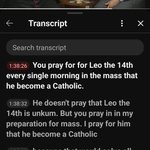
For example, in "September 2026 Q&A with Bp Donald Sanborn," Bishop Sanborn publicly states that he prays for Leo XIV*, thus emphasizing that the person he prays for is Pope Leo XIV:
"I (you - is wrong transcript) pray for Leo XIV every single morning in the mass that he become a Catholic."
* The name matters. He can call him by his papal name only if he recognizes him as the Pope.
But in 2024 he wrote that the Modernists are the Catholics who "have never been ejected from the Catholic Church by the Church's authority."
For the Thesis team, Leo XIV "has no formal authority," however, he is "elected pope" who "legally receives the power directly from Christ to create cardinals and appoint bishops to the Apostolic Sees, i.e., to secure the Apostolicity and Indefectibility of the Church."
In other words, the Thesis publicly states that Leo XIV (as all his predecessors) exercises the papal authority formally.
Only problem for the Thesis is that "uneducated people attack the Thesis and sow divisions," which, of course, is not true.
Some examples:


It's illogical to demand understanding and respect from people you publicly disrespect and call them uneducated. It's also at least odd to accuse Catholics of lacking charity because they disagree with an idea you've invented that has nothing to do with the Catholic doctrine.
PATRONAGE OF THE HOLY MOTHER OF GOD. In the 10th century the Mohammedan hordes attacked Constantinople during the reign of Emperor Leo the Wise. The terror-stricken people gathered within the church to pray to the Blessed Virgin. The Mother of God saved them from utter destruction and captivity. St. Andrew and St. Theophanius, both from Kyivan Rus, were in Constantinople at that time. They entered the church of the Holy Wisdom where the people were praying all night while the Christian army fought against the attacking Mohammedans.
At dawn St. Andrew and St. Theophanius saw the Blessed Virgin appearing with outstretched arms and imploring God's mercy upon the besieged Christians. She held a veil (omophor) over the attacked city as a sign of assured protection.
To the great joy of the inhabitants the Christian soldiers were blessed with a striking victory over the Moslems. On their return home the two Saints publicized the miracle among the people. Thus the feast of Pokrova (Patronage) of the Blessed Virgin was introduced into the Church to denote Mary's protection over the Christian people.
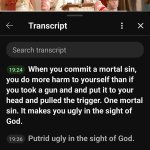
The Fifth Commandment forbids killing either of oneself or of others.
Moral Theology also says that the DIRECT taking of one's own life by one's own authority IS a mortal sin.
Because the DIRECT self-killing IS a mortal sin, that's not a good idea to encourage anyone to "took a gun and put it to your head and pull the trigger."
After you commit suicide by killing yourself with a gun in your head, the death will follow immediately, and you cannot "go to the confessional and in a few minutes have that completely cleaned and you emerge pleasing to God." In other words, you will die in the state of mortal sin.
However, Moral Theology says that:
"Indirect suicide is in itself forbidden, but may be permitted for a proportionately grave reason.
One kills himself indirectly if, without the intention of committing suicide, he knowingly and willingly does something which not only has an intended good effect, but from which death also follows. It is presupposed that the good effect results from the action as immediately as does death.
Therefore, it is permissible to leap from a dangerous height to escape burning to death, especially if there is some hope of escaping death from the fall. A woman may also do so to avoid being seized and violated by a libertine. - Thus, too, it is lawful in wartime to blow up an enemy fortification or ship, although one foresees that his life be lost in doing so." Moral Theology by Rev. Heribert Jone, Art. 207.

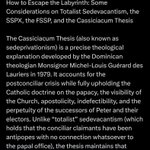
Sedevacantism does not hold that the conciliar claimants have been Antipopes. Sedevacantism holds that they have no connection whatsoever to the Papal office. One can only be an Antipope when there is a Pope. Sedevacantism holds that there has been no Pope since the death of Pius XII.
The following statement is an example of the Sophistic Labyrinth:
"The thesis maintains that these men are elected popes (validly designated and materially occupying the Apostolic See), but that they lack the formal authority of the papacy."
Aactually the thesis maintains that "these men" receive the power directly from Christ to validly create cardinals and appoint bishops to the Apostolic sees, securing Apostolicity, Indefectibility and Visibility of the Church.
In other words, because creating cardinals and appointing bishops can only be performed by the Popes who have the formal authority, the thesis maintains that "these men" have the formal authority.
Thus, "The thesis maintains that these men are elected popes" is the essense of the thesis. But it has no connection whatsoever to the Vacancy of the See.

