

Founder, @passportturtles 🐢 | Unlocking Sub-Saharan Africa’s Agricultural Alpha via Asset-Light Projects & Capital Networks (#AfricaIsNext)
Singapore
Joined September 2010
- Tweets2.4K
- Following270
- Followers330
- Likes1.7K





Pinned Tweet
Most founders waste months coding software nobody wants.
Meanwhile, I’m a software engineer running asset-light agricultural trade plays across Africa using a secret data moat.
We’re bridging Asia tech with African agriculture.
Here is the master plan for Passport Turtles 🐢👇
Over the last few months, I accidentally built an organic, highly active network of 47,000+ smallholder farmers and cooperatives across Sub-Saharan Africa.
My phone lights up daily with raw, ground-truth data logs.
Local crop surpluses, regional trucking gridlocks, and real-time factory buy-orders.
To an engineer, this isn't farming. It's un-optimized code.
The global agriculture market is a $13.4 trillion giant running on completely analog rails.
Mainstream capital is oversaturating tech stocks and real estate.
Meanwhile, the real "alpha" is sitting in emerging agricultural corridors trading at massive valuation discounts.
Traditional VCs won't touch it because they don't have eyes on the ground. We do.
At Passport Turtles, we use software leverage to run a highly efficient, two-speed model:
⚡ 30-90 Day Trade Runs: We pool angel capital to finance local logistics, moving crops from cooperatives to pre-signed factory weighbridges for quick double-digit returns.
🚀 The VC Track: We turn those supply constraints into lean AgTech SaaS apps built for 4-6 year corporate M&A buyouts.
Every single day, I am open-sourcing one raw, validated agricultural opportunity or startup concept straight from our 47k network right here on your feed.
No gatekeeping. Just hard metrics.
We don’t fly alone.
Lock in your syndicate access key and view today’s gated concept:
👉 passportturtles.com
#AfricaIsNext #BuildInPublic

1
1
157
Africa’s largest economy has an overlooked "black gold" opportunity—and it isn't oil. ☕🇳🇬
Coffee has grown in Nigeria for over a century, yet the country produced just 1,808 tonnes of beans in 2024 (compared to Kenya’s 49,500 tonnes).
Decades of oil dependency left the agricultural sector underfunded, forcing a nation of 220+ million people to rely heavily on imported instant coffee while local beans are smuggled across borders due to weak domestic infrastructure.
But the tide is turning. A new generation of Nigerian entrepreneurs is building a vibrant, homegrown specialty cafe culture in Lagos and Abuja, and the federal government has begun signaling renewed support for coffee cultivation.
To scale this from a niche curiosity into a global export powerhouse, Nigeria’s coffee value chain doesn't just need local grit—it needs strategic Foreign Direct Investment (FDI).
Here is where global capital can unlock massive value right now:
🌱 Supply Chain & Land Formalization: Many Nigerian smallholders farm on informal family plots. Impact capital can fund digital land mapping and traceability tech, helping local farmers meet strict EU anti-deforestation regulations and unlock lucrative European export markets.
🏭 Local Processing & Infrastructure: Investing in modern wet mills, roasting facilities, and cold-chain logistics will capture more value domestically, curb cross-border smuggling, and stabilize supply for local roasters.
📈 Agritech & Outgrower Schemes: Providing smallholder farmers with high-yield seedlings, climate-resilient training, and guaranteed off-take agreements can rapidly multiply Nigeria's annual tonnage.
Investing in Nigeria today requires navigating macroeconomic headwinds and inflation.
Yet, for patient, forward-thinking investors, backing a "frontier origin" coffee market offers ground-floor entry into one of the world's largest consumer bases and an untapped agricultural export engine.
The seeds are already in the ground. It’s time to fund the harvest.
Tomorrow, I'll continue with a special project plan for coffee production in Nigeria.
#AfricaIsNext #FDI #Nigeria #SpecialtyCoffee #FrontierMarkets
23
When 260 food and agribusiness lobbyists outnumber delegates from climate-vulnerable nations at COP31, who actually speaks for the people growing our food?
4 years of UN agriculture negotiations just collapsed in Antalya—leaving food and farming completely absent from the draft cover text.
For smallholder farmers across Sub-Saharan Africa (SSA), this isn’t just a policy stalemate. It’s a missed opportunity for survival and resilience.
Here is why what happens—and doesn’t happen—in those negotiating rooms matters on the ground in SSA:
1️⃣ Breaking Dependency on Expensive Inputs
Fertiliser lobbyists saw a 45% jump at COP31, pushing chemical inputs as the sole answer to food security.
Yet 99% of nitrogen fertilisers are derived from fossil fuels, leaving African smallholders vulnerable to global supply chain shocks and price spikes.
Real support means funding climate-resilient agroecology and local soil health—not locking farmers into volatile input costs.
2️⃣ Direct Finance for Climate Adaptation
Smallholders in SSA are already facing unprecedented losses from droughts, floods, and a climate-charged El Niño.
When agriculture is sidelined from official UN climate texts, it delays the targeted climate finance needed to help local farmers adapt, build water infrastructure, and protect their harvests.
3️⃣ Protecting Land and Livelihoods
The push for industrial livestock expansion and crop-based biofuels often comes at the expense of local ecosystems and pastoralist communities.
True climate solutions must prioritize local food sovereignty over corporate land use.
As Million Belay of the Alliance for Food Sovereignty in Africa (AFSA) noted at the summit, those on the frontlines of the climate emergency are being drowned out by vested interests.
If we want genuine food security in Sub-Saharan Africa, global climate policy needs to shift power—and funding—away from industrial lobbying and directly into the hands of smallholder farmers.
How can we ensure smallholder voices are better represented in global climate negotiations?
#COP31 #FoodSecurity #ClimateAction #Agroecology
51
Why is plant-based fake meat struggling globally?
The reason is that the industry tried to solve a commodity problem with luxury-priced, ultra-processed chemistry.
Over the past few years, billions in venture capital poured into Silicon Valley’s favorite thesis: that consumers would gladly abandon real meat if startups could engineer yellow peas and soy to sizzle, chew, & bleed like beef.
The market delivered a brutal verdict.
Category pioneers have lost over 95% of their valuation, fast-food giants quietly shelved nationwide rollouts, and 2/3 of consumers who tried plant-based meat went right back to animal protein.
The post-mortem comes down to 3 structural failures:
1. The Factory Floor Price Trap
Plant-based meat still costs 77% to 80%+ more per ounce than conventional beef.
Unlike cattle, which upcycle grass & agricultural byproducts, plant-based burgers require crops to be harvested, trucked, wet-fractionated into protein isolates, dried, shipped again, & cooked in energy-heavy industrial extruders.
That complex supply chain baked a permanent cost penalty into every patty.
You cannot disrupt a global staple commodity when your unit economics force a luxury markup.
2. The "Health Food" Illusion Shattered
Consumers initially bought fake meat thinking it was clean health food.
Once nutritionists & social media turned the package over—exposing 20-ingredient labels packed with methylcellulose, refined seed oils, and lab-fermented heme—health-conscious shoppers fled.
3. Cultural & Regulatory Pushback
Outside a handful of Western cities, fake meat never resonated.
Major agricultural markets in Europe banned meat-style labeling, while consumers across Asia, Africa, & Latin America saw no reason to pay more for an imitation of a food they already value.
The Biggest Misconception in FoodTech Today
Many investors look at this wreckage and assume the alternative protein thesis is dead.
It isn't. Consumers haven't stopped wanting sustainable, lower-cost protein—they just rejected fake burgers.
Smart capital has quietly rotated away from consumer-facing fake meat & into 3 far more profitable plays:
➡️Unapologetic Whole Foods: Minimal-ingredient staples like tofu, tempeh, & fungi that don't pretend to be beef—& actually win on price & clean labels.
➡️50/50 Blended Hybrids: Combining real beef or poultry with textured plant or fungal proteins. Foodservice buyers & inflation-weary families love it because it cuts costs & saturated fat while keeping the exact taste of real meat.
➡️Emerging-Market B2B Protein Extenders: Across Africa & Asia—where imported animal feed & meat prices punish local budgets—B2B ingredient startups are using local crops, fermentation, & insect protein to lower costs for food manufacturers.
There is no lifestyle marketing—just pure supply-chain margin.
The first wave of FoodTech tried to out-engineer nature & burned billions doing it.
The second wave is quietly fixing global protein economics from behind the scenes.
#AfricaIsNext #FoodTech #FutureOfFood

31
While plant-based fake meat struggles globally, an "unsexy" gold rush is quietly taking over East and West Africa. 🪰💰
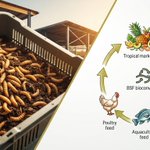
Forget lab-grown burgers. The highest-margin protein play on the continent right now is industrial insect farming—specifically, Black Soldier Fly (BSF) larvae.
And it’s turning urban garbage into serious capital.
Welcome to the era of the "Trash Barons of the Protein Crisis."
Across hubs like Accra, Lagos, & Nairobi, industrial insect farming—specifically BSF—is turning a massive urban sanitation crisis into a lucrative protein monopoly.
Here is why the unit economics of insect bioconversion are attracting both bootstrapped local pioneers & heavy European capital:
📉 1. The Macro Arbitrage: Escaping the Import Trap
Feed accounts for up to 70% of operating costs for African poultry & aquaculture farmers.
For years, local farms have been crushed by volatile currency exchange rates & soaring prices for imported soy & wild-caught fishmeal.
BSF larvae—which boast up to 60% crude protein content—allow feed millers to bypass global supply chains entirely using locally sourced, zero-cost inputs.
⚙️ 2. Unmatched Biological Velocity
BSF larvae are nature’s ultimate upcyclers. Fed on rotting market waste—pineapple peels, avocado pits, brewery spent grain, and abattoir scraps—they double their body weight every single day.
In just 10 to 14 days, they reduce organic waste volume by up to 70%, yielding two high-margin revenue streams:
Defatted/Whole Larvae Meal: A direct, nutrient-dense replacement for fishmeal and soy.
Organic Frass (Bio-fertilizer): An odorless soil amendment that routinely outperforms synthetic fertilizers, giving operators a dual-sided margin in both livestock and crop markets.
🏢 3. Playbook Emerging: Indigenous Aggregation
The Aggregator Play (Case Study — Wiggling Gold): While foreign players build big factories, Ghana’s Wiggling Gold (founded by Samuel Boadu) proves the power of decentralized, indigenous aggregation. Starting without heavy seed capital, Wiggling Gold scaled to supplying over 200 tons of BSF larvae monthly and 9–10 tons of bio-fertilizer per batch.
Even smarter: they turned smallholder farmers into outgrowers. By selling modular backyard starter kits (like their WIGO DOMUS system) and training youth across all 16 regions of Ghana, they crowdsource production capacity while controlling the commercial off-take and aggregation.
🚧 The Real Moat Isn't Tech—It’s Waste Logistics
In circular ag-tech, biology isn't the bottleneck; feedstock is.
As competition heats up, pure-play larvae farms will get squeezed on raw material costs.
The true long-term winners in Lagos, Nairobi, and Accra won't be the companies with the flashiest bioreactors—they will be the operators who lock down exclusive municipal waste contracts, supermarket off-take deals, and decentralized outgrower networks.
Whoever controls the city's organic trash today will control the price of Africa's meat tomorrow.
#AfricaIsNext #BSF #Ghana

1
89
Fractional cows, phantom yields, & the brutal reality of biological timelines. 📉🐄
In South Africa, the hyped "crowd-farming" startup Livestock Wealth was permanently shut down & placed into final liquidation.
The pitch was seductive: let everyday retail investors buy fractional stakes in pregnant cows and macadamia trees via a sleek mobile app, promising 20%+ returns while funding local agriculture.
On paper, it looked like the ultimate democratization of real-world assets (RWAs).
In practice, it became a textbook case study in why forcing biological assets into fintech payout structures almost always ends in disaster.
When the curtain was pulled back in court, the liquidation filings revealed severe governance and liquidity failures:
• Frozen liquidity: Retail investor withdrawals were quietly halted as cash inflows dried up.
• Zero audit trail: The company failed to produce basic audited financial statements despite managing millions in public capital.
• Regulatory smoke and mirrors: Regulators fined the firm for displaying the financial license number of a dormant subsidiary to project legitimacy.
• Textbooks signs of insolvency: Management attempted to take out an emergency ZAR 6.8 million loan simply to pay overdue returns to existing investors.
Livestock Wealth is far from an isolated failure.
Over the last few years, retail crowd-farming platforms across Africa and other emerging markets have quietly imploded one by one.
For global investors evaluating agritech, fractional ownership, and alternative yield platforms, there are three deeper structural lessons here:
1. The Asset-Liability Mismatch
Agriculture operates on messy, unpredictable biological timelines.
Cows have nine-month gestation periods.
Macadamia trees take years to reach peak yield. Weather, disease, feed costs, and commodity price swings dictate cash flow.
Retail app users, however, expect predictable, fixed-income-style payouts on rigid quarterly or annual schedules.
When a harvest is delayed or cattle underperform, a platform promising fixed yields faces an immediate cash crunch.
2. The "Yield Trap" in Emerging Markets
Promising 20%+ annualized returns in agriculture ignores basic unit economics.
Commercial farming is a capital-intensive, low-margin business where weather alone can wipe out a season's profit.
When a platform wraps a low-margin biological asset in a high-cost customer acquisition model and still promises venture-style yields, the math simply doesn't work without continuous new investor inflows.
The takeaway for allocators and builders is simple: technology can improve distribution, underwriting, and supply-chain transparency in agriculture, but it cannot software-engineer away biological risk.
If an alternative investment offers high, fixed yields backed by illiquid biological assets, always ask who is absorbing the volatility—and where the cash for today's payouts is actually coming from.
#AfricaIsNext #AlternativeInvestments #SouthAfrica
🤖 Made with AI

61
Over 70% of smallholder financing needs in Sub-Saharan Africa go unmet.
Why?
Because traditional banking demands land titles and hard assets as collateral—things most rural farmers simply don’t have.
Yet, smallholder farmers produce the vast majority of the region's food.
When we lock them out of capital, we lock entire economies out of growth.
So what do we do?
Launch a FinTech? Sure, why not.
But it is not as simple as it is.
There are lots of challenges and limitations.
For one, this is Side-Selling.
In value-chain lending, farmers occasionally sell their harvested crops to competing side-buyers for immediate cash rather than delivering to the contracted off-taker who financed their inputs.
Then there's High Operational Costs:
Delivering physical inputs and training to remote, scattered farms is expensive, making it difficult for lenders to achieve profitability without donor subsidies or high interest rates.
And lastly, there's Digital Divides:
While mobile lending is growing rapidly, limited rural smartphone penetration, patchy internet connectivity, and low digital literacy still exclude many of the poorest farmers.
But don't stress that out. There are ways to de-risk smallholder credit.
Instead of handing out cash and hoping for repayment, there's a way to build an agricultural franchise model that replaces physical collateral with structural alignment:
➡️Social Underwriting:
Farmers are organized into "Trust Groups" where peer accountability replaces land titles.
➡️In-Kind Precision:
Loans are disbursed strictly as high-yield seeds, fertilizers, and crop protection—paired with intensive, data-driven agronomy training to double yields per hectare.
➡️Harvest Liquidity & Off-Take:
Rather than forcing farmers to sell at harvest when market prices crash, FinTech companies aggregates, stores, and markets the grain collectively—selling at peak prices and deducting loan repayments directly from the proceeds.
The result?
Repayment rates consistently exceeding 98% in a sector where commercial banks fear 30%+ defaults.
For Impact Funds and Angel Investors looking at Agri-FinTech in SSA, the lesson is clear: credit alone is a commodity, and a risky one at that.
The investable edge lies in models that control the value chain—combining alternative data underwriting (satellite imagery, mobile money flows), bundled weather-index insurance, and guaranteed off-take agreements that prevent side-selling.
We don't have a smallholder creditworthiness problem in Sub-Saharan Africa.
We have a financial product design problem.
To the investors and operators building in emerging markets:
Where are you seeing the strongest unit economics right now—pure-play digital credit scoring, or vertically integrated "seed-to-market" models?
#AfricaIsNext #ImpactInvesting #FinTech #AngelInvesting
69
Tanzania’s tea sector holds massive untapped potential, yet its biggest growth engine is stuck in the "missing middle." 🍃🇹🇿
Smallholder farmers produce a significant share of Tanzania’s tea, feeding directly into local processing factories, aggregators, and regional logistics firms.
These mid-sized agribusinesses are the vital bridge between rural farms and global export markets—employing hundreds of people and anchoring local economies.
Yet, when they need $250K to $2M to scale, they hit a wall:
❌ Too large for microfinance.
❌ Too "risky" or collateral-light for traditional commercial banks, which often prefer high-yielding government securities over agricultural lending.
Without flexible growth capital, local processors can’t upgrade to energy-efficient machinery, aggregators struggle to pay farmers on time during peak harvest, and climate-resilient farming practices remain out of reach.
This is where blended-finance private credit changes the game.
Instead of forcing profitable agribusinesses into premature equity dilution—or leaving them starved of cash—tailored debt instruments can unlock immediate value across the entire tea value chain:
1️⃣ Working Capital & Offtake-Backed Loans: Tying repayments directly to verified export contracts and harvest cycles so processors can buy green leaf faster and pay farmers reliably.
2️⃣ Asset-Backed Equipment Financing: Funding solar-powered irrigation, modern withering troughs, and clean-energy boilers that slash factory operating costs and carbon footprints simultaneously.
3️⃣ Local-Currency & Blended Structures: Using catalytic first-loss capital to de-risk transactions and protect Tanzanian SMEs from FX volatility.
Investing in Tanzania’s missing middle isn’t charity—it’s smart, risk-adjusted private credit. When we equip local tea processors and aggregators with the right capital, yields rise, rural incomes stabilize, and global investors capture resilient, impact-driven returns.
Are you building, lending, or investing in East Africa's agricultural value chains ahead of 2027?
#AfricaIsNext #Tanzania #EmergingMarkets
🤖 Made with AI

1
49
I’ve spent the last few weeks deep-diving into the playbook of Novastar Ventures—studying how they scaled from an informal angel club in 2013 into a $350M+ institutional powerhouse across Africa, recently closing their $147M People and Planet Fund III.
For emerging fund managers building in frontier and high-growth markets, their blueprint offers a masterclass in turning structural challenges into defensible advantages.
Here are 5 takeaways from their model that every VC should study:
1. Bet on "The Many, Not Just the Few"
While traditional tech VCs often chase high-margin software for the top 5% of consumers, Novastar builds moats around essential services—food, energy, mobility, and agriculture—for the mass market. High volume at accessible price points creates unmatched resilience in emerging economies.
2. Concentration + Milestone-Based Reserves
Instead of spray-and-pray seed investing, they build high-conviction portfolios of 12–15 companies per fund. Crucially, they hold back 40%–50% of their capital for follow-ons, unlocking larger checks only when founders hit strict unit-economic and governance milestones.
3. Engineer a "Crowding-In" Multiplier
In frontier markets, early-stage equity is scarce because global investors worry about governance risk.
Novastar acts as an institutional stamp of approval—installing dedicated talent, ESG, and governance specialists inside seed-stage startups.
The result? For every $1 Novastar invests, their portfolio companies raise $4.50 in follow-on global capital.
4. Build a Cross-Continental LP Bridge
Most emerging managers struggle to raise from institutional LPs because they lack local-to-global translation.
Novastar split its footprint intentionally: on-the-ground deal teams in Nairobi and Lagos paired with capital and governance hubs in London and Tokyo.
By offering Japanese corporate giants like Mitsubishi and SMBC co-investment rights and market-entry insights, they unlocked a completely new pool of strategic capital.
5. Impact is a Commercial Driver, Not a Concession
Their Fund III thesis proves that climate adaptation and commercial scale are two sides of the same coin.
Backing companies that solve post-harvest loss, clean mobility, or smallholder resilience isn't philanthropy—it’s capturing massive, underserved market demand.
My biggest realization from studying their journey:
You don't need a $100M fund on Day 1 to use an institutional playbook.
Whether you're starting with deal-by-deal SPVs or raising Fund I, pairing deep local operating empathy with world-class governance is how emerging managers win.
To my fellow GPs, LPs, and ecosystem builders:
Which venture firm's blueprint has influenced how you think about fund construction? 👇
#VentureCapital #FrontierMarkets #AgTech #AfricaIsNext
79
Still in Avocado... 🥑
Monoculture avocado farming is thirsty, input-heavy, and vulnerable.
The future of profitable, climate-resilient horticulture lies in biological stacking.
Instead of treating a farm as a factory with expensive external inputs, forward-thinking growers are designing closed-loop ecosystems where every crop, insect, and waste stream actively supports the next.
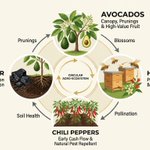
Here is how combining Avocados, Chili Peppers, Honey Bees, and Biochar creates a high-margin, self-sustaining agricultural powerhouse:
🐝 Honey Bees (The Yield Multiplier):
Avocado flowers have a notoriously complex pollination window (opening as female one day and male the next).
Placing apiaries inside the orchard boosts pollination rates and fruit set by up to 30%—while generating an immediate, high-margin secondary revenue stream through raw, avocado-blossom honey.
🌶️ Chili Peppers (The Cash-Flow & Pest Buffer):
Avocado trees take 3 to 4 years to reach commercial maturity.
Intercropping fast-growing chilies between young tree rows solves the early-year cash-flow gap for farmers.
Better yet, chilies act as a natural bio-repellent against orchard pests and provide low-lying nectar that keeps bees active when avocado trees aren't blooming.
🪵 Biochar (The Carbon & Water Vault):
Every avocado orchard generates tons of pruning waste, wood trimmings, and rejected pits.
Instead of burning or dumping this biomass, pyrolyzing it into biochar locks away carbon and creates a permanent, porous sponge in the soil.
Mixed into the root zone, biochar slashes irrigation needs by retaining moisture and holding onto nutrients so fertilizer doesn't wash away.
🔄 The Full Circular Loop (Added Value):
Compost + Biochar:
Charging biochar with organic compost or livestock manure supercharges soil microbiology, protecting shallow avocado roots from devastating fungal diseases like Phytophthora root rot.
Spiced Honey & Chili Oil:
Vertically integrated farms can infuse their raw honey with estate-grown chilies—creating a trendy, export-ready "hot honey" product alongside cold-pressed avocado oil.
When you stack biological synergies like this, you don't just protect the environment—you de-risk the asset.
Farmers cut input costs, diversify revenue across multiple harvest cycles, and build drought-proof soil equity.
For investors and operators in agribusiness: what other integrated crop-and-insect combinations are you seeing deliver outsized unit economics?
#AfricaIsNext #CircularEconomy #RegenerativeAgriculture #AvocadoFarming
🤖 Made with AI

47
Kenya is quietly becoming the world’s next major avocado superpower—and the real money isn't in the orchards. It’s in the packhouses. 🥑
As Africa’s largest avocado exporter and a top-six global supplier, Kenya’s Hass avocado sector has exploded over the past few years.
With new phytosanitary protocols unlocking massive consumer markets in China and India alongside traditional European buyers, demand is outpacing supply chain capacity.
For global investors looking at East African agribusiness, the thesis here is remarkably clear.
You don't need to take on agricultural production risk to capture this growth.
The highest-margin opportunity sits in export-grade packhouses and cold-chain logistics.
Here is why smart capital is targeting Kenya’s avocado mid-stream right now:
🚢 The Shift from Air to Sea Freight:
Airfreight margins are getting squeezed.
Exporters are rapidly transitioning to Controlled Atmosphere (CA) refrigerated sea containers via the Port of Mombasa.
However, surviving a 25-to-35-day ocean voyage requires strict pre-cooling within hours of harvest—creating urgent demand for modern packhouse infrastructure.
📋 Traceability & Compliance Moats:
Strict EU and Chinese import regulations require precise dry-matter testing, pest-free certification, and farm-to-port traceability.
Modern, tech-enabled packhouses that aggregate smallholder fruit and guarantee compliance command massive pricing power.
🥑 By-Product Monetization (Crude Avocado Oil): Export rejection rates for cosmetic blemishes can reach 20–30%.
Vertically integrated packhouses are turning those "imperfect" avocados into high-margin crude and extra-virgin avocado oil for global food and cosmetic buyers—turning waste into pure profit.
Investing in Kenyan avocados isn't about betting on weather or land.
It’s about financing the processing, sorting, and cold-chain bottlenecks that connect millions of existing trees to hungry global ports.
#AfricaIsNext #KenyanAvocados #ColdChain #FoodExports

1
42
Is Rwanda the Silicon Valley of global agritech? 🌍🌱
I’m currently mapping out a concept that’s been on my mind for a while: establishing a specialized Media-Ag Incubator Space right in the heart of Kigali. 🇷🇼
Rwanda’s Fifth Strategic Plan for Agriculture Transformation (PSTA 5) has built an incredible foundation.
The country has the tech infrastructure, the stability, and the ambition.
But when looking closely at the wider East African landscape, two critical gaps remain:
1️⃣Scaling early-stage agritech founders from seed to regional expansion.
2️⃣Telling the vibrant, data-driven story of African agricultural innovation to the global market.
To bridge this, we are considering a physical hub designed to cross-pollinate breakthrough science with world-class media:
💡 A Co-Working Space built specifically for ag-SaaS and fintech founders to build cross-border platforms.
💡 An Experiential Food-Tech Lab & Kitchen for testing, refining, and launching consumer agritech products.
💡 A State-of-the-Art Video/Podcast Studio to broadcast the realities, triumphs, and investment returns of East African agriculture directly to global LPs.
By creating the ultimate ecosystem for Ag-Tech storytelling in East Africa, our goal is simple: capture proprietary deal flow and build an unshakeable bridge between local talent and international venture capital.
Where we stand right now:
We are heavily evaluating the feasibility, local partnerships, and economic modeling of this project.
Over the coming weeks, I’ll be sharing our deep dives, constraints, and learnings here.
Stay tuned—I will formally update my network on whether we are greenlighting this project and pushing through with construction. 🚀
If you are an investor, founder, or ecosystem builder working in the intersection of climate-smart ag, SaaS, or media in East Africa, let’s connect.
Drop a comment or slide into my DMs—I'd love to hear your thoughts on this thesis.
#AfricaIsNext #RwandaTech #VentureCapital #PSTA5

3
4
116
Do Local Aggregators become "Greedy Middlemen" As They Grow Bigger?
In Sub-Saharan African agriculture, the "evil middleman" narrative is deeply entrenched.
We are told they exploit smallholders, manipulate scales, and capture all the margin.
But if you look past the VC-backed agrotech echo chamber, the ground reality is completely different.
The real economic engine of rural Africa is powered by local commodity aggregators who have proprietary networks of thousands of smallholder farmers, highly resilient operational cash flows, and zero online footprint.
They don't have websites, PitchBook profiles, or institutional capital.
But they do have trucks, warehouses, and the deep local trust required to move thousands of tonnes of grain, cocoa, and cashew every single crop cycle.
As these bootstrapped aggregators scale, do they structurally become predatory middlemen?
The candid answer is: yes, many do.
As overhead grows and commission-based agents take over personal relationships, margins are often protected by squeezing the most defenseless node in the chain—the farmer.
But there is a high-value exemption.
The best local aggregators understand that cutthroat arbitrage is a race to the bottom. Instead of just buying raw commodities to flip them, they build value-driven ecosystems:
1️⃣Localized Primary Processing:
They invest in millers, dryers, or hullers. To keep this machinery running, they need premium, predictable quality—meaning they actively invest in the farmer's inputs and agronomy.
2️⃣Traceable Export Pathways:
In high-value chains like Hass avocados, macadamia, or organic cacao, global compliance demands traceability.
These aggregators pass export premiums back to farmers to lock in supply loyalty.
3️⃣Informal Social Safety Nets:
They advance emergency capital for school fees and medical expenses during the lean season, absorbing post-harvest and structural risks that commercial banks won't touch.
The future of SSA agrotech shouldn't be about displacing these figures.
It should be about identifying these asset-heavy, operationally resilient, un-leveraged local entities and providing them with the structured finance and tooling to scale their impact.
Right now, I am communicating with local aggregators who genuinely lift farmers out of poverty rather than trapping them there.
I call them my "Angel Aggregators".
Stay tuned for my highlight stories on these aggregators in my upcoming posts.
#AfricaIsNext #AgroTech #SupplyChain #ImpactInvesting

65
The VC funding landscape in Sub-Saharan Africa (SSA) has transitioned out of the "VC winter" of 2022–2024 and entered a cycle focused on capital concentration, structural diversification, and climate-centric validation.
Following a baseline recovery where African tech startups raised $2.49 billion in the first nine months of 2025, projections for late 2026 into 2027 point toward calculated expansion under strict investor scrutiny.
1️⃣ Macro Projections: Baseline vs. Total Addressable Capital
➡️The Aggregate VC Recovery: Total tech VC in SSA is projected to steadily stabilize between $3.5 billion and $4.0 billion annually through 2027. This is supported by an influx of domestic dry powder and stabilizing macroeconomic conditions—with the IMF and World Bank projecting regional GDP growth of 4.3% to 4.5% for 2026/2027.
➡️The Agritech and Agrifood Share: Out of the broader VC pool, dedicated equity for Agritech is correcting toward a sustainable $250 million to $350 million annual baseline.
➡️The Massive Funding Deficit: Despite the VC recovery, a staggering $117 billion unmet agri-finance gap remains in SSA. Consequently, VC equity will only account for a fraction of the market, serving strictly as the catalytic "R&D layer" for highly scalable software, fintech, and hardware networks.
2️⃣ Structural Forecasts: The "Flight to Quality" & Series A Bottleneck
➡️The Series A Squeeze: Seed-stage activity remains resilient, but a major crunch exists at the Series A layer. Investors are bypassing mid-stage experimentation. Projections show that less than 15% of Seed-funded Agritech startups will successfully bridge to a Series A over the next year.
➡️Concentration in Top-Tier Winners: A small group of highly mature companies will absorb the lion's share of available cash. Late-stage rounds are capturing almost half of all active venture capital, heavily weighting headline numbers toward established players.
➡️Shift to "Blended Finance" and Venture Debt: Equity is no longer the sole instrument. Venture debt, hybrid instruments, and first-loss catalytic capital now make up roughly 40% to 50% of early-to-growth stage funding allocations. Dedicated vehicles—such as the recent $85 million injection into AgDevCo—are combining equity with debt to protect startups from equity dilution while navigating tight global markets.
There's more.
There have been Sector Rotations where ClimateTech Surpasses FinTech
The fundamental priority of African venture capital has flipped.
For the first time, climate-focused investments have displaced fintech as the largest venture bet in Africa. Climate tech and sustainable agribusiness absorb roughly 38% of total venture capital value.
So it is Utility over Hype.
The rotation from pure FinTech to ClimateTech offers a profound lesson for global venture capital: Capital ultimately flows to where the existential pain point is greatest.
#VCFunding #ClimateTech #AgTech #VentureCapital #AfricaIsNext
33
Big impact comes in small packages. 🌍🚀
When global investors think about the future of food security, climate resilience, and economic growth, their eyes should be on Sub-Saharan Africa (SSA)—specifically on plots of land no larger than 5 acres.
While individual plots may be small, the aggregate economic powerhouse of African smallholder farmers is massive.
Here are the numbers driving the next frontier of impact investing:
📊 The Macro View of SSA Agriculture:
➡️33 Million+ – The estimated number of smallholder farms operating across the continent.
➡️80% – The overwhelming percentage of all farms in Sub-Saharan Africa managed by smallholder farmers.
➡️Under 5 Acres – The size of the vast majority of these farms (with a massive portion operating on fewer than 2.5 acres).
➡️23% of GDP – The massive economic footprint agriculture contributes to the Sub-Saharan African economy.
💡 Why This Matters for Global Investors
1. The Bedrock of Food Security 🌾
Smallholder farmers are not just sustaining their households; they produce up to 80% of the food supply in Sub-Saharan Africa. Investing in these ultra-small farms directly unlocks the agricultural potential of a region aiming to feed a rapidly growing population, pivoting agriculture from subsistence to a highly lucrative, commercialized value chain.
2. Engines of Local Economies 💼
Smallholders constitute the largest private-sector group in Africa, employing up to 65% of the labor force. Capital injections here create a powerful multiplier effect: boosting farmer incomes directly drives rural development, financial inclusion, and localized market growth.
3. Champions of Biodiversity & Climate Resilience 🌱
Unlike massive, single-crop industrial farms, smallholders are the true custodians of biodiversity. They cultivate a rich variety of climate-resilient crop strains and traditional breeds. Supporting these systems scales Climate-Smart Agriculture (CSA), protecting delicate ecosystems while mitigating systemic supply chain risks against extreme weather events.
📈 The Investor Opportunity
Historically, traditional financial institutions viewed smallholders as "un-bankable".
Today, innovative blended finance, agritech platforms, and decentralized supply chains are completely de-risking the sector.
With Africa's food market projected to reach $1 trillion, these small 5-acre plots represent one of the greatest untapped asset classes for generating both high-signal financial returns and measurable ESG impact.
Let’s change the narrative from developmental aid to strategic, commercial investment.
👉 Are you looking at smallholder agritech and infrastructure in your current portfolio?
Photo Credits to John Kourkoutas
#AfricaIsNext #ImpactInvesting #FoodSecurity #ESG #SustainableAgriculture

1
82
Why #AfricaIsNext is the Ultimate Frontier
Global investors often misunderstand African agriculture, viewing it through a lens of risk rather than massive growth potential.
Our campaign is inspired by these structural realities:
1️⃣The Demographic Engine:
By 2050, Africa will account for 25% of the world's population.
Agriculture employs over 50% of the workforce in SSA (Sub-Saharan Africa).
Feeding this population requires a massive shift from subsistence to commercialized tech-driven farming.
2️⃣The Climate Leapfrog Opportunity:
Global South farmers are at the absolute frontline of climate change.
SSA is the ultimate testing ground for regenerative agriculture, drought-resistant biotech, localized carbon-credit systems, and decentralized solar irrigation.
Tech proven here can be exported globally.
3️⃣The Mobile-First Financial Backbone:
Thanks to pioneering rails like M-Pesa, MTN MoMo, and modern crypto/stablecoin off-ramps, SSA smallholders are highly financially included via mobile money.
This makes deploying capital, collecting micro-revenues, and tracking supply chains computationally seamless.
Stay tuned for our "Weekend Project" which we will announce tomorrow.
Happy weekend!
#AfricaIsNext
27
While the broader market chases volatile tech multiples, sophisticated capital is quietly positioning itself in a massive, uncrowded frontier:
Zimbabwe’s high-alpha agricultural sector. 📈🫐
This isn't speculative farming.
This is a highly calculated, time-based financial arbitrage leveraging Undervalued Assets.
The thesis is built entirely on the anatomy of Zimbabwe's "Perfect Microclimates."
Crisp, frost-free winters combined with intense daily sunlight allow local growers to harvest early-season export blueberries weeks ahead of global titans like Peru and South Africa.
By capturing this exclusive May-to-July global supply gap, these early harvests command premium prices of $5.00 to $6.00+ per kg, long before the international market faces a supply flush.
To help our private investor groups capitalize on this opportunity, we are structuring a high-velocity, asset-light Micro-SPV targeting this exact horticultural goldmine.
Here is a glimpse of the financial modeling we are deploying:
💰 CapEx Entry: Highly optimized by utilizing a structured Joint Venture (JV) model with established commercial farms, eliminating raw land risks.
📊 Projected Returns: Targeting a striking 35% – 42% Project IRR, with initial capital payback fully achieved within 36 months.
⏳ Exit Timeframe: A clean 5-to-7-year liquidity event, selling the fully mature, cash-flowing asset to regional agro-conglomerates or African-focused private equity funds.
But this is just the foundational layer.
The real asymmetric upside lies in how we plan to layer a high-scale AgTech play over this physical trade run—turning raw crop yields into a venture-scale enterprise.
💡 The complete operational breakdown, precise CapEx dollar figures, risk-mitigation frameworks, and tech expansion roadmap are available exclusively in our paid "Insider Newsletter" dropping this week.
Drop a comment below or send a DM to secure your access to the full briefing.
#AfricaIsNext #AlternativeInvestments #FrontierMarkets #AgTech #UndervaluedAssets #ZimbabweAgriculture

44
Investing in Sub-Saharan Africa’s water infrastructure isn't just a climate adaptation play—it’s an untapped, high-alpha asset class. 🌍💧
Deep-aquifer borehole development, structured via Special Purpose Vehicles (SPVs), offers institutional-grade infrastructure yield by treating water as a premium utility for commercial agriculture.
While surface water is failing due to climate volatility, deep ground aquifers provide a climate-immune asset base.
The key to unlocking this value lies in a Water-as-a-Service (WaaS) model financed through hard-currency (USD) or stable digital pricing.
This completely insulates investors from local currency depreciation while securing a predictable, recurring cash-flow stream.
Here is how the investment thesis splits across two distinct, high-performing sandboxes:
🇰🇪 1. Kenya: The AgTech & Mobile Money Sandbox
➡️The Alpha: High-margin, dense export value chains (fresh horticulture, premium avocados).
➡️The Economics: These cash crops can seamlessly absorb a $0.50 per m³ volumetric water tariff.
➡️The Scale: Integrating automated smart meters with mobile money rails (like M-Pesa) reduces operational overhead, ensures real-time revenue collection, and minimizes counterparty risk.
🇿🇼 2. Zimbabwe: The High-Alpha Catch-Up Market
➡️The Alpha: Severe localized supply deficits.
➡️The Economics: Premium food commodities in Zimbabwe often trade at a 30% to 50% price premium compared to regional averages.
➡️The Scale: This pricing anomaly provides extraordinary cash-flow margins for irrigated farms. Operating the SPV entirely in USD acts as a natural hedge, enabling investors to capture massive arbitrage while providing critical food security infrastructure.
💡 The Strategic Add-On: Solar Hybridization
To maximize the IRR of these SPVs, we shouldn't just build boreholes; we should build Solar-Powered Water Hubs.
By eliminating diesel reliance, we lower OPEX to near-zero post-CAPEX, instantly boosting net margins while ticking critical ESG and carbon-credit boxes.
By anchoring deep-aquifer infrastructure to high-value agricultural off-takers, we turn a fragmented, high-risk sector into a structured, bankable yield engine.
Which playbook moves the needle faster for an infrastructure fund?
The tech-enabled, high-velocity export model in Kenya, or the high-margin supply deficit play in Zimbabwe?
#AfricaIsNext #Kenya #Zimbabwe #WaterInfrastructure #ClimateTech

77
While the global climate conversation focuses heavily on surface water management, macro allocators in Southern Africa are looking deep underground.
The real key to agricultural resilience in the SADC region isn’t dams or rivers.
It’s deep-aquifer borehole infrastructure.
Southern Africa—stretching across nations like Zimbabwe, Zambia, Namibia, Botswana, and parts of South Africa—is experiencing unprecedented hydrological volatility.
El Niño-induced droughts are severely crippling rain-fed agriculture.
When surface water reservoirs evaporate and shallow wells dry up, agricultural productivity collapses, dragging regional GDP down with it.
Yet, beneath our feet sits a massive, underutilized asset class: transboundary deep-aquifer systems (like the Stampriet or the Karoo sedimentary aquifers).
Accessing these deeper, climate-resilient water tables via industrialized borehole networks is the single most vital intervention required to transition millions of smallholders from high-risk, seasonal rain-dependent farming to predictable, high-value, year-round commercial production.
But drilling a hole in the ground is no longer enough.
To truly unlock this resource at scale, countries across Southern Africa need to aggressively enhance three critical layers of their borehole infrastructure:
The "Water-as-a-Service" (WaaS) Financial Framework
The primary barrier to deep-borehole development is the massive upfront Capital Expenditure (CapEx).
Expecting a cluster of smallholder farmers to fund a $15,000 to $30,000 high-yield industrial solar borehole is unrealistic.
Southern African nations need to establish regulatory frameworks that support the Water-as-a-Service model. Institutional investors fund the drilling, solar arrays, and localized piping networks.
In return, smallholders or local water user associations pay a highly affordable, usage-based volume tariff (via mobile money) as an operational expense (OpEx) tied directly to their harvest cycles.
When you secure groundwater at a deep, climate-immune level, you eliminate weather risk from the agricultural investment equation.
You turn volatile smallholder farming tracts into highly predictable, multi-season commercial agri-hubs.
#AfricaIsNext #WaterSecurity #AgTech #SouthernAfrica

1
1
69
The most overlooked arbitrage in macro investing right now isn’t in energy or semiconductors.
It’s the hidden structural trade between the Kenyan highlands and the Gulf Cooperation Council (GCC) dairy markets.
The macro data paints a clear picture:
Saudi Arabia and the UAE have restricted the domestic cultivation of water-intensive forage crops to preserve their hyper-depleted aquifers.
Yet, the GCC’s sovereign food security mandates require their massive commercial dairy herds to maintain an uninterrupted supply of high-grade Alfalfa (Lucerne).
They cannot grow it. They must import it.
This has created a structural supply deficit.
The solution isn't corporate mega-farms, which face intense geopolitical and land-tenure headwinds in East Africa.
The institutional play lies in aggregating the localized hydrological abundance of Sub-Saharan African smallholder networks.
By deploying targeted capital to optimize smallholder production, investors can capture an exceptional spread: converting localized, renewable rainfall into high-value, dollar-denominated export contracts.
Here is the operational framework required to institutionalize this asset class across a network of smallholder farmers:
1️⃣Distributed CapEx via Shared Irrigation Infrastructure
Alfalfa requires a strict 28-to-30 day harvest cycle to hit the necessary crude protein levels (>20%) required by GCC buyers. Instead of standard asset-heavy land acquisition, capital is deployed into centralized, solar-powered borehole and drip networks shared by clusters of trusted smallholder farmers. This shifts the investment from a politically sensitive land play to a high-yield infrastructure play.
2️⃣Compressing Post-Harvest Degradation
The primary point of failure in East African agricultural supply chains isn't yield; it's post-harvest moisture management. To meet international commercial shipping standards, alfalfa must be compressed and dried to a uniform moisture level below 12%. Building localized, sensor-driven solar drying and mechanical baling hubs within smallholder clusters de-risks the product before it ever reaches the Port of Mombasa.
3️⃣Structured Currency and Offtake Management
By securing multi-year, dollar-denominated offtake agreements directly with sovereign backed dairy entities in the Gulf, the fund establishes a hard-currency revenue stream. Conversely, local operational inputs and smallholder payouts are executed in local currency with guaranteed floor pricing, creating a highly resilient structural hedge against inflation.
This is a pure macro resource play.
It treats agricultural capacity as a high-velocity manufacturing network rather than a volatile commodity gamble.
#AfricaIsNext #Alfalfa #GCC
58
The average farmer in Sub-Saharan Africa is 60 years old.
The average African is 19.
Read those two sentences again.
We are looking at the greatest demographic mismatch in human history, right in the middle of our most critical sector.
Traditional farming in Africa is facing an existential crisis because the youth don’t want to inherit a life of backbreaking, low-margin labor.
And honestly? Can you blame them?
But a quiet, massive shift is happening.
The next generation isn’t leaving the farm—they’re redefining it.
They aren't "farmers." They are Agri-preneurs.
They treat a plot of land exactly like a tech startup treats a codebase: an asset to optimize, scale, and monetize.
Here is the blueprint for a massive, high-substance opportunity driving this youth shift right now:
1️⃣The "Cloud Kitchen" Model for Arable Land (Land-as-a-Service)
The biggest barrier for a 22-year-old brilliant agronomist isn’t ambition; it’s land tenure. Land ownership is tangled in legacy, tribal, or bureaucratic red tape.
The winning play here is fractionalized Land-as-a-Service.
Companies that lease massive tracts of underutilized land, clear it, install solar-powered irrigation pipelines, and "sub-let" 1-hectare smart plots to young Agri-preneurs.
It turns capital expenditure into a variable monthly subscription.
So you see, the 50,000+ farmers in my network aren't looking for pity or handouts.
They are looking for leverage.
The future of African food security won’t be solved by legacy development funds.
It will be solved by 23-year-olds with a smartphone in one hand, soil data in the other, and an unshakeable startup mindset.
To the builders and investors:
Stop looking at African agriculture as a social cause.
Start looking at it as the ultimate growth-equity asset class.
To the Agri-preneurs in my network:
What is the biggest barrier keeping you from scaling your agribusiness from a side-hustle to a full-scale enterprise?
Land, machinery, or distribution?
Drop your thoughts below.
#AfricaIsNext #Agripreneur
1
1
56