


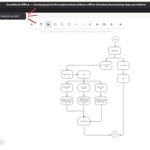

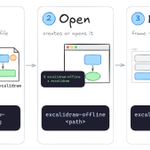
What I like about Omarchy: your agent works on the machine through plain files and CLIs.
Same idea in Excalidraw Offline. The skill writes .excalidraw JSON next to your code, excalidraw-offline <path> opens it, excalidraw-offline export renders PNGs. #omarchy
My coding agent and I now sketch on the same canvas.
Excalidraw Offline is a desktop app for Linux. The agent writes .excalidraw files, opens them with one command and exports PNGs. I edit the same file by hand.
No MCP, no account, no cloud.
Repo, releases and docs: github.com/gfaurobert/excali…

Agents can show you artifacts, HTML widgets, images. Fine to look at, not always meant for you to edit.
With Excalidraw Offline the agent and I edit the same .excalidraw file. It draws, I move boxes and add notes, it reads them back.
One file, two authors.
Linux first: AppImage, tarball, or build it on Arch with the included PKGBUILD. Current release is v0.7.1.
On Windows, the Linux build runs in WSL. There's an older Apple Silicon build too.
MIT. Feedback and issues welcome. Repo in the reply.
No MCP server, no canvas API. Just the file.
I ask for an architecture diagram. The agent writes arch.excalidraw and opens it with excalidraw-offline. I rework it on the canvas, autosave writes it back, and the agent picks up my edits from the same file.


Gregoire FAUROBERT retweeted

The strongest models are gated and access is granted only to a select few.
Hermes Agent now exposes MoA presets as virtual models, giving you capabilities beyond the publicly available frontier: 8% higher than Opus 4.8 and 11% higher than GPT 5.5 on our upcoming benchmark.
Gregoire FAUROBERT retweeted

A French engineer who lives quietly in Paris has spent 30 years writing software that the entire internet now runs on without knowing his name.
He wrote the code that streams every YouTube video, every Netflix show, every TikTok clip. He wrote the code that runs the virtual servers underneath AWS, Google Cloud, and Microsoft Azure. He calculated more digits of pi than anyone in history. He has no Twitter. He has no marketing. He just keeps shipping.
His name is Fabrice Bellard.
Here is the story, because almost nobody outside the systems programming world knows what one man has built.
Fabrice was born in 1972 in Grenoble, France. He studied at École Polytechnique, the top French engineering school. He never went to Silicon Valley. He never built a startup empire. He just wrote code.
In 2000 he started a project called FFmpeg, an open-source multimedia framework for encoding, decoding, and streaming video. He was 28. The project did one thing nobody else had done well. It handled every video and audio format that existed, in one library, on every operating system. He led it himself for years.
Today FFmpeg is the invisible engine of the internet. YouTube uses it. Netflix uses it. VLC uses it. Chrome and Firefox use parts of it. Every Android phone, every iPhone, every smart TV, every video editing tool you have ever touched runs FFmpeg somewhere underneath. If you have watched a video on a screen in the last 20 years, Fabrice's code processed it.
He was not done.
In 2003 he started QEMU, a machine emulator and virtualizer. He wrote it solo until version 0.7.1 in 2005. QEMU lets you run any operating system on any other operating system. It became the foundation of modern virtualization. KVM, the Linux kernel hypervisor, runs on top of QEMU. Every major cloud provider, AWS, Google Cloud, Microsoft Azure, IBM Cloud, runs virtual machines on infrastructure built around it. The Quick Emulator is the most cited piece of cloud infrastructure code on Earth.
He kept going.
In 2001 he won the International Obfuscated C Code Contest with a small C compiler that grew into TCC, the Tiny C Compiler. TCC can compile and boot a Linux kernel from source in under 15 seconds. In 2004 he calculated the most digits of pi ever computed at the time, using a personal desktop computer and an algorithm he derived himself called Bellard's formula. In 2011 he wrote a complete PC emulator in pure JavaScript that runs Linux in your browser, a project called JSLinux that engineers still cannot believe is real.
In 2019 he released QuickJS, a small but complete JavaScript engine that fits where V8 cannot. In 2021 he released NNCP, a neural network based lossless data compressor that immediately took the lead on the Large Text Compression Benchmark.
Then he turned his attention to large language models. He built TextSynth Server, a web server with a REST API for running LLMs locally. He released ts_zip and ts_sms, compression utilities that use language models to compress text and short messages at ratios traditional algorithms cannot reach. He released TSAC, a very low bitrate audio compression system. In December 2025 he released Micro QuickJS, a new JavaScript engine for microcontrollers, separate from QuickJS, designed for environments with almost no memory.
Fabrice co-founded a telecom company called Amarisoft in 2012, where he serves as CTO. Amarisoft builds 4G and 5G base station software used by carriers and labs around the world. He has been running it for over a decade while continuing to ship personal projects from his own home page at bellard dot org
He has no Twitter. He has no Instagram. He gives almost no interviews. His personal website is a flat list of projects with no styling, no fonts, no marketing copy. Just titles and links.
A quiet French engineer who never moved to Silicon Valley wrote the code that quietly runs the internet.
He is still shipping.

Gregoire FAUROBERT retweeted

The new Nano banana is like a Photoshop on steroids.
It lets you do INSANE things that weren't possible before.
Here are the 20 coolest examples I've found 🧵

🚀 Excited to unveil "Over The Hill" - a app for project progress tracking with Hill Charts! Say goodbye to boring task lists. #ProjectManagement #Innovation #HillCharts @v0 @shadcn. Check the demo: youtu.be/SvkJ-YrMq6o
Gregoire FAUROBERT retweeted

How does Google's new agentic browser (Project Mariner) compare with ChatGPT Operator?
I tested them head-to-head, using both platform's suggested prompts (to make it fair!) 👇
Gregoire FAUROBERT retweeted

And if you don’t want to watch all 3 hours, here’s a <1hr summary: AI Godfather's STUNNING Predictions for AGI, LLaMA 3, Woke AI, Humanoid Robots, Open-Source
youtu.be/bMoad-Fd9LI
Gregoire FAUROBERT retweeted

I like this drawing! thx, Mike


I'm just catching up on your recent work on agile+ use cases and jumped with joy as I read queue.acm.org/detail.cfm?id=…. This globallyunique.github.io/agi… is my why & how-to for use cases with agile in my world.

Great article from @strumenta!
Using LionWeb to combine JetBrains MPS with Kotlin tomassetti.me/using-lionweb-…
