

Grow food, not government. America First. Constitutionalist. Question everything. "Can't stop the signal, Mal" - Mr. Universe, Serenity
In my garden
Joined December 2019
- Tweets105K
- Following2K
- Followers2K
- Likes104K






Pinned Tweet
11/20/26 Gas and Diesel Price Update
$3.6898 is the Natl Avg for Gas Today
Gas was $3.8724 One Week Ago
Gas is $0.1826 Less Than One Week Ago
$5.8982 is the Natl Avg for Diesel Today
Diesel was $6.0640 One Week Ago
Diesel is $0.1658 Less Than One Week Ago
gasprices.aaa.com


11/19/26 Gas and Diesel Price Update
Today the Natl Avg for Gas is $3.7212
Gas was $3.9081 One Week Ago
Gas is $0.1869 LESS Than One Week Ago
Today the Natl Avg for Diesel is $5.9298
Diesel was $6.0977 One Week Ago
Diesel is $0.1679 LESS Than One Week Ago
gasprices.aaa.com

6

Glass Half Full retweeted

Iowa ranks approximately:
• Total ag production value / nutritional output: #2
• Corn: #1
• Grain (corn-dominant): #1
• Pork: #1 (~33% of US)
• Eggs: #1
• Ethanol: #1
• Biodiesel: #1
• Oats: ~#4
• Soybeans: #2
• Beef: ~#5-8 (cattle inventory #8, on-feed #4)
• Commercial red meat: #1
• Protein: top-tier (driven by pork/eggs)
On the quoted claim: No known safe level of lead exposure exists. Even low levels can cause irreversible neurological and developmental harm, especially in children (CDC/WHO). The planned Army lead-azide detonation is real and delayed.
Glass Half Full retweeted

Measles was eradicated at the time of the mid-60s rollout.
95% of everyone 15 & under had had them, & virtually all survived with lifetime immunity.
So, who, exactly, needed the shots?

In the 1950s (U.S) the estimated Infection Fatality Rate (IFR) for measles was roughly 0.011% to 0.017%.
Measles was a universal childhood rite of passage, with serosurveys showing 95% of the population contracted it by age 15.
By the late 1940s, measles fatality rates had already dropped by more than 90% compared to the 19th and early 20th centuries. Better nutrition, improved living conditions, and the introduction of antibiotics in the 1940s to treat secondary bacterial infections (like pneumonia) dramatically lowered the risk of death.
The first measles vaccines came out in the United States in March 1963.
People love fear porn but get so angry when you show them actual data.
pmc.ncbi.nlm.nih.gov/article…

Glass Half Full retweeted

This one is close to home

🚨 137-YEAR-OLD MARYLAND CHURCH DESTROYED BY FIRE — $280,000 IN DAMAGE, CAUSE UNDER INVESTIGATION
A piece of Maryland history has been lost after a devastating overnight fire destroyed Galestown United Methodist Church in Dorchester County on the Eastern Shore.
The historic church, built in 1889, had stood for 137 years before flames consumed the building early Thursday morning, November 19.
▪️ FIRE RESPONSE: Firefighters were dispatched around 3:04 a.m. Approximately 55 firefighters responded to the two-alarm blaze, battling the flames for roughly two hours.
▪️ EXTENSIVE DAMAGE: The Maryland State Fire Marshal estimates the destruction at approximately $280,000.
▪️ NO INJURIES: Despite the severity of the fire, no injuries were reported.
▪️ INVESTIGATION: Authorities determined the fire originated inside the building, but the exact cause remains unknown. Investigators have not identified evidence indicating the fire was deliberately set.
▪️ HISTORIC LOSS: The church was recognized by the Maryland Historical Trust as a distinctive historic landmark in the small Dorchester County community.
For generations, Galestown United Methodist Church represented more than a place of worship. It was part of the community's history, connecting families and traditions across more than a century.
Now, 137 years of Maryland history have been reduced to ruins.
Investigators continue working to determine what sparked the fire and whether any part of the historic structure can be salvaged.
A heartbreaking loss for Galestown and Maryland's Eastern Shore.
Glass Half Full retweeted

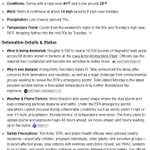
UPDATE: The army has delayed this detonation until Monday. Some speculate it was the "public outcry..."
... I think more likely, they are waiting for better weather conditions, as described by the "meteorological Go/No-Go" section in the Environmental Assessment:
( source: d34w7g4gy10iej.cloudfront.ne… )


The situation in Iowa is out of control, with officials planning on detonating 5 tons of bomb-making materials, producing a huge plume of lead dust that will scatter across a huge area of both populated and agricultural land (neither of which, clearly, is good).
The number of livestock within a 20-mile radius could exceed 70,000. [source: dtnpf.com/agriculture/web/ag… ]
Lead is a potent neurotoxin. Studies have shown that a piece of lead smaller than a grain of rice can be fatal. Worse, it bioaccumulates in larger animals as they ingest plants and smaller prey.
An Iowa State University beef field specialist recommended farmers take soil samples in advance of the detonation and keep animals from grazing in the landing zone or drinking surface water from creeks or ponds. [source: wqad.com/article/news/local/…].
Some schools have closed for the day. The Army expects the dust to linger for no more than an hour, depending on wind speed.
This is highly dangerous to people, animals, and agriculture...


Glass Half Full retweeted

FORBIDDEN STUDIOS PRESENTS: TWO WEEKS AWAY ☢️
For over 30 years, Benjamin Netanyahu has warned that Iran is just two weeks away from an existential threat.
This time, Donald Trump is taking it personally.
Glass Half Full retweeted
FORBIDDEN STUDIOS PRESENTS: HOLY WAR, TAKE ONE
Jake Lang stars as “Jake Lang.”
He’s been rehearsing the role in public for years.
Glass Half Full retweeted

🚨 TECH OUTAGES LINKED TO CYBERATTACKS
October 21 – November 20, 2026
A wave of hacking, ransomware, DDoS attacks, and security incidents has disrupted government agencies, hospitals, schools, gaming networks, and internet services.
CONFIRMED OR REPORTED CYBERATTACKS:
• Nov 17 — Wilmington School District, IL: Ransomware forced Windows devices offline.
• Nov 14 — South Portland, ME: Cyber incident shut down municipal networks, phones, and services.
• Nov 13–15 — Beget, Russia: DDoS attacks disrupted hosted websites.
• Nov 13 — Tor Network: DDoS attacks overloaded relays and disrupted connections.
• Nov 11–12 — Blizzard Battle.net: DDoS attacks caused login failures and gaming disconnections.
• Nov 9 — Monadnock Community Hospital, NH: Cyber incident disrupted servers, laboratory services, and patient care.
• Nov 9 — Franklin County, ID: Cyberattack interrupted a government livestream.
• Nov 4 — Queens Public Library, NY: Ransomware disabled computers, Wi-Fi, and digital services.
• Nov 3 — Washington Secretary of State: Cyberattack temporarily disabled an online ballot-drop-box map.
• Nov 1 — Beget, Russia: Destructive attack wiped hosted data and disrupted hundreds of websites.
• Oct 31 — Delaware E-ZPass: Website shut down following a security threat involving its technology provider.
ADDITIONAL SECURITY INCIDENTS:
• Nov 19 — Cleveland ISD, TX: Attempted intrusion prompted network restrictions.
• Nov 16 — CrossWind Technologies, VT: Public-safety software disrupted during security investigation.
• Nov 15 — ByWater Solutions: Compromised API keys disrupted library integrations.
• Nov 15 — Cuyahoga County Public Library, OH: Mobile app disabled following vendor-related unauthorized access.
• Nov 13 — Journal Technologies: Security incident disrupted court portals and electronic filings.
• Nov 13 — Perry Local Schools, OH: Malware disrupted systems and forced school closures.
• Nov 9 — N-able N-central: Remote management services temporarily suspended following vulnerability disclosures.
• Nov 9 — Vanderbilt University: Cybersecurity incident restricted IT systems.
• Nov 6 — Los Angeles Homeless Services Authority: Computers and email shut down during investigation.
• Nov 5 — Myriad Genetics: Network intrusion disrupted laboratory testing and order management.
• Nov 2 — Turning Stone Enterprises, NY: Cyber incident disrupted payments, ATMs, and services.
⚠️ IMPORTANT DISTINCTION:
Major outages involving the NSA, Apple, JPMorgan Chase, United Airlines, and AWS were NOT established as hacking incidents.
BOTTOM LINE:
These incidents demonstrate the continuing vulnerability of critical technology infrastructure to cyberattacks.
Not every security-related shutdown was caused by a confirmed intrusion, and there is no established evidence that these incidents were coordinated.
This is a documented incident summary, not an exhaustive worldwide inventory.


Glass Half Full retweeted

Happy National Peanut Butter Fudge Day! 🥜
Boil 2 cups sugar and 1/2 cup milk to soft-ball stage (234°F).
Off the heat, stir in 1 cup peanut butter and 1 tsp vanilla, then pour into a buttered 8x8 pan.
Georgia peanuts, of course!
#PeanutButterFudgeDay #FarmKitchen

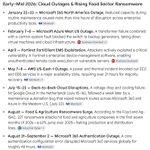
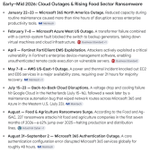
After reading the Daily Mail article "Shocking federal investigation exposes failures leaving America's food supply open to cyberattacks", I wanted to see a more detailed chronological list for this year.
This is what I found, so far.
dailymail.com/sciencetech/ar…


Glass Half Full retweeted
Alarming: media is pushing "cyberattack on food supply" narrative, citing the GAO report (mentioned above).
Government has been conducting tabletop exercises around this, from "Food Chain Reaction Game" to one called "Cyber Storm" a massive, multiday tabletop exercise involving state, local, tribal, territorial, federal and private-sector organizations — and it probed how well participants respond to a simulated cyber attack on food and agriculture.
Even cloud-connected tractors are vulnerable — video report here:
unshadowed.substack.com/p/cy…
dailymail.com/sciencetech/ar…
Glass Half Full retweeted

I don’t want technology to “evolve” another bloody inch. I hate that everything demands an app or QR code. I hate supermarket self-checkouts that scold you for “unexpected items” as if you have committed a hate crime with a packet of biscuits. I hate ringing a company and suddenly you’re trapped in a doom loop of an endless conversation with a robot before being left on hold long enough to waste an entire afternoon. I hate how local bank branches are closing and customer service is no longer communication with a bank manager but with an AI bot. I hate websites that force you to prove you’re human by enforcing a dystopian farce quiz to spot 3 sets of traffic lights in a fog of pixelated misery. I hate digital app passwords, verification codes and subscriptions. I hate how town centre car parks often no longer accept cash payments and the only way to park is by registering to another bloody app. I hate receiving unsolicited phone calls from an AI automated robot. And I really hate how the whole digital circus excludes half of the country’s pensioners simply because they never signed up to live inside a smartphone.
Rant over.
Glass Half Full retweeted

Before we blow up 68 barrels in Middletown and release a 100-mile lead plume, let's try something out of the box.
I've spoken with people who know this situation very well, including government officials in Washington, D.C.
Their take is that we have two options:
A) A planned detonation
B) An unplanned detonation
A problem delayed is a problem multiplied. It's been reported that we've known about this stockpile since 2004 and nothing has been done to get rid of it.
But an unplanned detonation would clearly be the worst option.
There are known ways to neutralize lead azide. The issue is that if a human tried to open the barrels to apply the chemicals, the disturbance alone could set them off anyway. The risk is too high.
Here is a moonshot option:
1) Plan as if we are going to detonate. Put all precautions in place.
2) Send in an Optimus from @elonmusk, with hands that can open each barrel individually and apply a chemical solution like ceric ammonium nitrate, with no people in harm's way.
It is a documented way to neutralize lead azide: it breaks the compound down and releases nitrogen gas.
Best case, we neutralize all of it and there's no explosion at all.
Middle case, we neutralize some of it and the detonation is smaller.
Worst case, a barrel goes off during the attempt, with every precaution already in place and no one nearby.
The Army should pause tomorrow's detonation long enough to think up crazy ideas that just may work.
Just going ahead as planned without trying to find a way to protect people, land, water, and soil is not an acceptable way to think about this.


Glass Half Full retweeted
USDA hit by Cyberattack - Farmer Payments Delayed
A cybersecurity breach has plunged critical US government systems into chaos, disrupting the federal programs that help keep America's food supply running (like farm loans and crop insurance).
The USDA has been grappling with widespread system shutdowns since at least Monday, disrupting vital financial services for farmers in a cybersecurity incident that only came to light publicly on Thursday.
The shutdowns have left employees unable to access crucial systems used to track farm loans and financial aid, with officials warning that disruptions could continue throughout the week.
Yesterday, a GAO report also flagged that USDA still hasn’t fully met key cybersecurity requirements for the food and agriculture sector, prompting some experts to proclaim 'America's food supply is at risk.'
nextgov.com/cybersecurity/20…


Cyber risks have reached USDA’s farm offices.
FSA loan software, ProTracts (used to administer NRCS payments) and Service Desk (used to map NRCS projects) have experienced intermittent outages at local offices since Monday.
FSA Administrator Bill Beam confirmed the outage with @dtnpf today.
The disruptions follow a string of global communications and transportation outages.
Meanwhile, a new GAO report released today warns of gaps in federal cybersecurity protections for the U.S. food and agriculture sector. USDA told GAO it had no plans for additional cyber exercises and improvements that it recommended.
dtnpf.com/agriculture/web/ag…

Glass Half Full retweeted

Did folks see what happened this week in the House? The Speaker had to adjourn session early because so many Republicans refused to show up for work that we didn’t have a majority. I get that members are demoralized from losing elections… but they still collect $14,500/month!

