

Cytoskeleton, membranes, filopodia, imaging, cell-free reconstitution @GurdonInstitute @CamBiochem
Cambridge, UK
Joined December 2014
- Tweets121
- Following349
- Followers459
- Likes190
Researchers connecting with families on #rarediseaseday youtu.be/z7lDzF4ypWI?si=EIEE… @lowesyn

1
157
We won the public engagement award! Wonderful commitment from everyone and couldn't have done it without the fantastic PE team 🥳😊

1
7
309
Thank you Paul for your wonderful talk, such helpful advice and perspectives for researchers youtu.be/pxEleABPkAM

1
85
Another beautiful morning in Pozzuoli for the Lowe Syndrome research meeting, wonderful hosting by @Tigem_Telethon @StaianoLeopoldo great to see @lowesyndrome and @lowetrust

Special visit from Lowe Syndrome Trust @lowetrust @lowetrustUK working together with LSA @lowesyndrome for European Lowe Syndrome Research Meeting @Tigem_Telethon

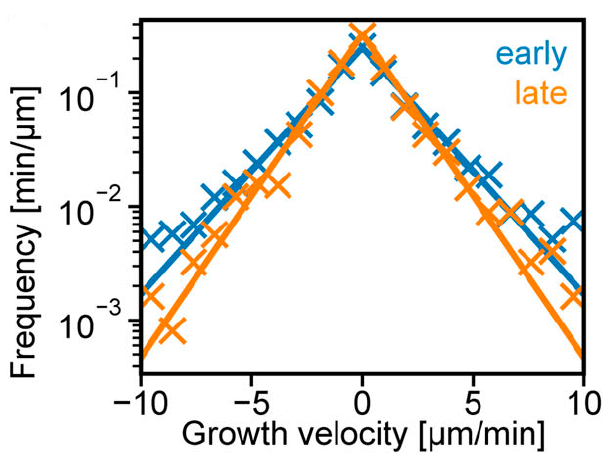
The icing on the cake was using machine learning to measure the momentary growth and shrinkage of filopodia in vivo during a developmental transition where filopodia are suppressed (muscle attachment, new from the 2019 bioRxiv version) [8/10]
2
5
Back to Drosophila: could this model make any sense for real filopodia? Well, yes! Fascin in the shaft has the same heterogeneous properties and fluctuates in and out of filopodia (here in tracheal cells, fascin in cyan, membrane in magenta) [7/10]
@EdouardHannezo and @ulidobra showed mathematically that a Laplace distribution can arise from multiple pairs of fluctuating proteins working together and we confirmed experimentally that proteins come in and out of the in vitro tip complexes [6/10]

Measuring the rates of FLS growth and shrinkage was the key breakthrough as they fitted a Laplace distribution: a very rare mathematical relationship where most events are slow growth or shrinkage, yet some are very, very fast (in a symmetric exponential way) [5/10]

1
5
Quantification revealed defined patterns: in vitro we could tell that actin regulators correlated with each other and some pairs did so more than others. Both FLS and filopodium lengths lay on exponential distributions suggesting the stochastic incorporation of actin [4/10]

1
5
Using lots of microscopy and image analysis, we found that both filopodial tips and in vitro FLS were much more heterogeneous than we had ever imagined [3/10]

1
4
Nice start to the weekend! Delighted to see our decade-long interdisciplinary effort on filopodia out! @JCellBiol rupress.org/jcb/article/220/… Mammoth experiment-theory integration from @ulidobra who is now on the job market! Our thinking developed such a lot, to explain... 🧵[1/10]